The parlor game Twenty Questions makes an outrageous promise: I think of anything - aardvark, Argentina, my aunt's regret - and you corner it with twenty yes-or-no questions. The game predates radio, yet nobody seems to find its success mysterious. It should be mysterious. Twenty questions against everything? Why does that ever work?
In 1948, a playful Bell Labs engineer named Claude Shannon published the answer inside a paper that created an entire field. "A Mathematical Theory of Communication" gave humanity a unit of measure for information itself - the bit, the amount you learn from one fair yes-or-no answer - and with it, a way to weigh questions, clues, secrets, and surprises on one scale. Shannon, for the record, was exactly the person you'd want holding this power: a man who built juggling robots and a mechanical maze-solving mouse named Theseus, and rode a unicycle through the halls of Bell Labs. His theory runs your phone, your zip files, and - quietly - your puzzle habit.
The arithmetic of narrowing
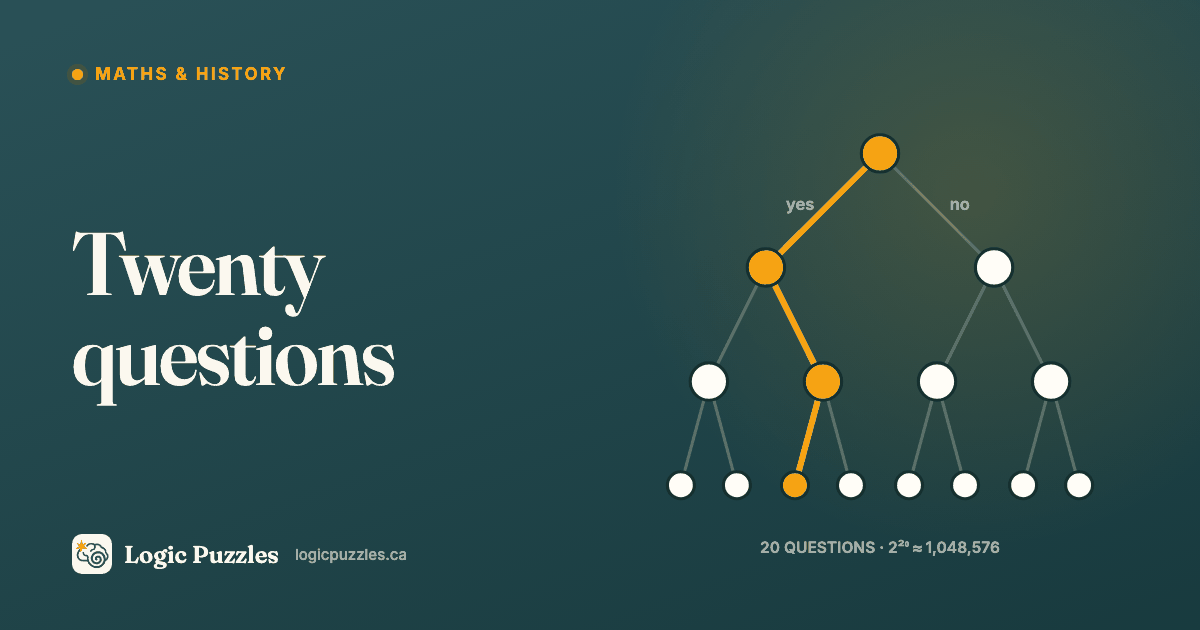
A good yes/no question splits the possibilities in half; the answer, either way, hands you one bit. Twenty honest bits therefore cut a space of 2²⁰ possibilities - about 1,048,576 - down to a single survivor. Twenty Questions works because a million categories, played skillfully, is roughly the size of a shared vocabulary of things. The game isn't magic; it's a budget. Binary search - the way you find a name in a phone book by repeated halving - is the same budget spent by an algorithm: a million entries, twenty peeks, done.
The discipline this imposes on question-asking is the part worth importing into the rest of your life. "Is it a hummingbird?" risks a millionth of the space for a near-certain no - a spent question earning almost nothing. "Is it living?" earns a full bit whatever the answer. The value of a question is not in the yes you hope for but in how evenly it divides the world. Shannon made that sentence into mathematics: the information in an answer is highest when you genuinely can't predict it, and zero when you already know what they'll say. Surprise, measured in bits, is information.
Every grid is a conversation
Now look at your morning puzzle through this lens. Before the first clue, a blank 9×9 Sudoku could be any of some 6.67 sextillion grids - about 72 bits of mystery, if you like your sextillions converted. Each given digit, each deduction you make, spends down that uncertainty. A solved puzzle is a mystery reduced to zero bits by a chain of honest answers.
The lens explains solving experiences you already know by feel:
Why some clues feel heavy. A clue that resolves instantly ("this row needs only the 7") delivers its bits and retires. The clue that felt load-bearing - the one you kept returning to - was one whose implications kept paying out across the grid. Setters ration these deliberately: a well-made puzzle spreads its information thin, so certainty must be assembled rather than found. That's the difference between a puzzle and a form to fill in.
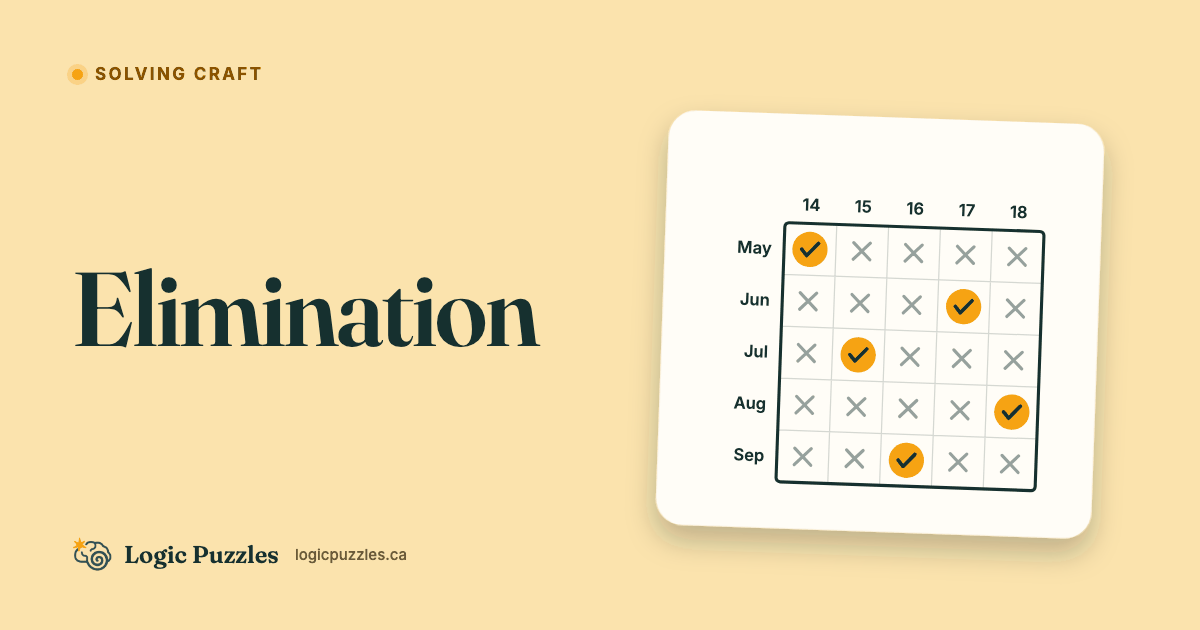
Why "I don't know" can be a clue. As we saw with Cheryl's birthday, a statement of ignorance eliminates every world where the speaker would have known - sometimes a huge harvest of bits. Information is anything that shrinks possibility; it doesn't care about grammar.
Why guessing feels cheap. A blind guess extracts no information from the puzzle - it injects noise and hopes. A probe, though ("suppose this cell is 5; contradiction?"), is a legitimate Shannon question addressed to the grid, and the contradiction that comes back is a paid-in-full bit. The difference between guessing and hypothesis-testing is whether you stay to collect the answer.
The leak that cracks cryptograms
Shannon's framework shines brightest on the substitution cipher - the cryptogram on our puzzle shelf. Replace every letter with a masked one and a message looks destroyed. It isn't, and Shannon proved why in a companion paper that founded modern cryptographic theory.
English is redundant. By Shannon's experiments - he had people guess texts letter by letter and measured their success - ordinary prose carries only around one to one-and-a-half bits per letter, far below the ~4.7 bits a 26-symbol alphabet could carry. The unused capacity is structure: E alone is about an eighth of all letters; Q drags a U; three-letter words lean heavily on THE and AND; doubled letters keep a short guest list. A substitution cipher hides the letters but transmits the structure untouched - every frequency, every pattern word, every apostrophe's confession leaks straight through the mask. A cryptogram is solvable for exactly the reason a compressed file is smaller: language repeats itself, and repetition is a fingerprint. (This is also why one-time pads - masks with no reusable structure - are genuinely unbreakable, and why nothing shorter is.)
When you crack a cryptogram by marking the one-letter words and the THEs, you are re-running, by hand, the frequency attack the Arab scholar al-Kindi described eleven centuries ago - now with Shannon's guarantee that the leak you're drinking from can't be plugged.
Spending your questions like a solver
The portable lesson from all this fits in a pocket. Faced with any unknown - a bug, a diagnosis, a stuck grid - you hold a budget of questions, and the instinct to ask the question whose answer you want is precisely the wrong spending rule. Ask the question that divides. Prefer the test that could genuinely go either way. Chase the observation that would surprise you most if it landed, because that is where the bits are.
Shannon's unicycle is the right closing image: a ridiculous vehicle, ridden through serious hallways, by the man who measured the difference between noise and news. Puzzles are where the rest of us practice that measurement daily - twenty questions at a time, one honest bit per answer, until the aardvark has nowhere left to hide.