Most people think solving a puzzle means finding the answer. But ask any experienced solver what they actually spend their time doing, and they will tell you something different: they spend most of it ruling things out.
This is the process of elimination, and it is quietly the most elegant idea in all of logic.
What elimination really is
On the surface, elimination feels like a negative action. You are not building something. You are not placing a number or filling a cell. You are just saying "not this, not this, not this" until what remains is the only possibility.
But that framing undersells what is actually happening. When you eliminate a possibility, you are doing something profound: you are making the invisible visible. Every crossed-out option reshapes the puzzle, tightening constraints, revealing connections that were hidden a moment ago.
In a well-designed puzzle, a single elimination can cascade. Remove one option from one cell, and suddenly a row resolves. That row forces a column. That column completes a region. The solver who crossed out one small thing just unlocked the entire grid.
Why elimination feels different from guessing
There is a reason elimination feels satisfying in a way that guessing never does. When you guess, you are hoping. When you eliminate, you are knowing.
Each elimination is backed by logic. You are not betting on an outcome - you are proving one impossible. That certainty compounds. After enough eliminations, the answer does not need to be found. It announces itself.
This is what separates logic puzzles from games of chance. The solution is not discovered by luck. It is uncovered by systematically removing everything that cannot be true, until only the truth remains.
The Sherlock Holmes principle
Arthur Conan Doyle gave Sherlock Holmes a famous line: "When you have eliminated the impossible, whatever remains, however improbable, must be the truth."
Holmes was describing detective work, but he was also describing the exact mental process behind every logic puzzle ever solved. The principle is the same whether you are solving a murder mystery or a 9x9 Sudoku grid:
- Start with all possibilities open.
- Apply constraints to remove the impossible.
- Trust what survives.
What makes this powerful is that you do not need to know the answer in advance. You do not need intuition or inspiration. You just need to be thorough. If your logic is sound and your eliminations are correct, the answer will emerge on its own.
Elimination as a thinking tool
The beauty of elimination extends far beyond puzzles. It is one of the most underused thinking tools in everyday life.
Consider how most people make decisions. They search for the "right" option. They compare pros and cons. They agonize over which choice is best. But experienced decision-makers often work the other way: they eliminate what clearly will not work, then choose from what is left.
- A doctor diagnosing a patient does not start with the answer. They rule out conditions one by one.
- A programmer debugging code does not guess where the bug is. They narrow it down by eliminating where it is not.
- A chess player choosing a move often starts by discarding the moves that lose immediately, then evaluates what remains.
In each case, elimination reduces a paralyzing number of options to a manageable few. The answer stops being a needle in a haystack and starts being the only thing left standing.
Why puzzles train this skill so well
Logic puzzles are elimination in its purest form. Every puzzle we build at LogicPuzzles.ca is designed so that the solution can be reached entirely through deduction - no guessing required. That means every solve is an exercise in structured elimination.
Here is why that matters:
- Immediate feedback. When you eliminate incorrectly, the puzzle breaks. You learn to be precise.
- Visible progress. Each elimination visibly shrinks the problem. You can see yourself getting closer.
- Compounding logic. Early eliminations enable later ones. You learn to build chains of reasoning.
- Patience over impulse. Elimination rewards the solver who checks every constraint before committing, not the one who rushes to fill in cells.
Over time, this rewires how you approach problems. You stop looking for answers and start looking for what you can rule out. It is a subtle shift, but it changes everything.
The courage to cross things out
There is something psychologically interesting about elimination: many people resist it.
New solvers often hesitate to cross out a possibility. What if they are wrong? What if they need that option later? So they leave everything open, staring at a grid full of maybes, overwhelmed by options they refuse to narrow.
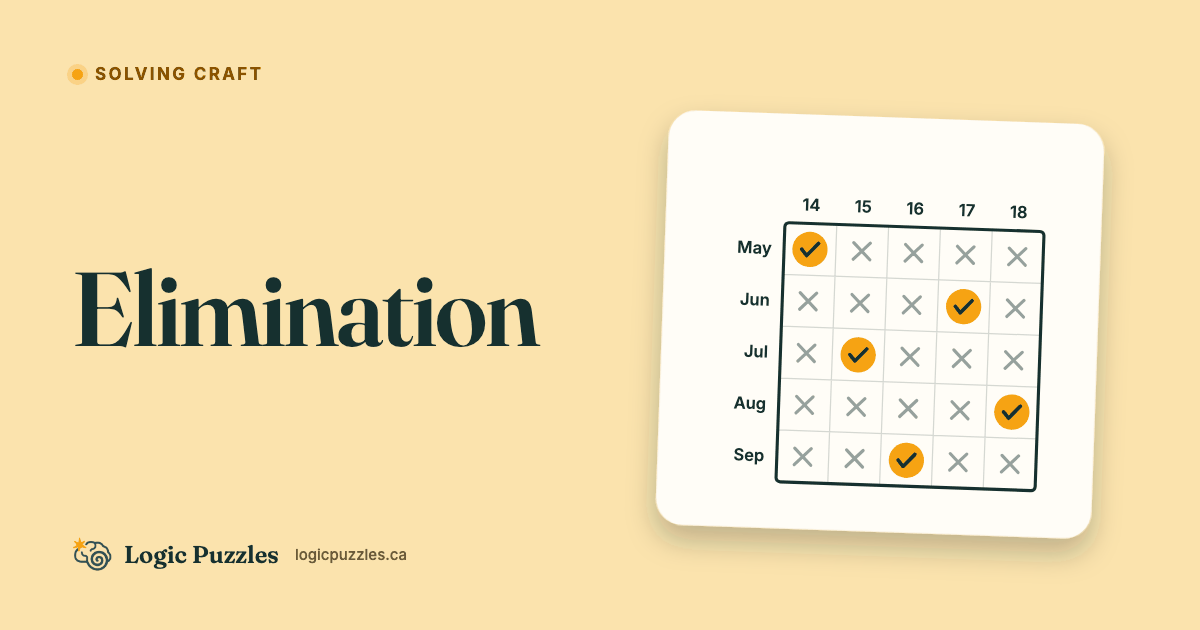
Experienced solvers do the opposite. They are aggressive eliminators. They trust their logic. They know that a wrong elimination will reveal itself (the puzzle will break), so they commit. Each X on the grid is an act of confidence.
This mirrors a broader truth about problem-solving. Progress often requires the willingness to close doors. Not every option deserves to stay on the table. The clarity you gain by eliminating three wrong paths is worth more than keeping five paths open "just in case."
The moment it clicks
The best moment in elimination-based solving is not placing the final answer. It is the moment when you eliminate one thing and the rest of the puzzle falls like dominoes.
You cross out a single possibility. Suddenly, a cell that had three options has one. That resolves a neighboring cell. That forces a value in a distant row. Within seconds, half the grid fills itself.
This is not luck. It is the accumulated pressure of every prior elimination reaching a tipping point. The puzzle was always heading toward this moment - you just needed to remove enough noise for the signal to come through.
The takeaway
Elimination is not the absence of an answer. It is the path to one. The next time you face a puzzle - or a problem - resist the urge to search for what is right. Instead, start crossing out what is wrong. You will be surprised how quickly the truth reveals itself.
Ready to practice the art of elimination?