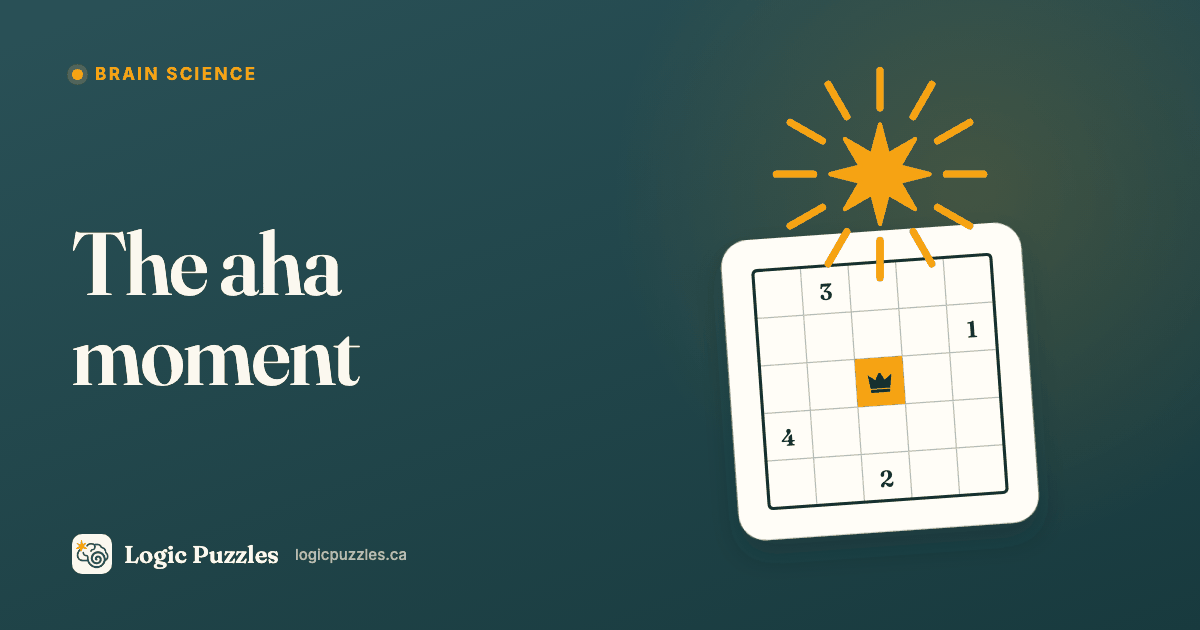
You are staring at a puzzle. Nothing makes sense. Then, suddenly, you see it. The solution appears fully formed in your mind, and you wonder how you ever missed it.
That flash is called the "aha" moment, and it is one of the most rewarding feelings a puzzle can offer. But what actually happens in your brain when it occurs?
What the research says
Neuroscientists have studied insight moments for decades. Here is what they have found:
- Different brain regions activate. Unlike gradual problem-solving, insight moments involve a sudden burst of activity in the right hemisphere, particularly the anterior superior temporal gyrus.
- The brain "prepares" without you knowing. Before an aha moment, there is often a brief period of alpha-wave activity - your brain is essentially closing its eyes to outside noise so it can focus inward.
- Dopamine rewards the insight. When the solution clicks, your brain releases dopamine, the same chemical involved in other pleasurable experiences.
This is why solving a puzzle feels genuinely good, not just intellectually satisfying.
Why puzzles are uniquely suited for insight
Not all problems create aha moments. Research suggests insight is most likely when:
- The problem is well-defined. You know the rules and the goal.
- You have hit an impasse. Your first approach did not work, forcing a mental restructure.
- The solution is surprising but makes sense. It feels obvious in hindsight.
Logic puzzles check all three boxes. A clear ruleset, a solvable structure, and a solution that hides in plain sight until you see it.
The role of "being stuck"
Here is the counterintuitive part: getting stuck is necessary for insight.
When you feel blocked, your brain is actually doing important work. It is testing and discarding assumptions, often below conscious awareness. The impasse forces you to let go of the wrong approach, which clears the path for the right one.
This is why we design puzzles with escalating difficulty. A puzzle that never challenges you will never reward you with that flash of understanding.
How to invite more aha moments
You cannot force insight, but you can create conditions where it is more likely:
- Step away when stuck. A short break lets unconscious processing continue.
- Avoid brute force. Guessing shortcuts the insight process.
- Trust that a solution exists. Confidence that the puzzle is fair keeps you searching.
- Reduce distractions. Alpha-wave activity increases when external noise decreases.
The best puzzle sessions often include a moment of walking away, returning, and immediately seeing what you missed.
Why this matters for puzzle design
As designers, we think about aha moments constantly. A well-crafted puzzle plants the seeds for insight early, then hides them just enough that the player has to work for the reveal.
If the solution is obvious, there is no insight. If it is arbitrary, there is no satisfaction. The sweet spot is a puzzle where the answer was always there, waiting for the right perspective.
The takeaway
The aha moment is not magic. It is your brain solving a problem in a way that feels sudden because the hard work happened beneath awareness. Puzzles are one of the best ways to experience this feeling on demand.
Next time you are stuck, remember: that frustration is often the prelude to a breakthrough.
Ready to chase an aha moment?