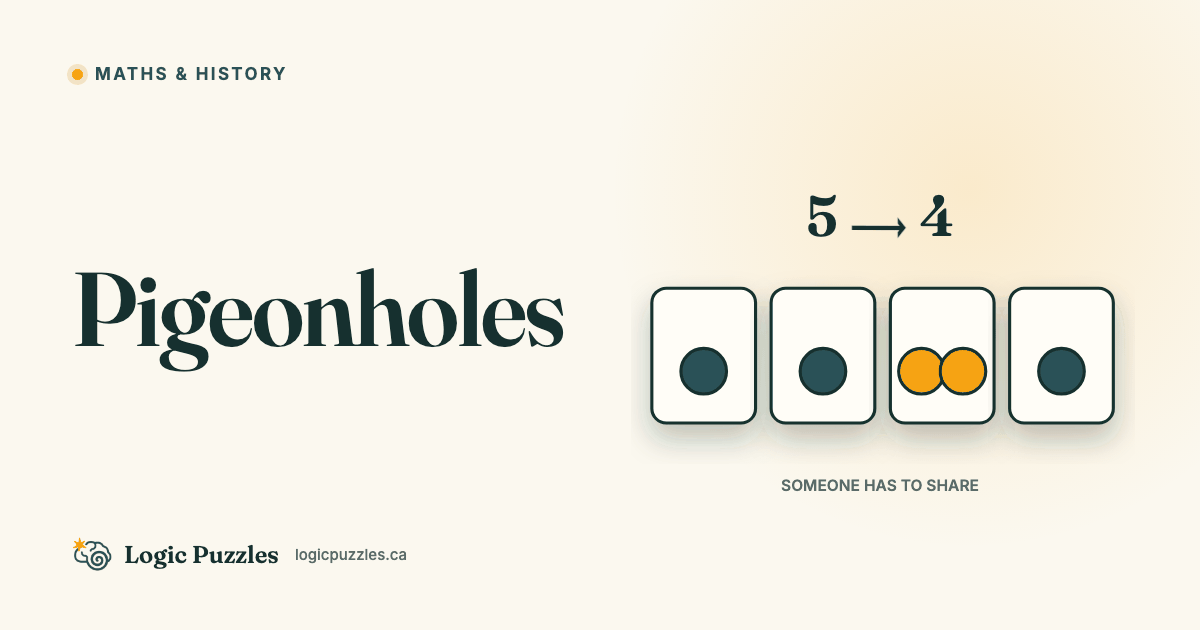
Some mathematical tools require years of preparation to hold. This one requires a sentence: if you put more pigeons than holes into holes, some hole gets at least two pigeons.
That is the entire principle. A child accepts it instantly; no proof feels necessary (though one exists). It seems less like mathematics than like an insult to your intelligence. And yet this observation - named the Schubfachprinzip, the "drawer principle," after the great mathematician Peter Gustav Lejeune Dirichlet put it to serious work in 1834 - powers real theorems, real impossibility proofs, and, as it happens, a large fraction of the deductions you make on a puzzle grid without knowing their name.
The pigeonhole principle is the best possible introduction to what mathematical style actually is: not computing harder, but choosing pigeons and holes so cleverly that a trivial truth does profound work.
Warm-up: the hairs of London
A classic, centuries old: two non-bald Londoners have exactly the same number of hairs on their heads. Not roughly - exactly.
No census required. A human head carries at most about 150,000 hairs - call the holes 1 through 150,000, one per possible hair count. London holds millions of non-bald heads - the pigeons. Millions of pigeons, 150,000 holes: some hole is shared, guaranteed, by heads that have never met. With the generalized principle (n pigeons, k holes: some hole holds at least n/k of them, rounded up), millions of Londoners force some sixty-plus people onto the same exact count.
Notice what happened: a statement about every head in a city, established from an armchair, with certainty. That is the pigeonhole signature - counting possibilities instead of examining cases.
The party theorem
A deeper cut, and a genuinely famous one. At any gathering of six people, there must exist either three mutual acquaintances or three mutual strangers. Any six people, any history - no exceptions.
Pick any guest, Alice. The other five each fall into one of two holes: Alice knows them, or she doesn't. Five pigeons, two holes - one hole holds at least three. Say Alice knows three people (the argument mirrors otherwise). Among those three: if any two know each other, they plus Alice are three mutual acquaintances. If no two do, those three are mutual strangers. Done either way.
This little argument is the doorway to Ramsey theory, the branch of mathematics whose slogan is that complete disorder is impossible - sufficiently large structures are forced to contain pockets of pattern, whether they want to or not. The engine under that grand claim is pigeons, all the way down.
One more, because it pays rent in the modern world: no compression algorithm can shrink every file. Files of length n are pigeons; strictly shorter files are holes; there are fewer holes than pigeons, so two different files would have to compress to the same result - and then decompression cannot know which one to give back. Every zip utility ever written lives under this ceiling: whatever it shrinks, it must (however rarely) expand something else. An impossibility proof about all software that could ever be written, by counting.
You already play this way
Now to the grid, because puzzle solvers use industrial-strength pigeonhole daily under other names.
Naked pairs are pigeonhole. Two Sudoku cells in a row whose candidates are exactly {3, 7}: two pigeons (the digits 3 and 7 needed by that row) and two holes (those cells). The digits must fill precisely those cells - so 3 and 7 die everywhere else in the row. The famous technique is nothing but "two pigeons, two holes, no room for guests," and naked triples and quads scale the same sentence.
Hidden singles are the flip side. If the digit 5 can live in only one cell of a box, that cell hosts it - one pigeon, one hole. Most "scanning" is this.
Fit arguments are pigeonhole with shapes. The Fleet reasoning we explored recently - "the four-cell ship has only two possible berths, and they overlap here" - counts big pigeons into scarce holes. Dominosa endgames ("three dominoes remain but only these regions can hold them") are the same.
Binary grids run on it. In a Binary Sudoku row of length ten needing five 1s, if four are placed and only one open cell can legally take a 1, the count is the deduction. Whenever you hear yourself think "there are n of these left and only n places they could go," tip your hat to Dirichlet.
There is a practical upgrade hiding in this recognition. Solvers plateau when they treat techniques as separate spells to memorize. Seeing the shared skeleton - count the needed things, count the legal homes, compare - turns a spellbook into a single method you can improvise from. On an unfamiliar puzzle type, you won't know any named techniques. You will always know how to count pigeons.
The art is choosing the holes
Why does such a trivial principle land such nontrivial blows? Because all its power hides in a decision the principle itself doesn't make: what counts as a pigeon, and what counts as a hole. Hair counts. Acquaintance-triples. File lengths. Candidate digits. The insight is never "more pigeons than holes implies sharing" - the insight is the framing, and the framing is where creativity enters.
Which makes pigeonhole the cleanest possible showcase of a truth that runs through all problem-solving, on grids and off: hard problems are rarely defeated by harder effort within the obvious frame. They are defeated by a re-description under which they become easy. The mathematician spends her cleverness choosing drawers precisely so the final argument requires none. Next time a deduction falls out of a puzzle so cleanly it feels like cheating - "well, the three remaining odd digits have to live in these three cells, so…" - notice the shape of what happened. You didn't outthink the grid. You re-counted it, and an idea simple enough to insult a child did the rest.