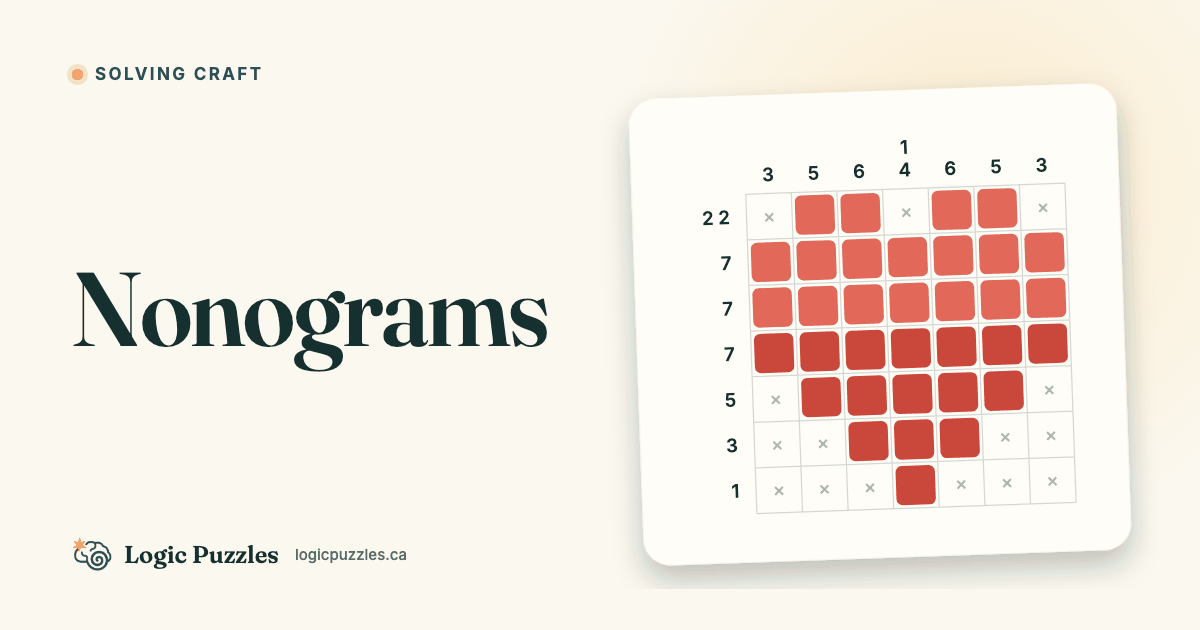
A nonogram makes an unusual promise. Solve me, it says, and you get more than the satisfaction of a finished grid - you get a picture. A sailboat, a cat, a cup of coffee, assembled cell by cell out of pure deduction. No other major logic puzzle pays out in images.
But new solvers often stall on the same misunderstanding: they try to solve the picture. They squint at a half-finished grid, guess that the blob in the corner is probably an ear, and fill cells to match. This works exactly until it doesn't, and then the grid collapses into contradictions. The truth about nonograms is stranger and better: the picture is a reward, not a tool. Every cell is determined by counting - and the counting starts with one beautiful trick.
The whole puzzle in one row
Take a single row, ten cells wide, whose clue is "8". Eight filled cells in a row of ten, position unknown. You might think nothing can be placed - the block could sit left, right, or anywhere between.
Slide it as far left as it goes: it covers cells 1 through 8. As far right: cells 3 through 10. Now compare. Cells 3 through 8 are covered in both extremes - and in every position between. Wherever the block truly lives, those six cells are filled. Mark them. You have deduced six-tenths of the row from a single number, without knowing where the block starts.
This is overlap logic, and it is the engine of the entire puzzle. The general recipe: push the row's blocks to the far left; push them to the far right; anything covered both times is certain. A clue of "5 3" in a ten-wide row forces the two blocks and their mandatory gap to fill nine of ten cells - the leftmost and rightmost layouts nearly coincide, and eight cells lock instantly. The bigger the clues relative to the row, the more the extremes overlap, and the more the puzzle hands you for free.
There is a pleasing arithmetic shortcut hiding here: sum the clues, add one for each gap between blocks, subtract from the row length. That number is the total slack - how much freedom the row has. Any block longer than the slack donates its excess to the grid immediately. Slack zero means the row solves outright. Experienced solvers compute this at a glance, which is why they seem to fill half the border before appearing to think.
The conversation between rows and columns
Overlap logic alone rarely finishes a grid. What finishes it is the crosstalk. Every cell you fill from a row clue becomes evidence for its column; every cell a column rules out reshapes the possibilities of its rows. A nonogram is two sets of fifty claims arguing with each other until only one picture survives.
This is where the second family of moves lives, the edge logic. If a filled cell touches the border of its row's leftmost possible block, the whole block is pinned and you can often cap it with an empty cell at its end. If a lone filled cell sits too far from any others to join them - its clue's block cannot stretch that far - a run of empties appears between them. And empty cells are not failures; they are load-bearing. Marking a cell as definitely-blank (solvers dot them) shrinks the space a block can occupy, which tightens the overlap calculation, which fills more cells. Half of nonogram skill is enthusiasm about blanks.
The rhythm of solving, then, is a loop: sweep the rows with overlap logic, sweep the columns, and watch each pass unlock the next. Nothing is guessed. The picture crystallizes the way a photograph used to develop - everywhere at once, gradually, then suddenly.
Why the picture must not help you
Here is a subtlety that separates well-made nonograms from careless ones. In a properly constructed puzzle, the image is the output of the logic, never an input. You should never need to know it's a sailboat.
Puzzle designers carry a heavier burden than artists here. It is not enough for the clues to be consistent with the intended picture - they must be consistent with only that picture. Plenty of pretty images fail this test: their row and column counts admit a second, meaningless arrangement of cells, and a solver working by pure logic reaches a fork the puzzle cannot justify. Good publishers verify uniqueness by machine before a grid ever reaches you, which is why every deduction you make can be trusted completely. (We have written before about why a unique solution is the contract behind every fair puzzle - nonograms are where that contract is easiest to feel.)
This is also why the solve the picture instinct misleads. The moment you fill a cell because it looks right rather than because it must be, you have quietly replaced the puzzle's guarantee with your guess.
An honest word about hardness
You might assume that a puzzle solvable by counting must be computationally easy. Curiously, no. In 1996, the researchers Nobuhisa Ueda and Tadaaki Nagao proved that nonograms in general are NP-complete - the same formal difficulty class as Sudoku and mine-counting puzzles, the class where no known algorithm avoids, in the worst case, an explosion of search.
The resolution of the apparent paradox is that published puzzles are a curated corner of the possibility space. Line-by-line logic - overlap, edges, crosstalk - happens to be enough for the grids designers choose to print, precisely because they choose them. Out in the wild, there exist clue sets that defeat every local technique and demand deep, branching search. Your daily nonogram is a walk through a garden that borders a wilderness.
The skill you are actually building
Nonograms train a specific and transferable habit: extracting certainty from incomplete information by considering extremes. "Push it all the way left, push it all the way right, keep what survives both" is not really a puzzle trick - it is interval reasoning, the same move an engineer makes when bounding a worst case, or a planner makes when testing a budget against its best and worst scenarios. If every extreme agrees on something, that something is true, and no further information can unsay it.
That is the quiet gift under the picture. You came for the sailboat; you are practicing how to be sure.