One of the most common questions we get is: "How do you know a puzzle has a single solution?" It is a fair question. A great logic puzzle should feel inevitable, not arbitrary. When you place the final piece, you should be able to say, "Of course. It could not be anything else."
Here is the practical answer: we use a combination of design rules, solver checks, and human playtesting to verify uniqueness. Each layer catches different types of errors, and together they give us high confidence that a puzzle is fair and solvable.
1. Start With Rules That Imply Uniqueness
Some puzzle rules are naturally good at producing a single solution. For example:
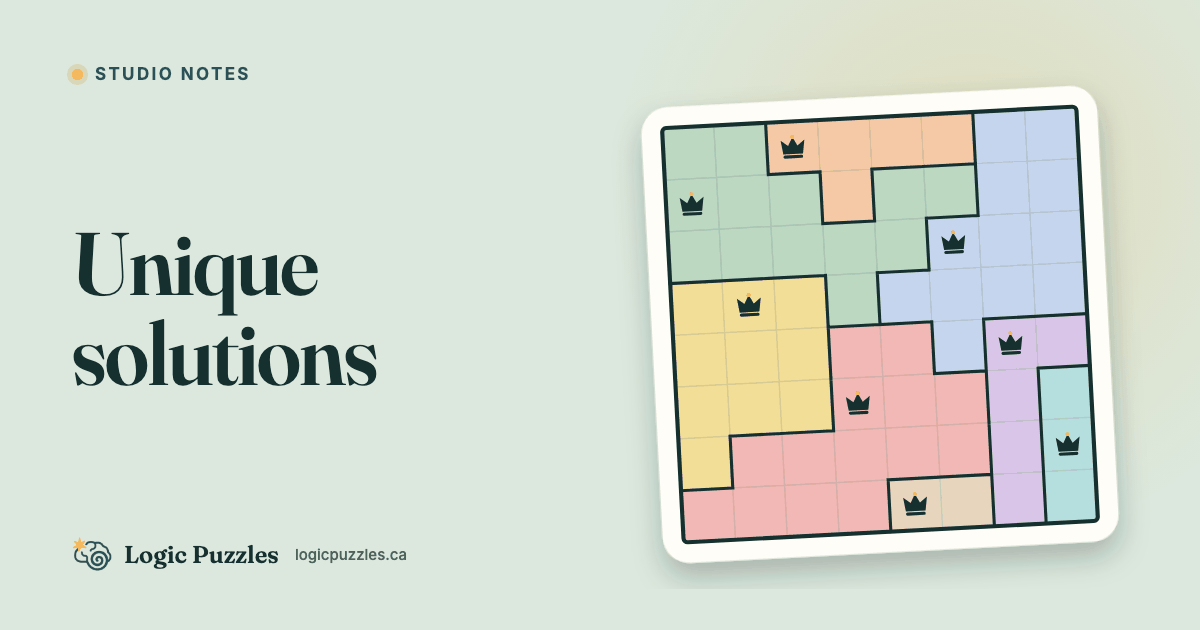
- Constraints that force placement (like "no two crowns can share a row, column, or region")
- Row/column counts that limit options (like Aquarium or Binary Sudoku+)
- Connection rules that prevent branching paths (like Color Flood: Logic Puzzle)
When the rules are tight, uniqueness becomes more likely. Loose rules can still be great, but they require stronger validation.
2. Build From a Solved Grid, Then Remove Clues Carefully
Most of our puzzles begin as a fully solved grid. From there, we remove clues in a controlled way:
- Remove a clue
- Check if the puzzle still has a single solution
- If it does, keep going
- If it does not, put the clue back
This is the simplest way to ensure we do not "over-remove" important information. It is slow, but effective.
3. Use Solver Checks (Automated Logic)
We use internal solver tools to test puzzle states. These tools do not "guess." They apply the same deductions a human would:
- Basic elimination (this cell cannot be X)
- Forced moves (only one place for a value)
- Pattern deductions (pairs, triples, and higher logic)
If the solver can reach a complete solution without guessing, it is a strong signal that the puzzle is fair.
4. Detect Multiple Solutions Early
A solver can also detect when multiple solutions exist. When a puzzle "branches" into multiple valid outcomes, the solver flags it. This tells us we need to:
- Reinstate a clue
- Adjust the starting pattern
- Tighten the rules for that puzzle set
We treat this as a stop sign. Multiple solutions are almost always a player frustration point.
5. Human Playtesting Still Matters
Automated checks are great, but they do not capture the feel of a puzzle. We playtest for:
- Clarity (is it obvious what the rules mean?)
- Flow (are there long dead zones?)
- Satisfaction (does the solution feel earned?)
Sometimes a puzzle is technically unique, but still not fun. Playtesting helps us catch those and refine the experience.
6. Difficulty Tuning Without Breaking Uniqueness
The hardest part is adjusting difficulty without changing the number of solutions. We do this by:
- Removing or moving non-essential clues
- Adding "decoy" information that still leads to the same deductions
- Building difficulty tiers from the same solved template
This keeps the puzzle fair, but gives each player a path that matches their skill level.
7. Continuous Feedback Loop
We watch anonymous play patterns (time to solve, hint usage, drop-off points) and use that to:
- Improve confusing puzzle templates
- Adjust future puzzle generation
- Identify where the difficulty spikes are too sharp
Over time, this creates puzzle sets that are cleaner, more consistent, and more enjoyable.
The Bottom Line
Unique solutions are not an accident. They come from careful rules, methodical clue removal, solver checks, and real human testing. This is the foundation of every puzzle we publish.
If you ever get stuck, that is part of the process too. Logic puzzles are meant to stretch your thinking. But you should always be able to trust that the puzzle is solvable - and that the solution you find is the only one that fits.
Ready to test your logic? Try: