Experience is supposed to be an unmixed good. Solve a thousand grids and the thousand-and-first should only be easier. Practice builds pattern recognition, pattern recognition builds speed - we have written admiringly about that engine before, and it is real.
But it has a failure mode, documented for over eighty years, with a German name and an unnerving eye-tracking signature: Einstellung - "set," or "attitude" - the phenomenon in which a solution you already know actively prevents you from seeing a better one. Not slows. Prevents.
Three jars of water
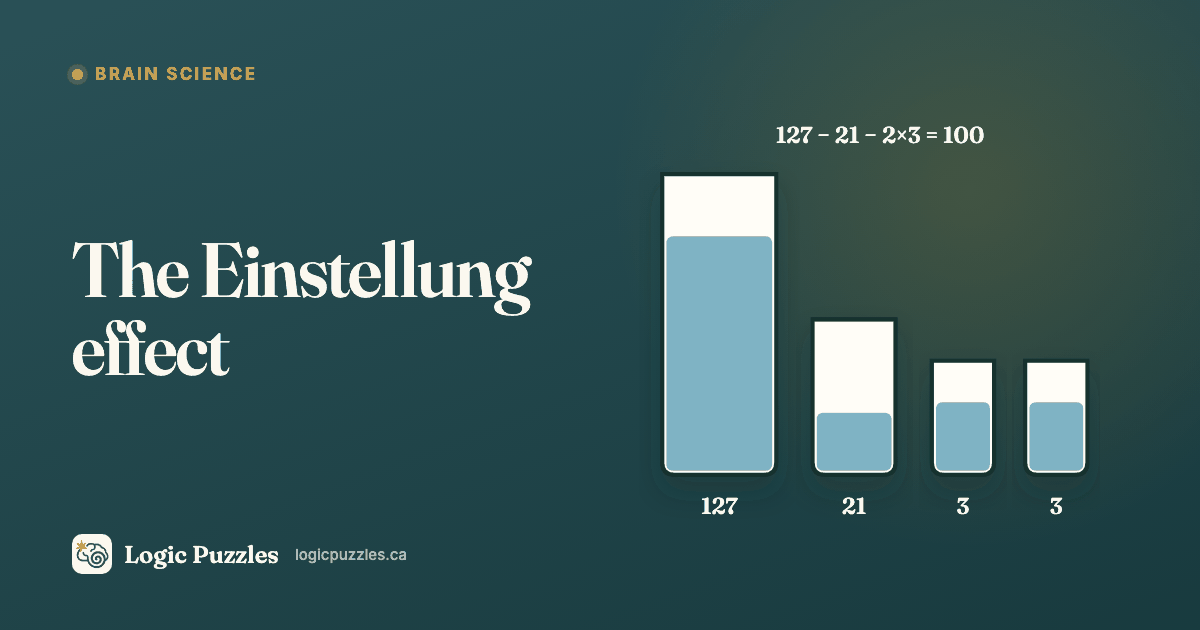
In 1942, the psychologist Abraham Luchins published one of the most replicated experiments in the history of problem-solving research. Subjects got word problems about measuring exact amounts of water using three jars of given capacities. The first several problems all yielded to the same somewhat clunky recipe: fill the big jar B, pour off A once, pour off C twice - B − A − 2C.
Then came the trap: problems solvable by the same long recipe, but also by something almost insultingly direct, like A − C. Two steps. Visible to any child.
Practiced subjects didn't see it. Overwhelmingly, they ground through the five-step ritual - and when Luchins slipped in a problem where the ritual failed but the simple move worked, the majority of practiced subjects failed a problem that novices solved easily. He called it the mechanization of thought: the recipe, rewarded a few times, had stopped being a tool and become a reflex - the practiced mind ran its program instead of reading the problem. Writing "DON'T BE BLIND" atop the test page helped only somewhat.
Sit with the design for a second, because it is diabolical and fair: the experiment doesn't defeat expertise with harder problems. It defeats expertise with easier ones.
The master's wandering eyes
For decades one could hope Einstellung afflicted only novices with fresh habits. In 2008, the researchers Merim Bilalić, Peter McLeod, and Fernand Gobet closed that exit with a beautiful chess experiment published under the exact right title: "Why good thoughts block better ones."
They showed skilled players positions containing a famous, textbook checkmate pattern - a smothered mate, five moves long - while a shorter three-move mate sat quietly available on the same board. Strong players found the familiar five-mover instantly. Asked to keep searching for something better, they reported doing so. Their eyes said otherwise: gaze tracking showed their attention returning, again and again, to the squares of the solution they had already found. They believed they were exploring; they were orbiting. On these trap positions, masters effectively played about a full skill class below their rating - the first idea acting as a gravity well that bent every subsequent "search" back into itself.
That is the mechanism, laid bare: Einstellung is not stubbornness or laziness. The known solution hijacks attention itself, filtering what can be noticed. You cannot simply will yourself open, any more than the masters could - their will was fine; their eyes were captured.
The everyday version is functional fixedness, shown by Karl Duncker's classic candle experiment in 1945: given a candle, matches, and a box of tacks, people struggle to mount the candle on the wall because the box registers as container, not shelf - until the tacks are tipped out, whereupon the solution rate jumps. Same lock, different door: a familiar role blinding us to an available one.
Where it bites the puzzle solver
You have met Einstellung on a grid, whether or not you had the name.
It is the Sudoku that stalls because you keep scanning for the naked pairs that cracked your last three puzzles, while an elementary box-line elimination sits unexamined. It is the Calcudoku where you factor every cage by reflex when simple parity would have collapsed a row. It is the veteran move of opening every Nurikabe from the big islands because that "always works" - on the puzzles you happen to have practiced. Hard puzzles are frequently designed as Luchins traps: the setter knows the standard sequence and deliberately builds a grid whose door is elsewhere. What feels like a brutally hard puzzle is often an easy puzzle standing behind your favorite technique.
The bitter irony, straight from the chess data: the stronger your pattern library, the stronger the gravity. Beginners can't be captured by patterns they don't own. This is why a child sometimes spots the move that eludes the household's best solver, and why "fresh eyes" is not folk wisdom but a literal description.
Breaking the set
The research suggests remedies more specific than "keep an open mind" - which, remember, is exactly what the masters believed they were doing.
Move your eyes on purpose. Since the capture is attentional, the counter is physical. Pick a region of the grid your current idea considers irrelevant and force a full scan of it. The masters' problem wasn't reasoning; it was coverage.
Ban the favorite. As an exercise: solve one puzzle this week while forbidding your most-used technique for the first ten minutes. Nothing reveals a rut like fencing it off. (Luchins's subjects, denied the long recipe, saw the short one immediately.)
Restate, don't re-search. Describe the blocking situation in different words - out loud if dignity permits. "I need this cell to be small" becomes "the row needs its large digits elsewhere," and the reframing routes around the captured pathway. Different description, different candidate moves.
Walk away honestly. We have written about incubation - the answer that arrives after a break. Einstellung is a large part of why breaks work: attention capture decays with time away, and the fixated pattern loosens its grip. A pause is not rest from thinking; it is the release of a hostage.
Expertise, with a governor
None of this is an argument against practice - the pattern library remains the most valuable thing a solver owns. It is an argument for practicing variety and for holding every first idea the way a scientist holds a hypothesis: gratefully, and at arm's length. Luchins put the moral on the page in 1942, and the eye-trackers have only sharpened it since. The enemy of the better solution is not ignorance. It is the good solution, arriving early, closing doors behind it.