Software folklore keeps a small, sacred ritual. A programmer, defeated by a bug, turns to a rubber duck on the desk and explains the code to it, line by line. Somewhere around line twelve - "…so this loop runs until the list is empty, which it always eventually… oh. Oh." - the bug surrenders. The duck says nothing. The duck never needs to.
"Rubber duck debugging" entered the canon through the 1999 book The Pragmatic Programmer, but programmers only named a phenomenon that teachers, therapists, and anyone with a patient spouse had already witnessed forever: explaining a problem, out loud, to someone who cannot help, routinely solves it. Psychology has spent four decades establishing that this is real, measuring it, and finding its limits - including one strange case where speaking makes you worse. All of it applies directly to a solver stuck on a grid.
The self-explanation effect
The foundational study is Michelene Chi's, from 1989. Her team watched physics students work through textbook examples and split them, in hindsight, by a habit: some students merely followed each worked step, while others paused to explain the steps to themselves - why this equation, why now, what changed. The self-explainers dramatically outperformed the others on new problems. Follow-up experiments made the causality clean: prompting students to self-explain improved learning, across ages and subjects, in one of the more dependable effects in the learning sciences.
The mechanism matters for us. Explanation is a completeness test. Reading, you skate over gaps without feeling them - recognition supplies a cozy sense of understanding (the same fluency illusion we met in the essay on desirable difficulties). Explaining permits no skating: every "because" must be manufactured, and the gaps announce themselves as stumbles. The duck works for precisely this reason. It isn't an audience; it's a forcing function. Speech runs strictly slower and stricter than thought, and somewhere in the translation, the assumption you never knew you were making has to pass through your own ears - where, at last, you can hear that it's false.
That is worth restating as the central claim: most stuckness is not missing information but an unexamined assumption, and explanation is the cheapest known instrument for surfacing assumptions.
The confession protocol for grids
Translate the ritual to puzzles and it becomes a concrete technique - the one we reach for after the standard scans fail.
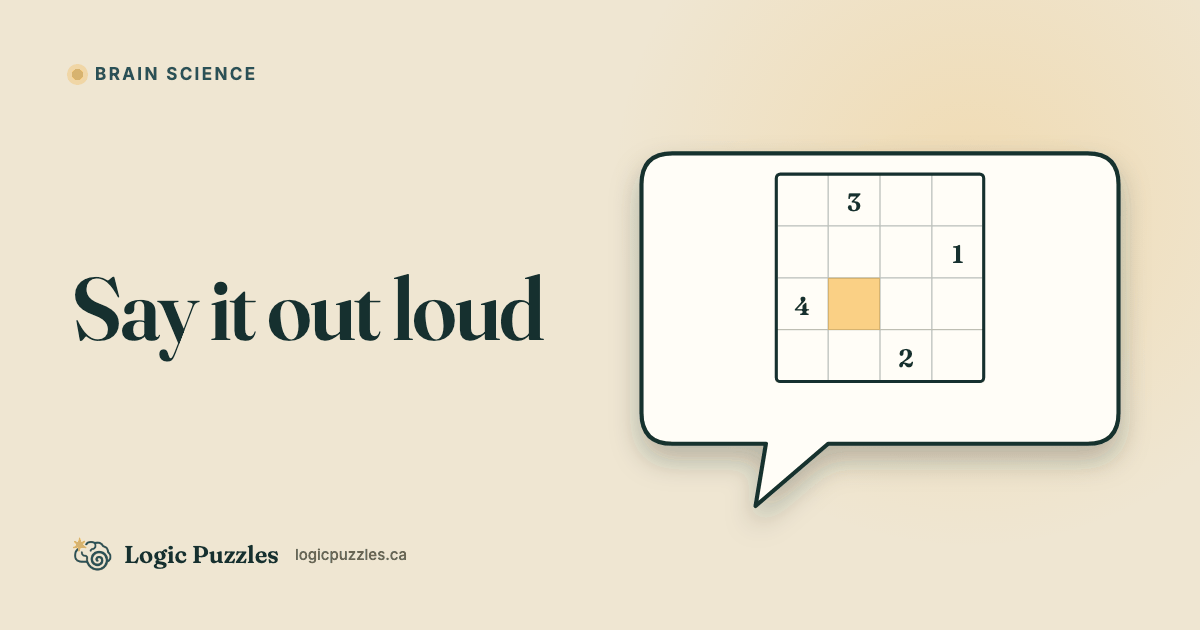
Stuck, you say - then explain the stuckness precisely, aloud or in writing, as if to a patient friend who knows the rules but not this grid: "This cell can't be 3 because of the column. It can't be 7 because the cage needs its 7 elsewhere - wait, does it? Why did I decide the cage needs the 7 there?"
Notice what the protocol does. First, it forces you to enumerate your reasons, and stuck positions are usually resting on one reason that was never actually derived - a placement made twenty minutes ago on momentum, now laundered into fact by familiarity. Second, it converts vague dread ("this corner is a mess") into named constraints, and named constraints can be checked one at a time. Third, it moves your eyes: as we saw with the Einstellung effect, stuck attention orbits a captured idea, and narration - which must proceed linearly through territory the orbit skips - is a socially acceptable way to break your own gravity.
Solvers who journal hard puzzles know the punchline: the write-up of why it's impossible is, a striking fraction of the time, interrupted mid-sentence by its own refutation. You cannot finish the false explanation. That's the duck, collecting.
The protégé bonus
A wrinkle with charm: explaining to an actual mind - even a lesser one - works better still. Studies of "learning by teaching," running back to experiments in the 1980s and continued with computerized "teachable agents," find that people preparing to teach material learn it deeper than people preparing to be tested, and children tutoring a struggling virtual pupil work harder and understand more - the protégé effect. Responsibility sharpens the explanation reflex.
This is the honest secret of puzzle communities, by the way. The person who answers "how do I even start Nurikabe?" in a forum thread is compensated in kind: nothing exposes the holes in your own method like handing it to a beginner. Teach a puzzle this month and watch your own solving reorganize.
The case where silence wins
Now the fascinating exception, because it maps a real border. In the 1990s, Jonathan Schooler and colleagues found verbal overshadowing: for certain tasks, verbalizing actively hurts. Describe a face and you'll recognize it less accurately; and - directly relevant here - narrating your thinking during classic insight problems (the kind solved by a sudden restructuring, an aha) measurably reduced solution rates, while leaving step-by-step analytical problems unharmed.
The interpretation: language is a serial, criteria-driven instrument. It flatters processes that are already serial - chains of deduction, eliminations, case analysis - and it tramples processes that are holistic and pre-verbal, the quiet recombination that precedes an aha. Some knowing simply doesn't compress into words yet, and demanding words evicts it.
So the full prescription has two speeds, and mature solvers toggle between them. When a puzzle is a chain - Sudoku logic, cage arithmetic, fleet accounting - explain freely; every word is an audit. When a puzzle awaits a reframe - when you sense the answer needs a different way of seeing rather than a longer derivation - stop talking. Stare, wander, let the walk-away effect we've written about do its silent work. The duck handles the logic. The shower handles the insight. Confusing the two jurisdictions is why advice like "just think out loud" sometimes lands and sometimes ruins.
The one-sentence version
Every technique in this essay compresses to a move you can execute tonight: when stuck, explain the stuckness to something that can't help you - completely, in order, out loud - and listen for the sentence you can't finish. No apparatus, no hints, no cost. Just the oldest peer review there is: your own voice, made to walk slowly past every door you were sure was locked, jiggling handles.
Quack.