Aquarium has been our favorite playtest for months. It's finally out - and if you like clean constraints and that "oh, of course" feeling, you'll probably love it too.
What is Aquarium?
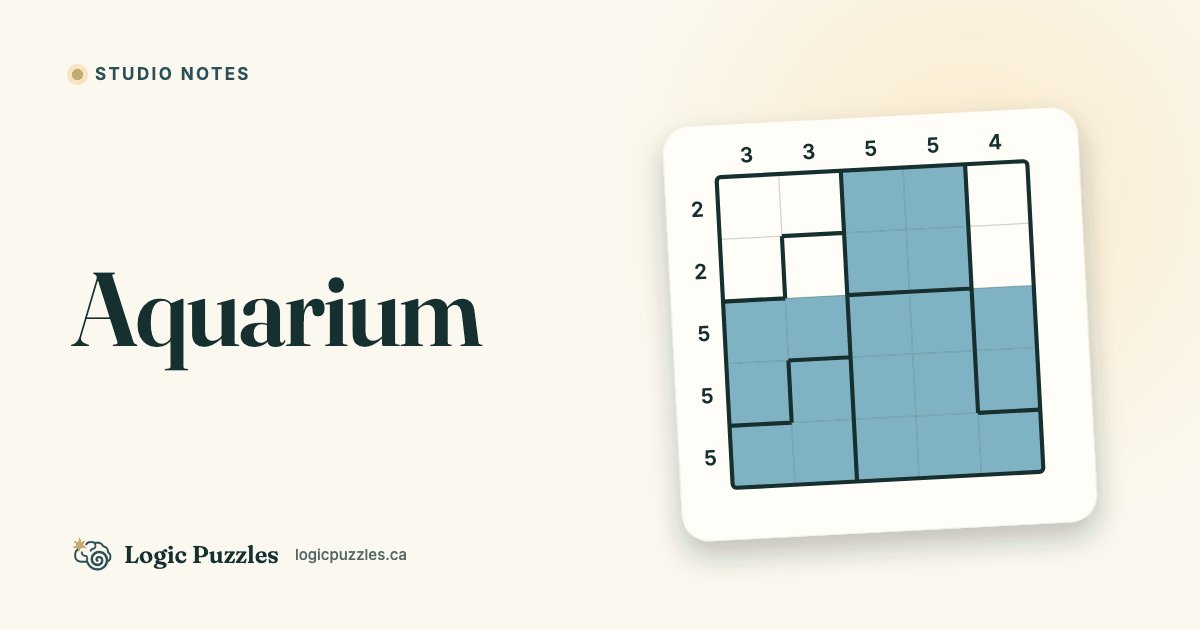
Aquarium is a logic puzzle where you fill containers with water based on numerical clues. The rules are simple: water settles to the bottom; row and column counts tell you how many cells should be filled; and cells within the same compartment must share the same water level.
The interactions between these rules are where the magic happens. A single clue can cascade through the grid, revealing placements you didn't expect.
The Core Rules
- Water settles: If a cell is filled with water, every cell below it in the same compartment must also be filled.
- Row/column counts: Numbers along the edges tell you exactly how many cells in that row or column contain water.
- Compartment consistency: Cells in the same aquarium (bounded region) share a water level - you can't have water in one cell without filling everything below it in that compartment.
What We Focused On
- Fair Deductions: Every board is solvable without guessing. If you're stuck, there's a logical move waiting to be found.
- Clarity: High-contrast visuals and immediate feedback help you track progress and catch mistakes early.
- Hand-Curated Levels: A smooth ramp from simple to challenging, with each puzzle designed to teach or test specific deduction patterns.
The Inspiration Behind Aquarium
We wanted a calm, thoughtful rhythm - something meditative but mentally engaging. Water-level constraints fit that perfectly. There's something satisfying about watching the grid fill in as logic reveals the solution.
The puzzle type originated in the logic puzzle community and has been featured in various puzzle magazines. We've taken the core concept and refined it for digital play, focusing on touch-friendly controls and responsive feedback.
Crafting the Puzzles
Every puzzle was built and replayed until the deductions felt crisp. We didn't just generate grids algorithmically - each board was tested by hand to ensure a smooth solving experience.
Our level design process involves:
- Defining grid size and complexity: Smaller grids with simple compartments for beginners; larger grids with intricate boundaries for experts.
- Placing aquarium boundaries: The shape of compartments determines how constraints propagate. Good boundaries create interesting deduction chains.
- Calculating row and column water totals: These numbers must be tight enough to force logical moves but not so restrictive that the puzzle becomes trivial.
- Extensive playtesting: We solve every puzzle ourselves, noting where the flow feels smooth and where it stalls. Stall points get adjusted.
Why It's Worth Your Time
If you enjoy Sudoku, Nonograms, or other deduction-first puzzles, Aquarium's constraint chain will feel fresh and fair. It shares DNA with those classics but offers a unique twist that rewards careful observation.
The game is also excellent for short play sessions. Most puzzles take 2-10 minutes depending on size and difficulty, making it perfect for a coffee break or commute.
Play Now
In your browser: Aquarium
Tell us where you struggled and where it clicked - we read everything and use your feedback to improve future puzzles.
Happy puzzling!