In 1953 a graduate student named Solomon Golomb stood up in front of the Harvard Mathematics Club and talked about shapes you could cut from graph paper. Take some squares, glue them edge to edge, and see what comes out. Two squares make a domino. Three make a little straight bar or a bent corner. Four make five different shapes. Golomb gave the whole family a name that sounded like it had always existed: polyominoes.
The next year he wrote the idea up in a paper called Checker Boards and Polyominoes, and in 1965 he published a whole book on them. Puzzle makers have been raiding his toy box ever since. One of the cleanest results of that raid is LITS, a shading puzzle built from four of Golomb's five four-square shapes. This essay is about those shapes, the one that got left out, and why its absence is the secret to the whole puzzle.
Counting shapes is surprisingly hard
Start small. With one square there is one shape. With two there is one (the domino). With three there are two. With four there are five, usually named after the letters they resemble: I (four in a row), L (three in a row with a foot), T (three in a row with a bump in the middle), S (a zigzag), and O (a 2×2 square). Here we count a shape and its mirror image as the same piece, so S and its backwards twin are one shape.
With five squares there are 12 shapes, the pentominoes. With six there are 35. Then the numbers start climbing fast, and here's the wry part: nobody has ever found a formula for them. To know how many polyominoes have, say, twenty squares, mathematicians have to count them, with clever computer searches. A child can draw every one of the small ones in an afternoon, and the general question is still open.
Simple pieces, deep questions: that was Golomb's kind of problem.
The checkerboard trick
One of Golomb's favourite tools was a checkerboard pattern, and the five tetrominoes give a perfect demonstration of why.
Here is a natural question. The five shapes have 20 squares between them. Can you fit all five together into a rectangle, say 4 by 5 or 2 by 10? People fiddle and fiddle, and it never works. A Golomb-style colouring explains why it can't.
Paint any such rectangle like a checkerboard. Because each row has an even length, or there are an even number of rows, it always has exactly 10 dark squares and 10 light ones. Now drop each piece onto a checkerboard and count. The I, L, S and O each cover 2 dark and 2 light, wherever you put them. The T is the troublemaker: it always covers 3 of one colour and 1 of the other. Add it all up and the five pieces cover either 11 dark and 9 light, or 9 dark and 11 light. Never 10 and 10. So the rectangle is impossible, and no amount of fiddling will change that.
We love this argument because it's the solver's mindset in miniature. You don't check every arrangement. You find one property that every arrangement must share, and you notice the pieces can't supply it.
Where LITS comes in
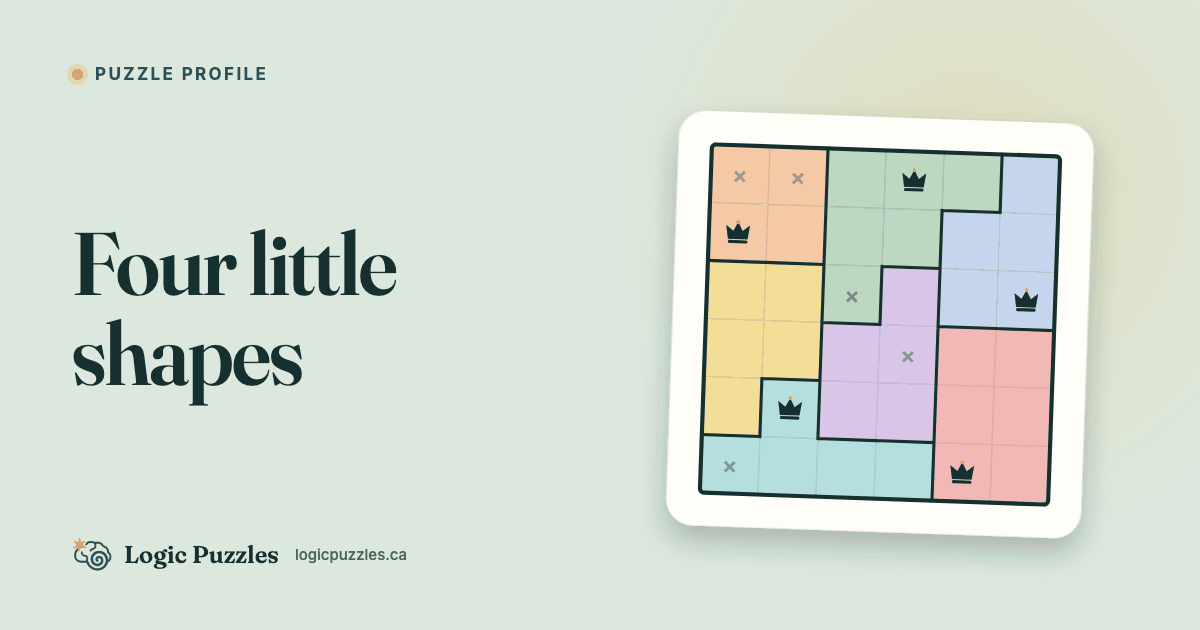
LITS takes Golomb's shapes and builds a puzzle around them. The grid is divided into regions, and the rules are short:
- Shade exactly one tetromino in each region, and it must be an L, I, T or S (rotations and reflections allowed).
- All the shaded cells must connect into one group, through edges.
- No 2×2 block anywhere on the grid can be fully shaded.
- Same shapes can't touch: if two neighbouring regions hold the same shape, their shaded cells can't meet along an edge.
Notice what's missing. The O is not on the list, and it doesn't need to be, because the 2×2 rule already bans it. A shaded O is a 2×2 block. But the rule goes further than that: it also stops two different pieces from teaming up to form a solid square across a region border. The banned fifth shape haunts the whole grid. Every time you shade, you're really asking: have I just built an O by accident?
That's the design lesson hiding in the name. Leave one shape out, turn its absence into a rule, and suddenly every placement has a ghost to avoid.
Four techniques that crack the grid
1. Start with the cramped regions. A region of exactly four cells has no choice at all: shade it. A region of five or six cells has only a handful of possible tetrominoes. Write them out in your head and look for what they share.
2. Shade the overlap. If every possible tetromino in a region uses a particular cell, that cell is shaded, even before you know which shape wins. In a long thin region, the middle cells are often forced this way. It's the same move that solves nonogram rows: when every option agrees, you don't need to choose.
3. Guard the ghost. Whenever three cells of a 2×2 block are shaded, the fourth must stay empty. Make this a reflex. After each placement, scan the squares around it. A stuck LITS grid often has a forced empty cell sitting quietly next to a corner you just finished.
4. Follow the connection. Every region's shape has to link up with the rest. If a region can only reach its neighbours through one narrow gap, the shading must pass through that gap. And if a candidate shape would leave a piece of shading sealed off from everything else, that candidate is dead. The same-shape rule finishes the job: two neighbouring regions that both look like they want an L can't let those Ls touch across their shared border.
None of these is hard on its own. The pleasure of LITS is in how they chain. A cramped region forces an overlap, the overlap creates a near-square, the near-square blocks a cell, and the blocked cell leaves a neighbouring region only one way to connect. Every grid we publish has exactly one solution, so that chain always exists. Your job is to find its first link.
Playing with the pieces
Part of the charm of Golomb's shapes is that anyone can pick them up. You don't need a theorem to start. You need squares, curiosity and a willingness to notice what can't happen.
That habit travels well beyond the grid. When something won't fit, whether it's a schedule, a budget, or a bookshelf, it's worth asking Golomb's question before you try a hundred more arrangements: is there a simple count that says this is impossible? Sometimes the most useful thing you can learn about a problem is which shape was never going to fit.