Watch an expert solve a Sudoku or logic puzzle, and you will notice something: they write a lot more than answers. Those small notes in the margins and corners are called pencil marks, and they are one of the most underrated skills in puzzle solving.
What are pencil marks?
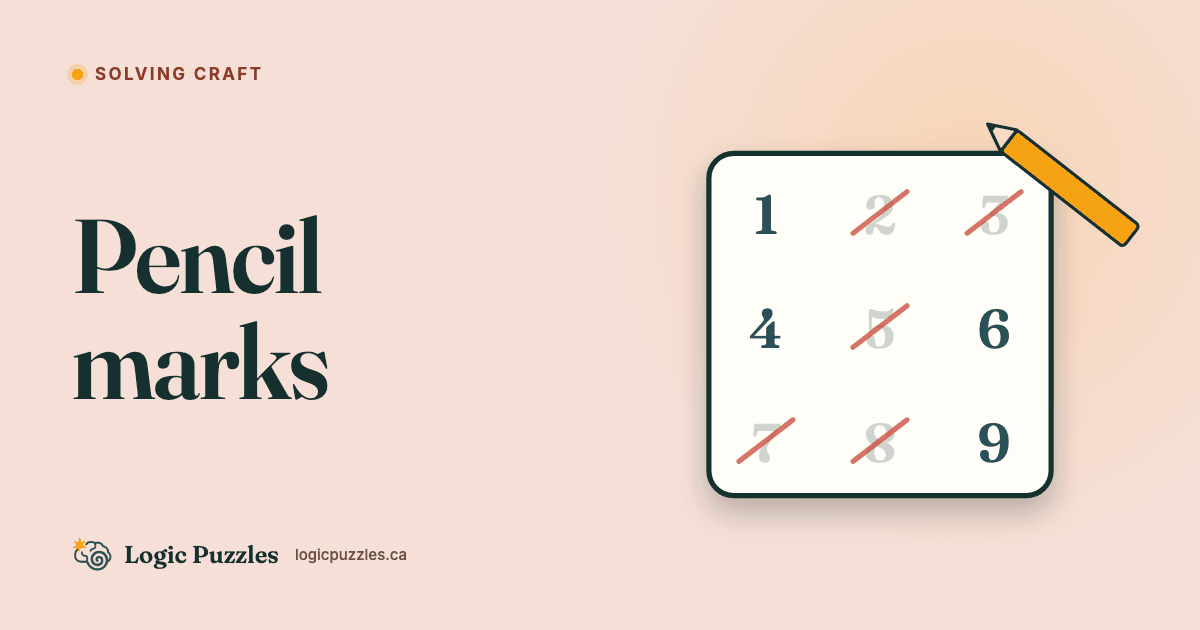
Pencil marks are temporary notations that track possibilities. Instead of committing to an answer, you write down what could go in a cell or what must be true about a region.
Common types include:
- Candidate lists: Small numbers in a cell showing which values are still possible.
- Elimination marks: Notes that cross out ruled-out options.
- Constraint reminders: Arrows or dots indicating relationships between cells.
The point is not to clutter the grid. It is to externalize your working memory so your brain can focus on deduction, not recall.
Why pencil marks matter
Human working memory is limited. Studies suggest we can hold about four to seven items in mind at once. A typical logic puzzle might have dozens of constraints interacting at any given moment.
Pencil marks solve this problem by turning memory into vision. Instead of thinking, "What were the possibilities for that cell again?", you simply look.
This has several benefits:
- Faster elimination. You spot contradictions immediately.
- Fewer errors. You cannot forget what is written down.
- Deeper chains. You can follow multi-step deductions without losing track.
How to use pencil marks effectively
Not all notation helps. Here are principles for keeping your marks useful:
1. Be consistent
Pick a system and stick with it. If small numbers in corners mean candidates, always use that format. Inconsistent marks slow you down.
2. Update as you go
When you place a value, immediately erase or cross out that candidate from related cells. Stale marks are worse than no marks.
3. Start sparse, add as needed
You do not need to mark every cell at the start. Begin with cells that have few candidates or that interact with tricky regions. Add more marks when you hit an impasse.
4. Use location meaningfully
Many solvers place candidates in consistent positions within a cell. For example, in Sudoku, the number 1 might always go in the top-left corner, 2 in the top-middle, and so on. This makes scanning faster.
Pencil marks in digital puzzles
In our games, we build notation tools directly into the interface:
- Tap-and-hold or right-click to toggle pencil mark mode.
- Color-coded marks to distinguish different types of notes.
- Auto-removal when a value is placed in certain modes.
Using these tools is not cheating. It is playing the way experts play.
When to skip pencil marks
For very easy puzzles, notation can be overkill. If you can see the next move immediately, just make it. Marks are most valuable when:
- You are stuck and need to track possibilities.
- Multiple constraints overlap in one area.
- The puzzle requires chains of reasoning longer than two or three steps.
Think of pencil marks as a tool you reach for when the puzzle demands it, not a mandatory step.
The real skill
Pencil marking is not about writing more. It is about writing the right things so your brain can do less holding and more thinking. The best solvers know when to mark, what to mark, and when to erase.
If you have been solving puzzles without notation, try adding it on your next hard puzzle. You might find that the grid suddenly makes more sense.
Ready to practice?