In the early eighteenth century, a Danzig-born instrument maker named Daniel Gabriel Fahrenheit was sealing mercury into thin glass tubes in the Dutch Republic. Thermometers already existed, but they were unreliable: two instruments could sit side by side in the same room and disagree. Fahrenheit's great achievement was not the idea of a thermometer. It was making thermometers that agreed with each other, so that a reading in one city meant the same thing in another.
A few decades later, in 1742, the Swedish astronomer Anders Celsius proposed a hundred-step scale between the freezing and boiling points of water. Here's the wry part: his original version ran upside down, with 0 for boiling and 100 for freezing. It was flipped into the familiar order shortly after his death.
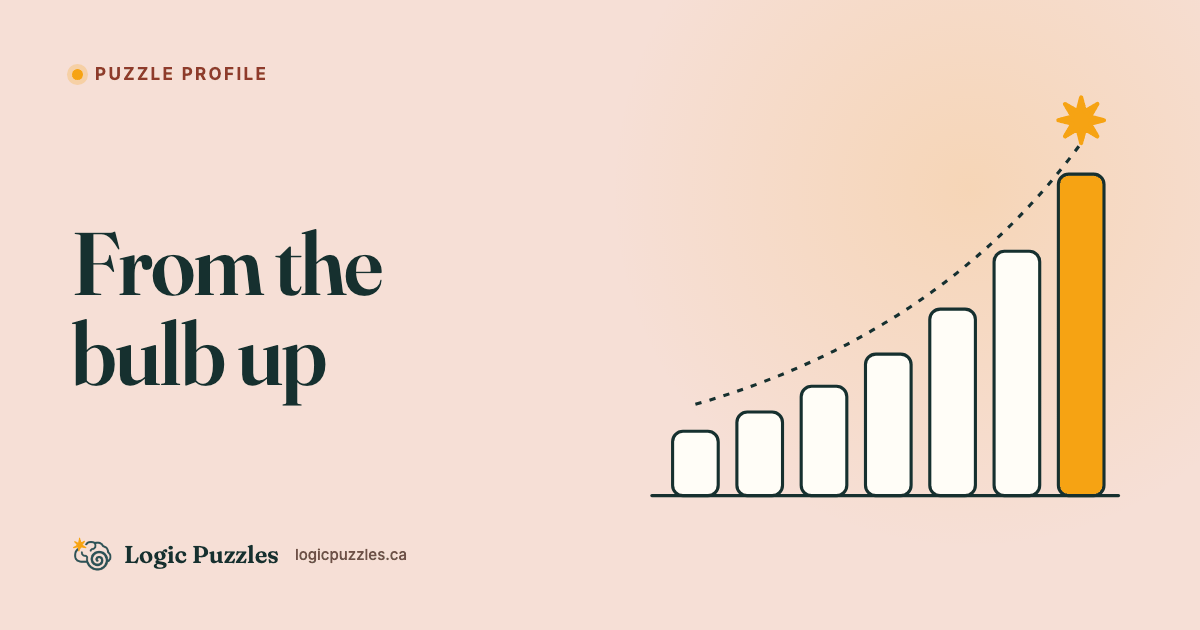
Both men were wrestling with the same simple object. A bulb, a narrow tube, and a column of liquid that climbs from the bulb toward the tip. That column is the whole idea behind our puzzle Thermometers, and it turns out to be a surprisingly powerful piece of logic.
The rules, and the one that matters
A Thermometers grid contains thermometer shapes of various lengths, each with a round bulb at one end. Your job is to fill some of their cells with mercury. Numbers beside each row and above each column tell you exactly how many filled cells that line contains.
The catch is the physics. Mercury fills continuously from the bulb. A thermometer can be empty, partly filled or completely full, but you can never fill a cell near the tip without filling everything between it and the bulb first. No floating bubbles, no gaps.
That rule sounds like decoration, a cute theme on top of a counting puzzle. It is actually the engine.
Five choices instead of sixteen
Take a thermometer four cells long. If each cell could be filled or empty independently, there would be 2 × 2 × 2 × 2 = 16 possible patterns. But mercury rules most of those out. The only legal states are: empty, one cell, two cells, three cells, or full. That's five options, not sixteen.
In general, a thermometer of length n has n + 1 possible fills instead of 2 to the power n. The gap grows fast. A thermometer of length 8 has 9 legal states instead of 256.
Now picture a grid with ten thermometers, each four cells long. Treated as loose cells, that's 16 to the power 10, about 1.1 trillion patterns. Treated as thermometers, it's 5 to the power 10, just under 10 million. The bulb rule throws away more than 99.99% of the possibilities before you've even looked at a clue.
This is the mathematical heart of the puzzle: each thermometer isn't really a row of cells at all. It's a single number, its fill level, hiding in the shape of a tube. Once you see it that way, the grid stops being a mess of yes-or-no questions and becomes a small set of dials, each turned somewhere between zero and full.
Two arrows of inference
Because the fill is continuous, every cell carries two automatic consequences, pointing in opposite directions:
- If a cell is filled, every cell between it and the bulb is filled. Mercury can't skip.
- If a cell is empty, every cell beyond it toward the tip is empty. Nothing can sit above a gap.
Logicians would call each of these an implication, and the pair of them is what makes Thermometers feel so different from a plain counting grid. One mark rarely stays a single mark. Fill the third cell from the bulb and you've really filled three cells, possibly across three different rows, each of which now has one fewer filled cell to find.
That's why the puzzle rewards a slightly odd habit: whenever you decide anything, follow the tube. Ask which way the arrow points, and mark everything it drags along.
The solver's toolkit
Most Thermometers grids fall to a few techniques used again and again.
1. Zeros sweep the board. A row or column with a count of 0 has no mercury at all. Empty every cell in it. Then apply the second arrow: any thermometer that passes through that line is empty from that point onward to its tip. If a bulb sits in a zero line, the entire thermometer is empty, however far it stretches.
2. Full lines fill backwards. If a row's count equals the number of thermometer cells in it, every one of them is filled. Now apply the first arrow: each of those cells pulls mercury down its tube toward the bulb, often into rows you haven't touched yet.
3. Track the minimum and the maximum. For each thermometer, keep two numbers in your head: the least it could possibly be filled and the most. A row clue might cap a thermometer's level ("it can't reach this row, or the row would overflow"). A column clue might demand a minimum ("this column needs three, and only this tube can supply them"). When the minimum and maximum meet, the thermometer is solved.
4. Long tubes first. Long thermometers cross many lines, so they're touched by many clues at once. That makes them the most constrained pieces in the grid and usually the best place to start squeezing.
5. Count what's left. Late in a puzzle, compare each line's remaining count with its remaining undecided cells. If they're equal, fill them all. If the count is already met, empty the rest. Then, as always, follow the tubes.
What the bulb teaches
There's a lovely echo between Fahrenheit's workshop and the puzzle grid. His thermometers were valuable because they were constrained: the mercury could only behave one way, so a reading meant something. Our thermometers work the same way. The bulb rule doesn't make the puzzle harder to think about. It makes each mark mean more, because every decision carries its consequences along with it.
That's a useful idea well beyond the grid. A lot of problems look enormous because we treat every part as an independent choice: every task on the list, every option on the menu, every cell in the row. Often the parts are linked. Some things can't happen until others have, and once something is ruled out, everything that depended on it falls away too. Spot the order hiding inside a problem and you'll find that a trillion possibilities were only ever a few million, and the few million were only ever a handful of dials.
Next time you're facing a tangle, look for the bulb. Find what everything else is built on, settle that first, and let the rest rise from there.