In the spring of 1974, a Hungarian professor of architecture built a cube of twisting blocks to help his students feel three-dimensional movement. Then he scrambled it - and spent more than a month figuring out how to restore it, unsure at first that it was possible at all. He had invented the best-selling puzzle in human history and become its first victim in the same gesture.
The Magic Cube went global in 1980, and the numbers still astonish. Its six faces and twenty-six visible pieces generate 43,252,003,274,489,856,000 distinct positions - 43 quintillion, thousands of times the Sudoku grid count we've marveled at before. Scramble a cube and you hold an arrangement that, in all likelihood, no cube in history has ever displayed.
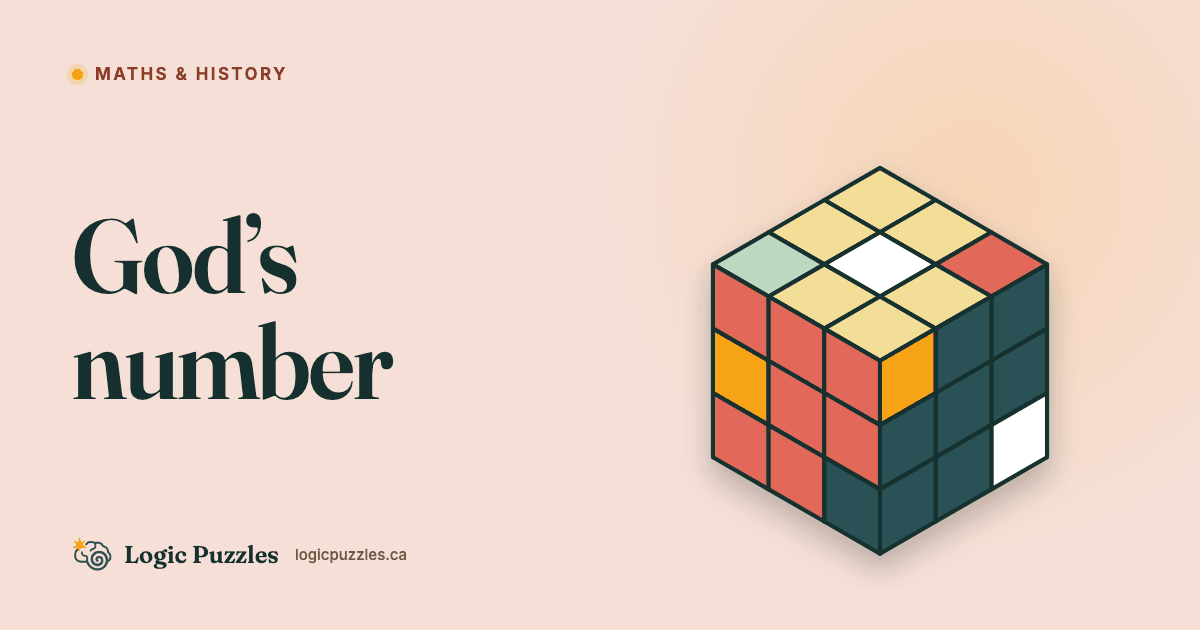
And yet: every last one of those 43 quintillion tangles is at most 20 moves from solved. Not roughly 20 - exactly at most 20, with some positions needing all of them. That number has a nickname mathematicians use without smiling: God's number. Proving it took thirty years.
Why "God's"
The framing is lovely. Imagine a being of perfect knowledge - no algorithms, no memorized sequences, just complete sight of the shortest path from any position. How many moves would that solver need in the worst case? The question asks for the diameter of an unimaginably large maze: positions are rooms, moves are doors, and God's number is the longest walk between any room and home, assuming you never take a wrong turn.
Lower bounds came from pure argument: there are only so many move sequences of a given length, and counting shows sequences of 17 or fewer can't reach 43 quintillion positions - so some positions need 18+. One particular position - the superflip, every piece home but every edge flipped in place, a cube that looks almost solved and lies - was proved in 1995 by Michael Reid to require a full 20. So God's number was at least 20.
Upper bounds were the war. In 1981, the English mathematician Morwen Thistlethwaite gave a strategy guaranteeing 52 moves, using a ladder of nested move-vocabularies - a beautiful idea that decomposes chaos in stages. Herbert Kociemba's two-phase refinement pushed guarantees into the 20s. But closing the final gap needed exhaustion: checking, in effect, everything.
In July 2010, Tomas Rokicki, Kociemba, Morley Davidson, and John Dethridge finished it. Their trick was industrial-scale symmetry: partition all positions into about two billion families, solve each family's representative cases with ferociously optimized solvers, and let the cube's symmetries fill in the rest. The bill ran to roughly 35 CPU-years, donated from a tech company's idle machines, compressed into a few weeks. The verdict: no position needs more than 20 moves. God's number is exactly 20.
It joins a lineage this blog keeps meeting - the Four Color Theorem, Sudoku's 17-clue floor - of truths humans could frame but only fleets of machines could certify: mathematics' empirical frontier.
The gap that dignifies practice
Here is the part I find most instructive. God solves in 20. How do humans solve?
The standard speedcubing method (CFOP: cross, first two layers, orientation, permutation) executes around 50 to 60 moves. World-class solvers do this in just over three seconds - hands blurring, around twenty moves per second. Notice what they are not doing: nobody finds 20-move solutions live. Optimal paths are invisible even to the greatest human solvers; they're found only by computer search. Humans instead trade optimality for findability: a repertoire of memorized sequences, each solving one sub-goal while provably not disturbing finished work, chained by pattern recognition. Three times God's move count, executed at superhuman reliability.
That trade is the deep lesson, and it generalizes to every puzzle and most of life. The best solution and the best procedure for finding solutions are different objects. A grid may admit some dazzling five-step deduction, but the solver who methodically runs singles, pairs, and eliminations - forty small certain moves - finishes while the genius is still searching. We saw the same divide in how computers solve Sudoku: the machine's shortest proof isn't the human's usable path. Optimal is a property of answers. Systematic is a property of solvers. When they conflict, bet on systematic.
There's even comfort in the superflip: the position farthest from home looks nearly solved. Every solver knows that feeling from the inside - the grid that's 95% done and utterly stuck is often genuinely deeper in the maze than the blank one was. Distance-to-solution and appearance-of-progress are simply different measurements. The cube proved it.
The inventor's real invention
The cube's inventor, now in his eighties, has always insisted the cube's meaning isn't speed. His month of struggle in 1974 - no notation, no community, no video tutorials, alone with an object he wasn't sure could be un-scrambled - remains the purest version of the experience the cube offers: a problem that is visibly finite, guaranteed solvable, indifferent to bluffing, and respectful of exactly one currency: understanding structure.
Forty quintillion positions, one destination, twenty moves of separation, and a lifetime's difference between knowing the path exists and being able to walk it. Every puzzle we publish lives somewhere in that gap - and so, on any honest accounting, does nearly everything else worth doing.