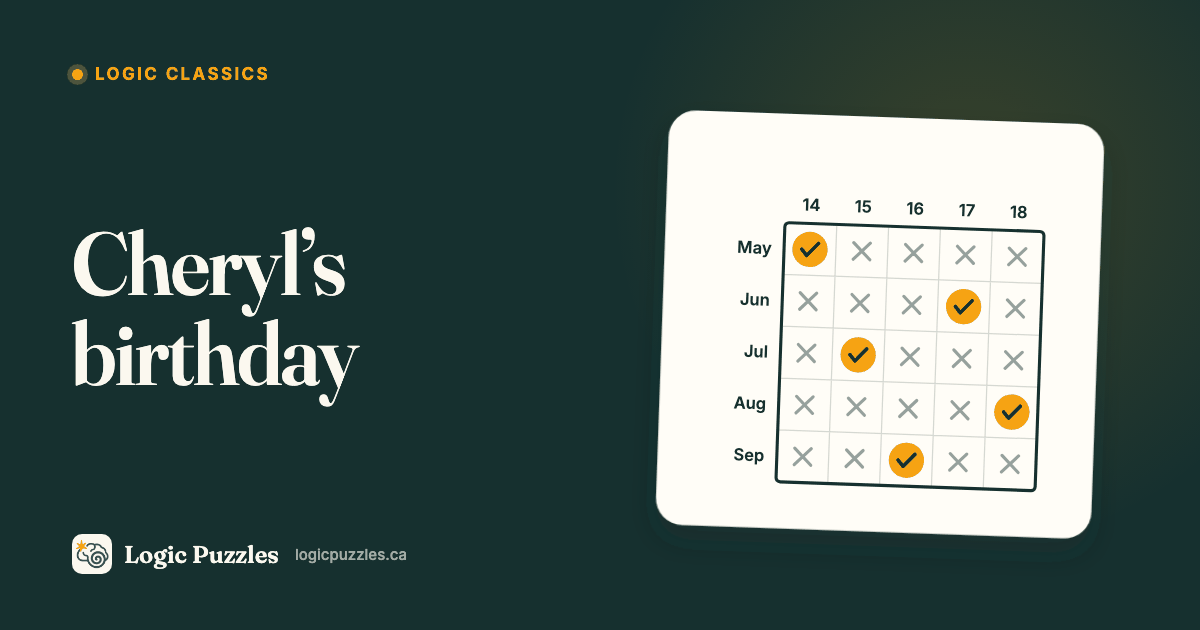
In April 2015, a Singaporean television host posted a photograph of a math-olympiad question on social media and accidentally set the internet on fire. Within days, "Cheryl's Birthday" was on the evening news, in the world's major newspapers, and in a million arguments. The problem - set for teenage competitors in the Singapore and Asian Schools Math Olympiad - contains no arithmetic at all. What it contains is something stranger: people deducing facts from each other's ignorance.
It is the most famous member of a genre worth knowing, because the genre teaches a skill no ordinary grid can: reasoning about what other minds know.
The puzzle
Cheryl gives her friends Albert and Bernard a list of ten possible dates for her birthday:
May 15, May 16, May 19, June 17, June 18, July 14, July 16, August 14, August 15, August 17.
She then tells Albert only the month, and Bernard only the day. The following exchange happens, in public:
- Albert: "I don't know when Cheryl's birthday is - but I know Bernard doesn't know either."
- Bernard: "At first I didn't know, but now I do."
- Albert: "Then now I know too."
When is Cheryl's birthday?
Ignorance as information
The genius of the puzzle is that every statement of not-knowing eliminates dates, just as surely as a Sudoku clue eliminates digits.
Albert's statement. Albert knows the month. Him not knowing the date is unsurprising - every month has multiple candidates. The payload is the second half: he is certain Bernard doesn't know. Look at the days: 19 appears only once (May 19), and 18 only once (June 18). If Bernard had been told 19 or 18, he would know the birthday instantly. Albert can only be sure this hasn't happened if his month contains no uniquely-identifying day - which rules out all of May and all of June. From "I know that he doesn't know," we learn the month: July or August.
Bernard's statement. Bernard, hearing this, performs the same elimination we just did, then adds his private day. "Now I know" means his day picks out exactly one of the five surviving dates: July 14, July 16, August 14, August 15, August 17. If his day were 14, two candidates would remain and he couldn't know. So the day is 16, 15, or 17 - leaving July 16, August 15, August 17.
Albert's reply. Albert knows the month, and now he knows too. If the month were August, two candidates would still remain and he couldn't claim knowledge. So the month is July, and the answer is July 16.
Nobody stated a single fact about the date directly. Three sentences about the state of two minds, spoken aloud, collapsed ten possibilities to one. That collapse has a name in logic: the puzzle is an exercise in epistemic reasoning - logic whose atoms are not "X is true" but "A knows X," "A knows that B doesn't know X," and on up the tower.
The genre's older monuments
Cheryl has distinguished ancestors. In 1969, the mathematician Hans Freudenthal posed what is now called the Impossible Puzzle: two mathematicians are told, respectively, the sum and the product of two hidden numbers, and through a short dialogue of "I don't know" and "I knew you didn't know," both come to know the numbers. Solvers need a spreadsheet and a free evening; the mechanism is exactly Cheryl's.
Older and deeper still is the muddy children puzzle, a staple of logic courses (its islander variant, involving blue eyes, has circulated for decades). A group of children can each see mud on the others' foreheads but not their own. An adult announces, "at least one of you is muddy" - apparently telling everyone something they can already see - and yet, after several rounds of "do you know if you're muddy?" silence, the muddy children all suddenly know. The announcement's real cargo was not the fact but its common knowledge: everyone now knows that everyone knows that everyone knows it, all the way up. That upgrade, invisible as it seems, is what starts the clock ticking; each round of public silence then transmits one rung of inference, exactly as Albert's public statement handed Bernard an elimination.
The moral shared by the whole genre: in a group, what is known matters less than what is known to be known. A fact everyone holds privately is inert. The same fact made public becomes a gear.
Why computer scientists take this personally
This looks like parlor logic, but it runs infrastructure. Distributed systems - databases replicated across servers, blockchains, fleets of satellites - are teams of agents that must act on beliefs about each other's beliefs. The field's founding parable, the Two Generals Problem, proves that two armies communicating over an unreliable channel can never achieve the common knowledge needed to guarantee a coordinated attack: every "did you get my last message?" needs its own confirmation, forever. It is a muddy-children puzzle with no adult, and its impossibility shapes how real protocols settle for weaker guarantees.
Game theorists, likewise, model auctions and negotiations on towers of "she knows that I know that she knows." The economist Robert Aumann won a Nobel Prize in part for a theorem about when rational agents can and cannot agree to disagree - a result that is, at heart, Cheryl's birthday with money on the table.
Training the third eye
Ordinary logic puzzles train you to ask, what follows from these facts? Epistemic puzzles add a second question that feels almost social: what would this person have said if the world were otherwise? Bernard's day being 14 is never asserted and never denied - it dies because, had it been true, his sentence would have been impossible.
That move - eliminating worlds by testing them against observed behavior - is counterfactual reasoning, and it transfers everywhere people exchange partial information: diagnosing why a colleague's question implies what they haven't read, bidding in a negotiation, or simply decoding "well, I heard she didn't say no." Logic grid puzzles flex the same muscle in miniature every time a clue tells you what someone is not.
The internet, in 2015, mostly argued about whether the answer was July 16 or August 17. The better souvenir is the method: silence, hesitation, and "I don't know" are data. In a well-posed world, even ignorance leaks the truth.