Open a book printed in 1586 and, on the title page, you will find a strange little drawing: a loop of beads draped over a triangle, like a necklace hung on the corner of a tent. Underneath it runs a motto in old Dutch: Wonder en is gheen wonder. "A wonder is no wonder."
The author was Simon Stevin, an engineer and mathematician born in Bruges around 1548. He was a practical man who worked on windmills and sluices for draining the Low Countries and, in a short pamphlet a year earlier, argued that everyone should be using decimal fractions. The necklace was his proof of how weights balance on a slope. The motto was his philosophy. Things that look like magic stop being magic once you see the simple rule underneath.
That same year Stevin published a second book, on the weight of water. In it he described something that still surprises people today. We think it is also the best way into one of our favourite puzzles, Aquarium.
The paradox in the bucket
Take two containers with bottoms of exactly the same size. One is a plain straight-sided jar. The other is shaped like a funnel turned upside down, wide at the bottom and narrowing to a thin neck, so it holds much less water. Fill both to the same height. Which bottom feels more push from the water above it?
Most people guess the jar, because it holds more water. Stevin showed the answer is neither: the push is the same. The force of water on the floor of a container depends on the area of the floor and the depth of the water. Not the amount. Not the shape of the walls. Just the height.
This result is called the hydrostatic paradox, and it is a paradox only until you see why. Water is lazy. It always settles so that its surface is flat, and every bit of water at the same depth is pressed equally hard. The walls make up the difference. Once you know that, the funnel and the jar are no mystery at all. A wonder is no wonder.
A puzzle built on flat water
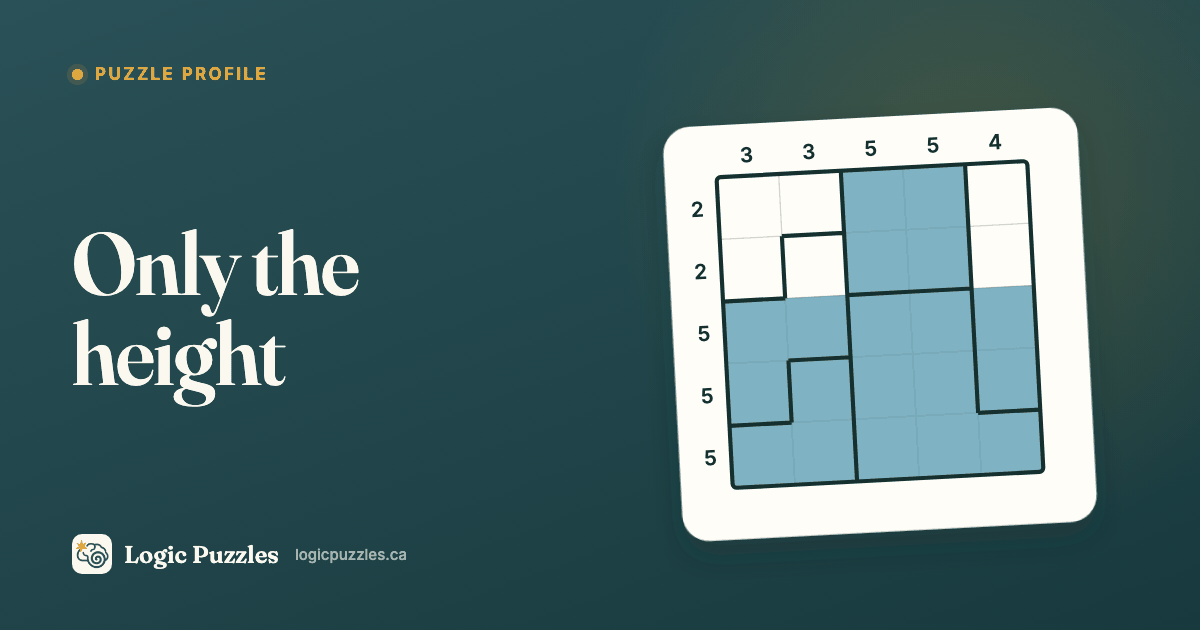
Aquarium takes Stevin's lazy water and turns it into a logic puzzle. The grid is divided into outlined compartments, the tanks, and some of them have wonderfully awkward shapes. Your job is to decide which cells hold water. The rules are short:
- Water settles. If a cell is filled, every cell below it in the same compartment must also be filled. No floating water.
- Water is flat. Within each compartment, the water forms one level surface.
- Counts on the edges. The number beside each row and above each column tells you exactly how many cells in that line contain water.
Each compartment is its own tank and follows its own level, independent of its neighbours.
That is all. But notice what the first two rules really say, because this is where Stevin comes back in. However twisted a compartment looks, its water is described by one single number: the height of the surface. Every cell of the tank at or below that height is wet. Every cell above it is dry. The shape of the walls does not matter. Only the height matters.
Why one number per tank is a gift
This changes how big the puzzle really is. A 6 by 6 grid has 36 cells, and if each cell could independently be wet or dry, there would be 2 multiplied by itself 36 times, or about 69 billion possible patterns. Hopeless.
But cells are not independent. Suppose those 36 cells were split into eight tanks, each three rows tall. Each tank can be empty, or filled to one of three heights: four choices. That gives 4 to the eighth power, or 65,536 ways to set the levels. Still a lot, but more than a million times fewer than before, and the edge numbers cut it down fast.
So the first habit of a strong Aquarium solver is a change of view. Stop asking "is this cell wet?" and start asking "how high is this tank?" You are not filling 36 boxes. You are setting a handful of dials.
The key techniques
Here are the deductions we lean on most, all of which fall straight out of flat water.
1. The slice that is too wide. Look at one row. Where a compartment crosses that row, its cells in that row sit at the same height, so they are all wet or all dry together. If a tank spans four cells of a row whose clue is 3, that slice cannot be wet. It must be dry, and because water settles, everything above it in that tank is dry too. This one idea opens a surprising number of puzzles.
2. The full row. If a row's clue equals the width of the grid, every cell in it is wet. Each tank that touches that row now has a level at least that high, so every cell of those tanks below that row is wet as well. One clue can pour water down half the board.
3. Wet means the floor is wet. The moment you know any cell of a tank holds water, the lowest cells of that tank must hold water too. Tanks with uneven floors are worth a close look: a single wet cell high up can force water into a deep pocket on the other side.
4. The zero line. A clue of 0 dries a whole row or column, and in each tank it crosses, everything above that point dries with it.
5. Count the whole board. The row clues and column clues must add up to the same total, the amount of water in the grid. When you are stuck, adding up what each tank could still contribute often shows that one tank simply has to be fuller, or emptier, than you assumed.
Notice the rhythm. Every technique is about pushing a tank's level up or down, never about one lonely cell. When we design Aquarium boards, the satisfying moment we aim for is exactly that: a clue on the far edge nudges one dial, and the water rearranges itself across the grid.
A wonder is no wonder
Stevin's motto is a good one to keep near any puzzle. A tangled compartment looks like it needs a tangled answer. It doesn't. Strip away the shape and there is one number underneath, and the rules tell you how to find it.
The same move works well away from the grid. When a problem looks complicated, it is worth asking: what is the one quantity that actually matters here? Often the walls are just walls. Find the water level, and the rest of the picture fills itself in.