You have probably heard someone say "I just don't have the patience for that." They say it about puzzles, about cooking, about learning an instrument, about anything that requires sitting with discomfort for longer than feels natural. They say it the way you might say "I don't have blue eyes" — as a fixed fact about themselves. Something they were born with or without.
This is one of the most common and most limiting beliefs people carry. Because patience is not a trait. It is a skill. And like every other skill, it can be practiced, developed, and strengthened over time.
The misunderstanding
When we call patience a virtue, we frame it as a moral quality. Patient people are good. Impatient people need to try harder — to simply be more patient, through some act of will or character. This framing makes patience sound like a personality feature: fixed, innate, and largely outside your control.
But watch what actually happens when someone is patient. They are not sitting still through some superhuman act of self-restraint. They are doing something specific and learnable. They are tolerating incomplete information without rushing to fill the gaps. They are resisting the urge to act before they have enough data. They are maintaining focus on a process whose outcome is not yet visible.
These are skills. Specific, observable, practicable skills. And puzzles happen to be one of the best training grounds for developing them.
What puzzle solvers actually practice
When you sit down with a difficult logic puzzle, patience is not something you bring to the table. It is something the puzzle teaches you, session by session, grid by grid.
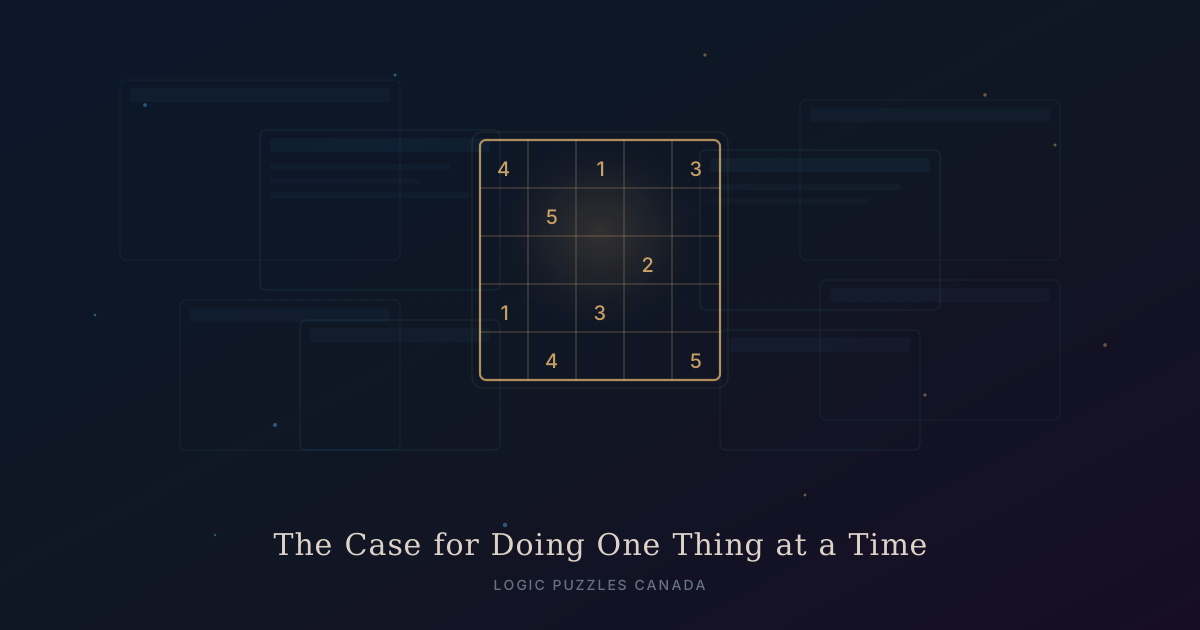
Consider what happens when you hit a wall in a Sudoku. You have scanned every row, checked every column, and nothing obvious presents itself. The grid looks stuck. The natural impulse — the impatient impulse — is to guess. Pick a number, place it, see what happens. If it leads to a contradiction, backtrack. It feels productive. It feels like doing something.
But experienced solvers resist this. Not because they are more virtuous, but because they have learned that guessing is inefficient. They have learned, through practice, that there is almost always a deduction hiding in the grid that they have not seen yet. So instead of guessing, they scan again. They check constraints they have already checked, looking from a different angle. They slow down instead of speeding up.
This is patience as a practiced skill. The solver is not suppressing an urge. They are applying a strategy that experience has proven effective. The ability to sit with the incomplete grid — to tolerate the tension of not knowing — is not an innate quality. It is something they developed by doing it hundreds of times and learning that it works.
The discomfort of not knowing
There is a specific feeling that comes with incomplete information. A restlessness. A low-grade anxiety. Your brain wants closure, and it wants it now. This is not a character flaw — it is a deeply wired cognitive tendency. Our brains evolved to resolve uncertainty quickly because, for most of human history, uncertainty meant danger.
But most of the uncertainty we face today is not dangerous. It is just uncomfortable. The uncertainty of a half-solved puzzle. The uncertainty of a project mid-stream. The uncertainty of a decision where you do not yet have all the facts. In none of these cases will rushing to resolution produce a better outcome. In most of them, it will produce a worse one.
Patience, in this context, is the ability to tolerate that discomfort without letting it drive your behavior. To feel the pull toward premature action and choose to wait — not because waiting feels good, but because you have learned that waiting produces better results.
How the skill develops
I have watched this development happen in puzzle solvers, and I have felt it happen in myself. It follows a predictable arc.
Early on, you guess frequently. You place a number because it feels right, not because you have proven it. Sometimes you are right. Sometimes you hit a contradiction twenty moves later and have to undo everything. The cost of impatience is tangible and immediate: wasted time, a messy grid, the frustrating feeling of having to start over.
Gradually, you start to recognize the feeling that precedes a guess. That restless urge to just put something down. And you learn to pause at that moment — to treat the urge as a signal, not as a command. The signal says: I do not have enough information yet. The patient response is to go looking for more.
Over time, this pause becomes natural. Not effortless — there is always some tension in sitting with an unsolved grid — but familiar. Comfortable, even. You develop a tolerance for not-knowing that would have felt impossible when you started. The grid that once made you anxious now makes you curious. The gaps are not threats. They are invitations to look more carefully.
The transfer effect
Here is what makes this interesting beyond puzzles. The patience you develop at the grid does not stay at the grid. It leaks into everything else.
People who practice patience in puzzles report — and I have experienced this myself — that they become more comfortable with uncertainty in general. More willing to let a difficult conversation develop without rushing to resolve it. More able to sit with a complex decision without forcing a premature conclusion. More tolerant of the messy, incomplete middle stage of any project.
This is not magic. It is skill transfer. When you practice tolerating incomplete information in a controlled, low-stakes environment, you build neural pathways that generalize. The puzzle grid is a safe place to learn that not-knowing is survivable, that patience produces better outcomes, and that the urge to rush is a feeling, not a fact.
Patience is not passive
One of the reasons patience gets misunderstood is that it looks passive from the outside. A patient person appears to be doing nothing — just sitting, just waiting. But anyone who has been patient through a difficult puzzle or a long project knows that patience is intensely active.
When you are being patient with a puzzle, you are scanning, evaluating, holding multiple possibilities in your working memory, testing constraints, and systematically narrowing the field. You are working hard. You are just working without the visible output that impatience demands.
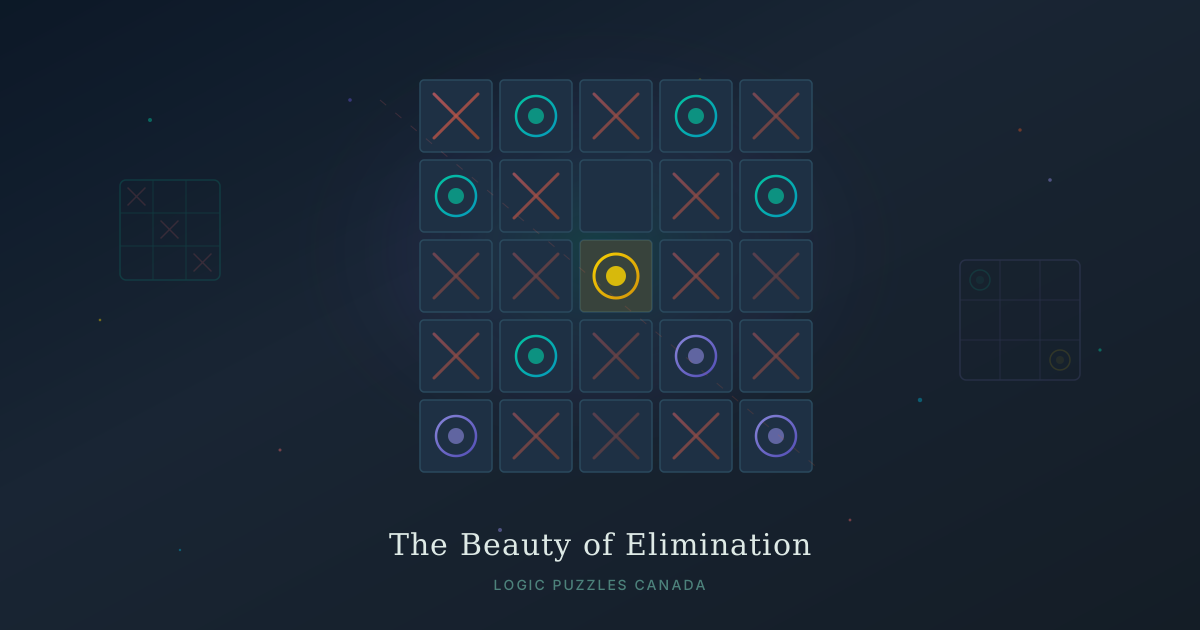
The impatient solver places a number. The patient solver eliminates three possibilities. The impatient solver makes visible progress. The patient solver makes invisible progress that is, almost always, more valuable.
This is true outside of puzzles too. The patient listener in a meeting is not zoning out — they are processing, waiting for the moment when their contribution will be most useful. The patient writer is not avoiding work — they are letting ideas develop until they are ready to be written. Patience is not the absence of effort. It is effort directed inward, where it cannot be seen but where it often matters most.
Building the skill deliberately
If patience is a skill, it can be trained deliberately. And puzzles offer one of the cleanest training protocols available.
Start with a puzzle at the edge of your comfort level. Not so easy that patience is unnecessary, and not so hard that frustration overwhelms the learning. When you feel the urge to guess, notice it. Do not fight it. Just notice it, and then make a deliberate choice to scan one more time before acting.
Over weeks and months, this practice accumulates. The window between impulse and action grows wider. The tolerance for not-knowing deepens. The skill of patience — the actual, mechanical, practicable skill — gets stronger.
And the beautiful thing about practicing patience through puzzles is that the feedback is immediate and unambiguous. When patience leads you to a correct deduction instead of a wrong guess, you feel it. The grid confirms it. The reward is built into the process. Every time patience works, the skill reinforces itself.
The permission to be impatient
There is one more thing worth saying. Treating patience as a skill rather than a virtue removes the moral judgment from impatience. When you are impatient, you are not being a bad person. You are simply using a skill that has not been developed enough for the current challenge. That is a solvable problem. It does not require self-criticism. It requires practice.
The next time you feel impatient — with a puzzle, with a person, with a process — try reframing it. Not "I need to be more patient" as if patience is something you summon from your character. Instead: "I have not practiced enough patience for this situation yet." The difference sounds small. It changes everything. One framing makes you feel inadequate. The other makes you feel like you are on a path.
You are. Every grid you solve without guessing, every time you sit with the discomfort of an incomplete answer and choose to keep looking instead of rushing — you are practicing. And the skill is building, whether you feel it or not.