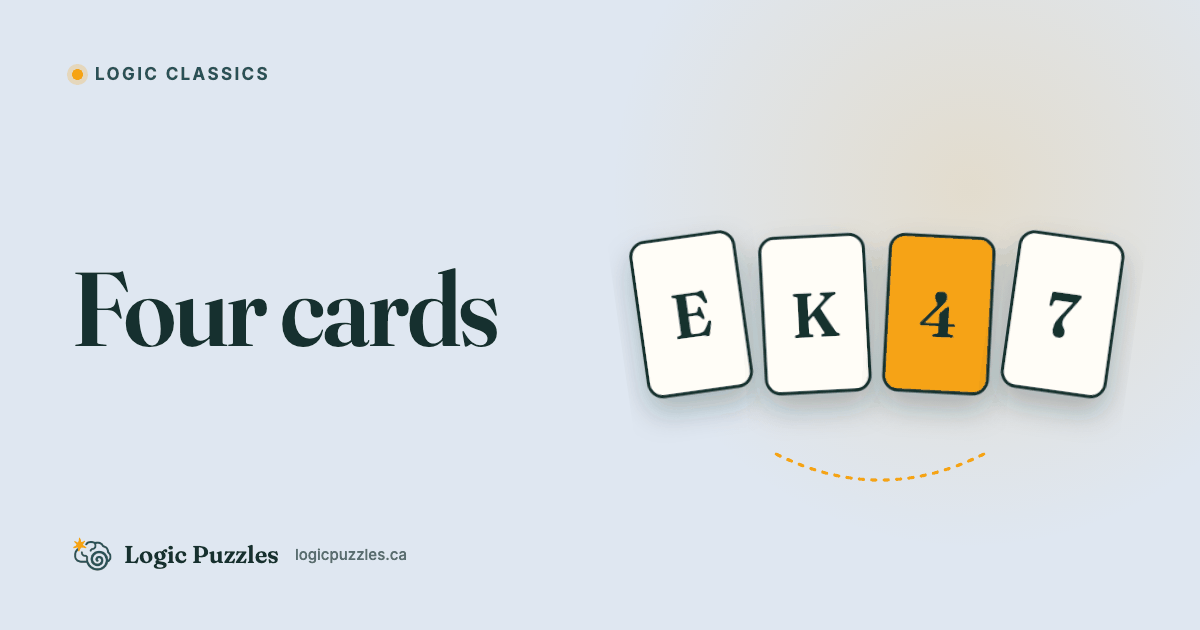
Here is the most famous problem in the psychology of reasoning. Four cards lie on a table. Each has a letter on one side and a number on the other. You can see:
A - K - 4 - 7
Claim to test: "If a card has a vowel on one side, then it has an even number on the other." Which cards must you flip to find out whether the claim is true?
Decide before reading on. Really - commit to an answer.
When the psychologist Peter Wason began running this task in the 1960s, the results were an embarrassment to our species' self-image: typically fewer than one in ten people answer correctly, and the errors are not random noise but a consistent, confident, wrong pattern. Most people say "A and 4." Nearly everyone says A. Nearly everyone spares the 7.
The correct answer is A and 7.
Why the 4 is a trap and the 7 is the point
The A is obvious: a vowel showing, so the rule stakes its life on the number behind it.
The 4 feels relevant - the rule mentions even numbers - but flip it and consider the outcomes. A vowel behind it? Consistent with the rule. A consonant? Also fine: the rule says vowels bring even numbers, not that even numbers bring vowels. No possible result of flipping the 4 can hurt the claim, which means, as evidence, it is worthless. We flip it because it could agree with the rule, and agreement feels like progress.
The 7 is where the rule can die. If a vowel hides behind that odd number, the claim is false - and no other card except A can catch it. The K is padding either way.
The pattern in our failure has a name: confirmation bias. We instinctively test claims by looking where they'd be confirmed, not where they'd be refuted - even though only refutation-hunting actually tests anything. Wason had demonstrated the same reflex in his earlier "2-4-6" experiment: told that the triple 2-4-6 obeys a hidden rule, people propose 8-10-12, 20-22-24 - endless examples fitting their pet theory ("counting up by twos"), almost never a triple designed to break it. The real rule was merely "any increasing numbers," and confident subjects announced wrong theories after long parades of yes answers. You cannot learn the shape of a rule from inside its yeses.
The costume change
Now the twist that launched a thousand papers. In 1982, Richard Griggs and James Cox re-ran Wason's task with one change of costume. Four patrons; the rule: "If a person is drinking beer, they must be over nineteen." The cards: drinking beer - drinking cola - 22 years old - 16 years old.
Whom do you check? Everyone knows instantly: the beer drinker and the sixteen-year-old. Nobody cards the 22-year-old to confirm the law. In this version, around three-quarters of people answer perfectly - the same logical structure that defeated ninety percent of us in letters and numbers.
Why the transformation? The evolutionary psychologists Leda Cosmides and John Tooby argued we carry specialized machinery for detecting cheaters in social contracts - the underage drinker is a violator, and violator-detection is old, fast, and reliable in a way abstract logic is not. Others credit familiarity, or the difference between descriptive rules and rules of obligation. The debate continues; the data point stands either way, and it is worth engraving: human logic is not content-free. The same inference, dressed differently, can be trivial or nearly impossible.
What this means for people who like grids
Logic puzzles are sometimes dismissed with a version of the transfer critique: abstract reasoning doesn't generalize, so why drill it? The Wason literature suggests a more interesting reading of what solvers are doing.
A logic puzzle is a machine for making refutation feel natural. Consider what experienced solvers actually do all day: elimination. "Could a 5 live here? Then the row dies. Gone." That is falsification - flipping the 7 - performed dozens of times per grid, rewarded instantly every time. Sudoku barely traffics in confirmation at all; a candidate is never proven by looking right, only by every alternative dying. Binary-logic puzzles state it outright: the way to place a 1 is to show a 0 breaks the world.
The puzzle habit, in other words, trains the exact move the four cards show us we skip. Whether that fully transfers to arguments and news feeds is a question we've treated honestly before - far transfer is never free. But the Wason results locate the failure precisely, and it is not in our logical machinery, which handles beer drinkers flawlessly. It is in our test-selection instinct: which evidence we reach for. That instinct is exactly the thing deliberate practice can retrain - ask any scientist, whose entire profession is a prosthetic for this bias. Karl Popper built a philosophy of science on the asymmetry the cards exploit: a thousand confirmations never prove a rule; one clean counterexample settles it.
Carrying the 7 with you
Some portable habits, cheap to adopt:
When you believe something on a grid, attack it. Before committing a big placement, spend ten seconds trying to kill it. The attempt is free; the habit is the product.
In arguments and plans, ask the beer-drinker question: what observation would show this is wrong, and have I looked there? A plan whose failure modes nobody has visited is an A-and-4 plan.
Re-costume hard abstractions. Struggling with a formal statement? Recast it as rule-and-violator - who would be cheating here? - and watch your ancient machinery come online. The trick works in both directions; it is why good teachers reach for concrete stories, and why we build puzzles out of tents and campsites rather than quantifiers.
Wason's four cards have been on the table for sixty years now. They are not going anywhere, and neither is the reflex they expose. But the 7 is always sitting there, quiet and unglamorous, holding the only answer that matters - and every evening spent eliminating candidates from a grid is a small rehearsal in reaching for it first.