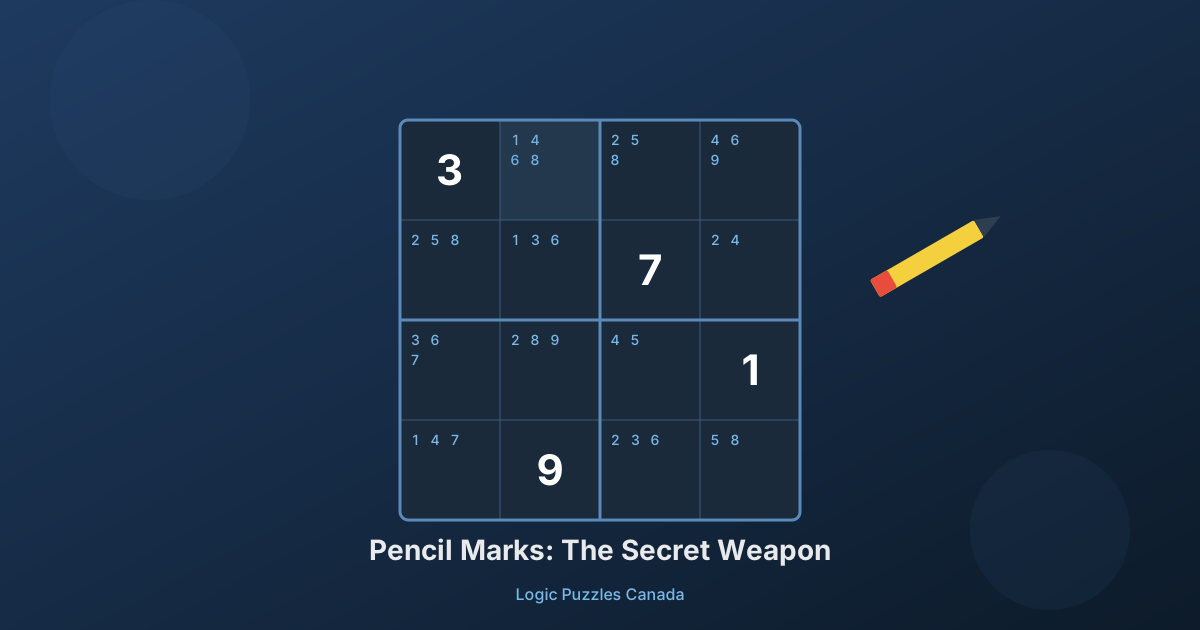
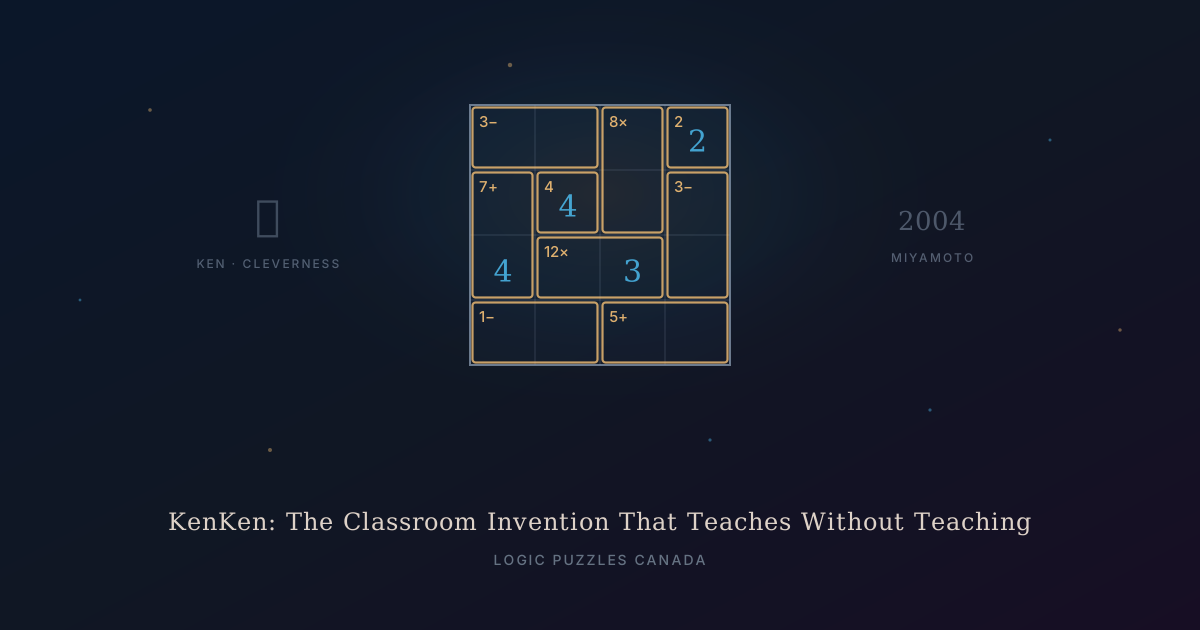
Nobody needs to solve a Sudoku. There is no boss waiting for the result. No client depending on the output. No deadline, no paycheck, no practical consequence of any kind. The puzzle exists, you solve it, and the world is exactly the same as it was before — except that a grid on your screen is full of numbers that were not there twenty minutes ago.
And yet millions of people do this every day. Not occasionally. Daily. Routinely. With the kind of quiet dedication usually reserved for things that matter.
What is going on?
The open loop
There is a concept in psychology called the Zeigarnik effect. It describes the tendency of the human mind to fixate on incomplete tasks. An unfinished task occupies mental space. It nags. It lingers. The mind keeps returning to it, not because the task is important, but because it is open.
A puzzle is an open loop, deliberately constructed. When you see a partially filled grid, your brain registers it as unfinished business. The empty cells are not neutral. They are invitations — or, more accurately, demands. Your mind wants to close the loop. It wants to fill in what is missing, to resolve the incompleteness, to make the thing whole.
This is not a choice. It is closer to a reflex. The same mental mechanism that reminds you of an unsent email or an unresolved argument is the one that makes you stare at a half-finished Nonogram thinking "I can figure this out."
You do not solve the puzzle because you need to. You solve it because your brain cannot comfortably leave it unsolved.
The compulsion to order
Humans are pattern-seeking creatures. This is not a metaphor. It is a deeply embedded feature of how our brains process the world. We see faces in clouds, rhythms in random noise, constellations in scattered stars. The drive to find order in disorder is so fundamental that it operates beneath conscious thought.
A logic puzzle is disorder waiting to be organized. The empty cells are chaos. The constraints are the rules of the universe you have been dropped into. And the act of solving is the act of imposing order — not by force, but by understanding. You do not arrange the grid however you want. You discover the single arrangement that the rules demand.
This is deeply satisfying to a brain built for pattern recognition. Every number you place is a piece of the world clicking into position. Every constraint you satisfy is evidence that the system is coherent, that the rules work, that order is possible.
In a world that often feels chaotic and unpredictable, that small demonstration of order carries more psychological weight than its trivial context would suggest.
The uselessness is the point
Here is the counterintuitive part: the fact that puzzles are useless is not a flaw. It is the source of their power.
When you work on something useful — a task at your job, a chore at home, a problem with real stakes — your brain operates in a particular mode. It tracks consequences. It monitors for risk. It calculates whether the effort is worth the outcome. There is always an accounting running in the background: is this a good use of my time?
Puzzles bypass that accounting entirely. There is no ROI on a Sudoku. No one will ever evaluate whether your time spent solving was justified. The activity is so thoroughly without practical purpose that your brain has no framework for optimizing it. And so, for once, it just... thinks. Without calculating. Without hedging. Without the background noise of "is this worth it?"
That pure, unoptimized thinking is rarer than you realize. Most of our mental activity is instrumental — aimed at producing some outcome. Puzzles create a space where thinking is its own reward. Where the process is not a means to an end but the end itself.
Why we cannot stop
If you have ever told yourself "just one more puzzle" and then solved three, you have experienced something that game designers call a compulsion loop. But in logic puzzles, the loop is not driven by variable rewards or dopamine hits from random outcomes. It is driven by something more fundamental: the satisfaction of resolution.
Each completed puzzle is a resolved loop. The tension of the open grid gives way to the relief of the filled one. Your brain registers this as deeply satisfying. And then it looks for the next open loop to close. Not because it was manipulated into doing so, but because that is what brains do. They seek incompleteness and resolve it.
This is why puzzle solving feels different from scrolling social media or watching another episode. Those activities also create compulsion loops, but they do so through novelty and intermittent reward. Puzzles create the loop through the basic human need to complete things. The difference matters. One leaves you feeling drained. The other leaves you feeling settled.
The social puzzle
There is another dimension to this. Puzzle solving, despite being a solitary activity, connects to something deeply social. When you solve a puzzle, you are participating in a shared human behavior that crosses every culture and every era. People have been solving logic puzzles, in various forms, for centuries. The specific grid may be new, but the impulse is ancient.
There is something grounding about that. You are doing the same thing, in essence, that people did with riddles around campfires, with mathematical recreations in ancient Greece, with chess problems in medieval Persia. The human mind has always sought out problems to solve, not because it needs to, but because solving is what it does.
When you open a puzzle app on your phone, you are answering a call that is older than writing. The format is modern. The compulsion is timeless.
The answer nobody asked for
Think about what happens when you finish a puzzle. You have a completed grid. A solution. An answer. But nobody asked the question. There was no problem to solve, no stakeholder waiting, no inbox where the answer needed to be delivered. The answer exists for no one. It was generated purely by your own mind, for your own satisfaction, and it will be forgotten the moment you start the next puzzle.
This should feel pointless. Instead, it feels strangely fulfilling.
The reason, I think, is that the value of solving is not in the solution. It is in the solving. The completed grid is just evidence that something happened — that your mind engaged, reasoned, deduced, and arrived. The real product is the twenty minutes of focused thought that preceded it. The grid is just the receipt.
Solving as a form of being
There is a version of this essay that tries to justify puzzle solving. That lists the cognitive benefits, the improved pattern recognition, the better decision-making. Those benefits are real, and I believe in them.
But I do not think that is why people solve puzzles. People solve puzzles because solving feels right. Because the mind, when given an interesting problem and enough time, does not need a reason to engage. It just does. The way your eyes follow motion. The way your ears parse language. The way your hand reaches out to straighten a crooked picture frame.
You solve because you are a solver. Not because someone asked you to. Not because the answer matters. Not because there is a reward at the end. But because an unsolved puzzle is an open question, and your mind — your beautiful, restless, order-seeking mind — cannot help but answer it.
That is not a weakness or a waste. It is one of the best things about being human.