Picture four undergraduates at Trinity College, Cambridge, in the late 1930s, hunched over sheets of squared paper. Their names were Leonard Brooks, Cedric Smith, Arthur Stone and Bill Tutte, and they were chasing a question that sounds like something you'd doodle in the margin of a maths lesson: can you cut a square into smaller squares so that no two of them are the same size?
With repeats allowed, it's easy: draw a grid and you're done. The challenge is to make every piece different, with no gaps and no overlaps, and that turns out to be fiendishly hard. Some people suspected it couldn't be done at all. The four students not only found ways to do it, they found a way of thinking about it that nobody expected: they turned the tiling into an electric circuit. This essay is about that idea, and about the puzzle on our site that lives in the same world of areas and edges, Rectangles.
Squares that refuse to repeat
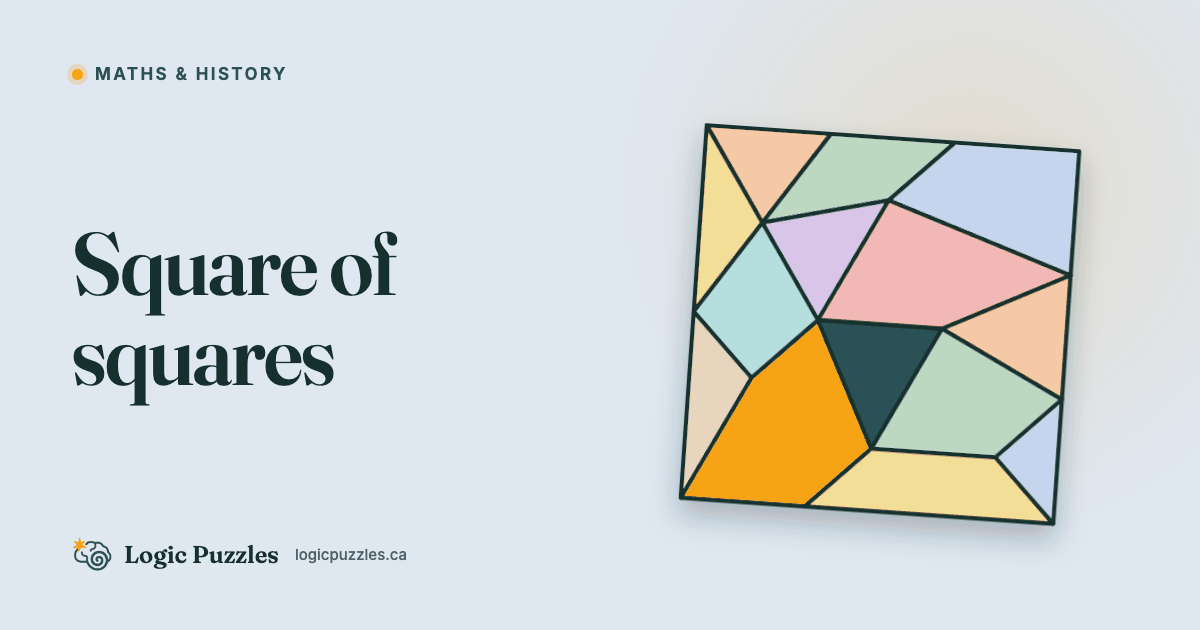
A square cut into unequal squares is called a perfect squared square. For a long time the best anyone could manage was a near miss: a rectangle cut into unequal squares, which is easier, or a square where a couple of sizes repeated.
The first perfect squared square was published in 1939 by the German mathematician Roland Sprague. It used 55 squares, and he built it by fitting together pieces of rectangles that had already been squared. The Cambridge four published their own big paper, "The Dissection of Rectangles into Squares," in 1940, and it gave the field its foundations.
The hunt for the smallest example went on for decades. In 1978 A. J. W. Duijvestijn, working with a computer, found a perfect squared square made of just 21 squares, with an outer side of 112 units. It has since been shown that no perfect squared square uses fewer pieces, and that this one is the only arrangement with 21. Nearly forty years of searching, and the answer fits on a postcard.
Turning tiles into a circuit
Here's the trick at the heart of the Cambridge students' work. Take a rectangle that has been cut into squares. Now look at every horizontal line in the picture: the top edge, the bottom edge, and every shelf where one square sits on another. Treat each of those lines as a junction in a circuit. Treat each square as a wire running from the line along its top to the line along its bottom.
Then let the width of each square be the electric current in its wire, and let its height be the voltage drop across it. In a square, width and height are equal, so every wire behaves like a resistor of the same strength.
The magic is that the rules of tiling and the rules of electricity line up perfectly. Along any shelf, the widths of the squares resting on it must add up to the widths of the squares beneath it, or the picture would have gaps. In a circuit, the current coming into a junction must equal the current going out. That's Kirchhoff's current law, worked out by Gustav Kirchhoff in the 1840s. Squares become resistors, horizontal lines become junctions, and a hard geometry problem becomes a circuit you can analyze with tools that engineers already had.
Bill Tutte went on to a remarkable career. During the Second World War he worked at Bletchley Park, where he deduced the structure of a German cipher machine without ever seeing one, and he later became one of the great figures of graph theory, the mathematics of dots and the lines between them.
Rectangles: where every number is an area
Our game Rectangles asks a gentler question with the same flavor. The grid is scattered with numbers, and your job is to split the whole grid into rectangles (squares count too) so that:
- Every cell belongs to exactly one rectangle, and rectangles never overlap.
- Each rectangle holds exactly one number.
- That number is the rectangle's area. A 6 covers six cells, as a 2x3, a 3x2 or a straight line of six.
Notice what the Cambridge four would notice: the whole puzzle is about how areas add up. The numbers on the board must total the number of cells, every edge you draw is shared by two rectangles, and every number is really a little question about factors. Which pairs of whole numbers multiply to make it? A 12 could be 1x12, 2x6, 3x4 or their sideways twins. A 7 has only one factor pair, 1x7, so it can only ever be a straight line.
Four moves for cutting the grid
1. Start with the shapes that fit one way. A 1 is a single cell, done. A number pinned in a corner, or a big number boxed in by its neighbors, may have only one possible rectangle. And the primes like 5, 7 and 11 can only be straight lines, which on a small board often leaves just one direction they can run.
2. Find the cell only one number can reach. Every cell has to belong to someone. If only one number on the board could stretch a rectangle over an empty cell, that number's rectangle must cover it. This is the circuit idea in miniature: nothing can be left unaccounted for.
3. Look for the overlap. Sometimes a number has three or four possible rectangles and you can't pick one yet. But if every one of those options covers the same cell, that cell is taken no matter what. Mark it as belonging to that number, and other numbers can stop reaching for it.
4. Test an option and watch it fail. When the easy moves run dry, pick a number with only two choices and imagine drawing one of them. If that leaves another number with no room, or cuts off a cell that nobody can reach, the option is wrong and the other one is right. A failed test isn't wasted time. It's a proof.
Thinking in pieces that fit
The quiet lesson of squaring the square is that a problem can look impossible in one language and easy in another. Four students stared at tiles until they saw wires, and the wires obeyed laws that were already understood. The shape of the problem never changed. Only their way of describing it did.
Rectangles invites the same habit on a smaller scale. A 12 isn't just a number, it's a short list of shapes. A blank cell isn't just empty, it's a debt someone has to pay. And when a plan in everyday life feels stuck, from a packed weekend to a cramped bookshelf, ask the Cambridge question: what would this look like described differently? Sometimes the answer is already sitting in an old textbook, waiting for someone to notice that the pieces fit.