Picture a quiet room in the Netherlands in the 1940s. A psychologist sets up a chess position from a real game, lets a visitor look at it for a few seconds, then covers the board. Now put the pieces back. A beginner manages a handful. A club player does better. And the strongest players in the room rebuild the position almost perfectly, piece by piece, as if they had taken a photograph.
The psychologist was Adriaan de Groot, a strong player himself, and the experiment became part of his 1946 doctoral thesis on how chess players think. What he found has shaped the science of expertise ever since. It also happens to be the best explanation we know of why some people glance at a Crowns grid and see the answer starting to form, while others see a muddle of colored cells.
The masters weren't calculating more
We tend to picture a chess master as a human calculator. De Groot asked players to think out loud while choosing a move, and the transcripts told a different story. The strongest players did not search much more than good amateurs did. They looked at a similar number of options, about as deeply.
The difference was which options they looked at. The masters' first ideas were usually the good ones. They were not out-thinking the position so much as out-seeing it. Before any calculation began, their eyes had already sorted the board into what mattered and what didn't.
So was this a gift, or something the masters had built?
The scrambled board
In 1973, William Chase and Herbert Simon at Carnegie Mellon University repeated the memory test with a twist. Some of the positions came from real games. Others were the same pieces scattered at random, the kind of arrangement that would never arise in actual play.
On the real positions, the master crushed the weaker players, just as de Groot had seen. On the random boards, the master's advantage almost disappeared. Later studies found a small edge survives, but nothing like the gap on real positions. The master's memory wasn't better in general. It was better at remembering chess.
Chase and Simon also watched how players put the pieces back. The masters didn't place them one at a time. They placed them in bursts: a castled king with its pawn shield, a pair of rooks on an open file, a familiar cluster of three or four pieces at once. Then a pause, then another burst. Each burst was a single chunk, one meaningful pattern stored as one thing. Simon estimated that a master carries tens of thousands of these patterns, built up over years of play.
Seven slots, used wisely
Why do chunks matter so much? Because our working memory is tiny. In 1956 the psychologist George Miller published a famous paper, "The Magical Number Seven, Plus or Minus Two", arguing that we can juggle only a small number of items at once. Later research suggests the true number is even smaller. But Miller's key insight was that an item can be almost anything. A random string of letters fills your memory fast. The same letters grouped into familiar words take up far less room.
That's the trick experts use without noticing. A beginner looking at a chess board holds twenty-odd separate pieces and runs out of room. A master holds five or six chunks, each one already packed with meaning, and has space left over to think. Expertise is mostly better packing.
A starter set of Crowns chunks
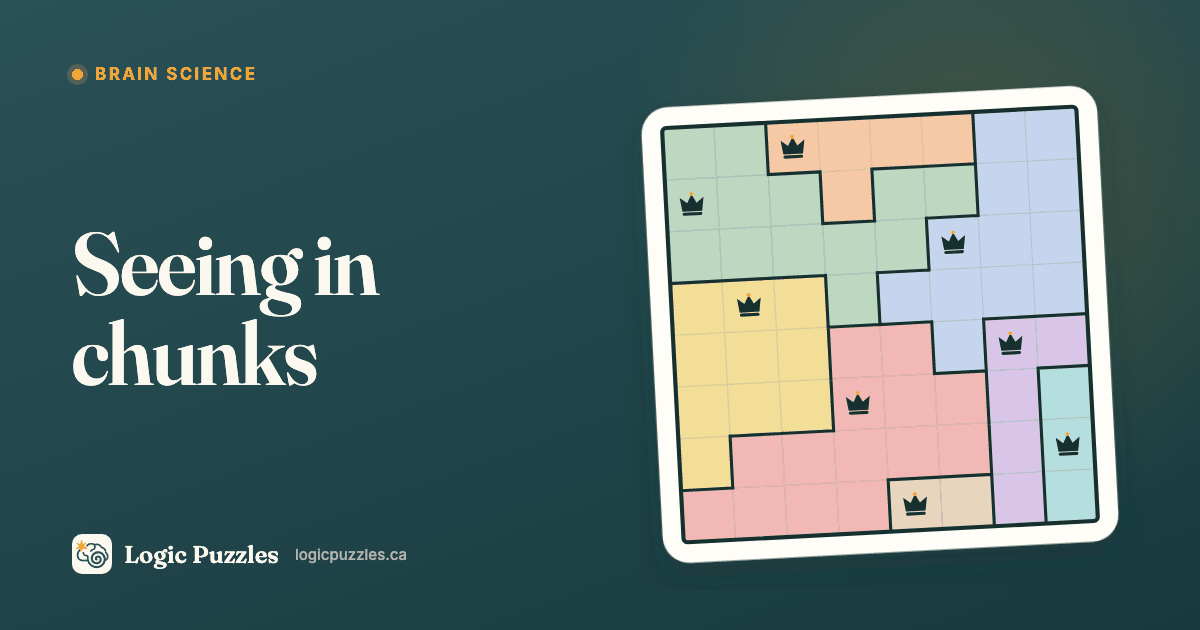
Here's the good news for solvers: Crowns is full of shapes that behave the same way every time you meet them. Recall the rules. One crown in every row, every column and every color region, and crowns can never touch, not even diagonally. That no-touching rule means each region shape casts a predictable "shadow", a set of cells its crown will rule out wherever it lands. Learn the shapes and you stop working them out from scratch.
The domino. A region of two cells side by side. Whichever cell gets the crown, it will touch the two cells directly above the pair and the two directly below. Four crosses, instantly.
The bar of three. Three cells in a straight line. The cells beside the middle cell, one on each side of the bar, touch all three, so they're out. And since the whole region sits in one row (or column), that line's crown belongs to this region, so every other cell in the line is out too.
The L. Three cells that form an L fit inside a two-by-two square, with one corner missing. That missing corner touches all three cells of the L, so it can never hold a crown, no matter which cell wins.
The two-by-two rule. Any two-by-two square, anywhere on the board, can hold at most one crown, because all four of its cells touch each other. It's a lens you can lay over any part of the grid, and it pairs beautifully with counting: two rows must hold exactly two crowns, and every two-by-two block along them can hold only one.
None of these are new rules. Each is just a consequence of the rules you already know. The point is to stop deriving them and start recognizing them, the way a reader stops sounding out letters and simply sees words.
How to grow your library
Chunks come from practice, and a few habits help them form faster.
Name what you see. When a deduction works, give the shape a name, even a silly one. A named pattern is easier to spot next time than a vague feeling.
Replay the key move. After you finish a grid, look back for the one deduction that broke it open. Ask what shape made it possible. That small review is where a one-off trick becomes a pattern you own.
Play smaller boards often. Small grids show the same shapes again and again with less noise around them. That repetition is how chunks get built.
The photograph that isn't one
The masters in de Groot's room weren't taking photographs. They were reading. Where a beginner saw two dozen separate pieces, they saw a handful of familiar ideas, and that left room for actual thought.
The same shift happens far beyond chess and grids. An experienced cook sees "a sauce about to split", not a pan of liquid. A seasoned driver sees "a car about to change lanes" before it moves. None of them are smarter than they were as beginners. They have simply learned what goes together. And every Crowns grid you solve is quietly adding a few more pages to that library, until one morning the L-shaped region in the corner just looks like a cross in the empty cell beside it.