The hidden-mine number game never asked to be taken seriously. By the early 1990s a version of it came installed by default on hundreds of millions of office computers, a three-minute escape hatch disguised as software. For a generation, "computer game" meant this: a gray grid, a row of tiny numbers, and the small heartbreak of a misclick.
Then, in 2000, a mathematician at the University of Birmingham named Richard Kaye looked closely at the office time-waster and found something extraordinary inside it. The mine-counting game, he proved, is NP-complete. The card game on the next desktop never got a theorem. This one connects directly to the most famous unsolved problem in computer science - a problem whose resolution carries a one-million-dollar prize.
What the numbers really are
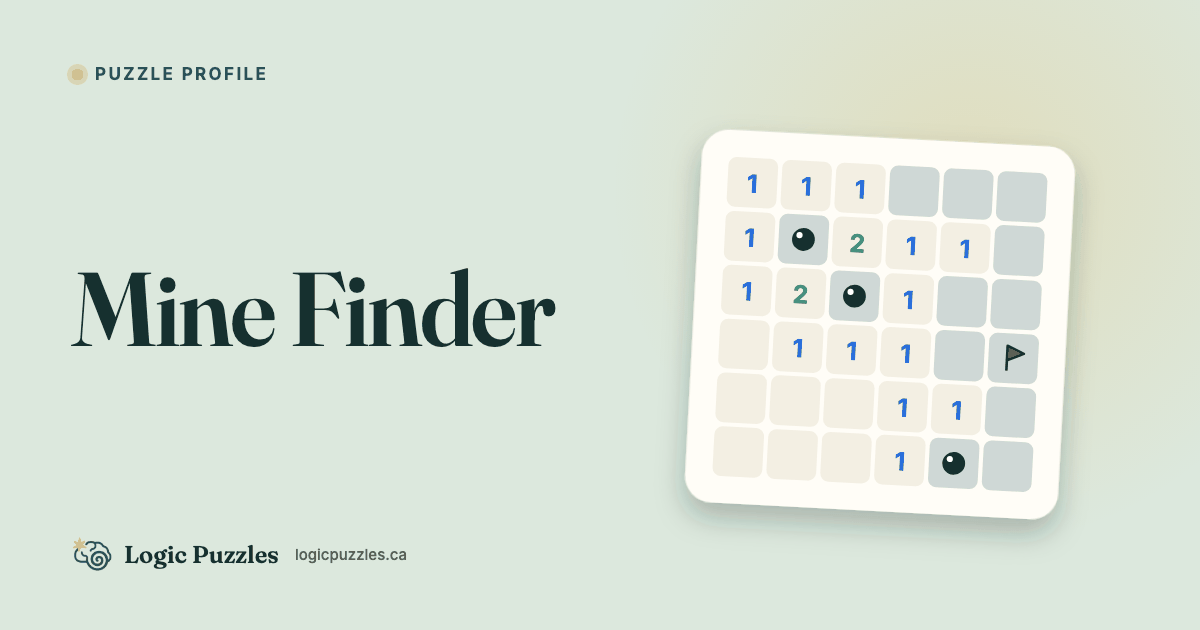
Strip the game to its logic. Every revealed number is a constraint: this cell touches exactly three mines among its eight neighbors. Play well and you are not clicking squares - you are solving a system of simultaneous statements. A "1" whose neighborhood has only one unopened cell is an equation with one unknown. Two overlapping numbers form the classic subtraction pattern: if a "1" and a "2" share most of their territory, the difference between them often pins a mine precisely, the same way subtracting two equations cancels their common terms.
This is why the mine-counting game belongs in the logic-puzzle family despite its arcade reputation. The deductions are Sudoku's deductions - elimination, forced placement, the arithmetic of overlapping regions - running under time pressure and mild dread.
Kaye's beautiful trick
Kaye's question was the theorist's version of the player's: given a board state, is it even consistent - is there some arrangement of mines agreeing with all the visible numbers? His proof that this question is NP-complete used a move that sounds like science fiction: he showed that you can build computers out of minefields.
Within a large enough grid, Kaye constructed configurations of revealed numbers that behave like wires - patterns that can be consistent in exactly two ways, "current" or "no current" - and then junctions that behave like AND, OR, and NOT gates acting on those wires. Chain enough of them together and any circuit of Boolean logic can be laid out as a mine-counting position, such that the position is consistent precisely when the circuit can output true. Deciding whether a board is consistent is therefore at least as hard as the granddaddy of hard problems, Boolean satisfiability. A grid of numbers that came free with your office computer is, in the formal sense, a general-purpose computer frozen in place.
The million dollars
NP-complete problems share a strange, taut property. Any proposed solution can be checked quickly - show me the mine layout and I verify it against the numbers in moments. But finding a solution seems, for all known methods, to require search that explodes as boards grow. Whether that explosion is truly necessary is the P versus NP problem, and in 2000 - the same year as Kaye's paper - the Clay Mathematics Institute named it one of seven Millennium Prize Problems, each worth $1,000,000.
The connection is direct: because mine-board consistency is NP-complete, a fast, general, always-correct algorithm for it would settle P versus NP and claim the prize. The mathematician Ian Stewart, writing about Kaye's result, put it with appropriate mischief: you could in principle win a million dollars by playing a mine-counting game. The catch is that "playing" means producing an algorithm that tames every conceivable board, not clearing the hardest level before your coffee cools. No one expects it to happen - most theorists believe P ≠ NP - but the fact that the question can even be asked through this game is a small miracle of mathematics turning up where nobody scheduled it.
The 50/50 and the honest game
Every player of the classic mine game eventually meets the moment the theory predicts: a corner where the numbers, fully mined for information, still permit two arrangements - and nothing on the board can say which. The dreaded 50/50. It feels like a design flaw. It is actually the game being honest about something most puzzles hide: a position can be perfectly consistent and still underdetermined. The classic game places its mines blindly, so it sometimes manufactures unprovable endings; the skill ceiling includes recognizing them early, steering toward information-rich regions first, and accepting that some losses were decided by the generator, not by you.
That is also the sharpest possible advertisement for the other tradition of grid puzzles - the one this site lives in - where every puzzle is verified before publication to have exactly one solution reachable by deduction alone. Play a logic-checked mine puzzle like Mine Finder and the 50/50 simply never comes; a solvable path is a promise, not a probability. The two experiences train different muscles: the blind-random game teaches risk management under uncertainty, verified puzzles teach pure deduction. Knowing which game you are in is half of playing it well.
Why hardness is a gift
There is a tempting misreading of Kaye's theorem: if the game is formally intractable, why do humans get good at it? Because NP-completeness is a statement about worst cases at scale, not about your Tuesday board. Almost all positions on a standard grid yield to local logic - the equations with one unknown, the overlapping subtractions - and the rare deep tangle is exactly what makes an expert's clear feel earned.
This is the recurring bargain of great puzzles, and the mine-counting grid states it more plainly than most. A game easy enough to solve by formula would not be worth your attention; a game hard in the worst case keeps its horizon open forever. Somewhere between the office distraction and the million-dollar question, a grid of shy little numbers has been teaching the same lesson for thirty-five years: certainty is available, most of the time, to whoever does the arithmetic - and wisdom includes knowing the moments when it isn't.