Set out a chessboard and hand a friend eight rooks. The rook is the plain, honest piece: it slides along its row and its column and nowhere else. Ask your friend to place all eight so that no rook attacks another. They will manage it in seconds, usually with a tidy diagonal from one corner to the other. Then ask the follow-up: how many ways are there to do it?
That second question is where the fun starts. It takes a few lines of reasoning to answer, it leads straight into one of the most useful ideas in mathematics, and it turns out to be the skeleton hiding inside every Crowns grid you have ever solved.
Eight rooks, one shuffle
Work through the board one row at a time. The rook in the first row can stand in any of 8 columns. The rook in the second row can use any column except the one already taken, so it has 7 choices. The third row has 6, and so on, down to the last row, which has exactly one column left and no say in the matter.
Multiply those choices together and you get 8 × 7 × 6 × 5 × 4 × 3 × 2 × 1, which mathematicians write as 8! ("eight factorial"). It comes to 40,320 peaceful arrangements.
Here's the neat part. Read any of those boards row by row and write down the column of each rook. You get a list like 3, 7, 1, 8, 2, 5, 4, 6: every number from 1 to 8, each used exactly once, in some order. That list is a permutation, a shuffle. Every peaceful rook board is a shuffle, and every shuffle is a peaceful rook board. Counting one counts the other.
Factorials grow fast. A 9×9 board has 362,880 rook arrangements, nine times more than the 8×8. This is the first rule of Crowns in disguise: one crown in every row and every column means every finished Crowns grid is a shuffle.
Now give the kings some elbow room
Crowns adds a second rule: crowns can't touch, not even corner to corner. In chess terms, our crowns behave like kings, the piece that reaches one square in every direction. So the question becomes: how many ways can you place eight kings, one per row and one per column, with no two touching?
Think about what "touching" can still mean once rows and columns are taken care of. Two crowns can't sit side by side in a row, because a row only has one crown. They can't be stacked in a column either. The only way left for them to touch is diagonally, in neighbouring rows. In the language of shuffles, that means two numbers next to each other in the list can't differ by exactly 1. The shuffle 3, 7, 1, 8, 2, 5, 4, 6 fails, because 5 is followed by 4.
Try it on tiny boards and something surprising happens. On a 2×2 or a 3×3 board there is no answer at all. On a 3×3, the crown in the middle row needs its neighbours above and below to sit two columns away, in two different columns, and a three-column board simply doesn't have the room. On a 4×4 there are exactly two answers, the shuffles 2, 4, 1, 3 and 3, 1, 4, 2, which are mirror images of each other. On a 5×5 there are 14.
On the full 8×8 there are 5,242. Combinatorics even has a name for this count: Hertzsprung's problem. That one rule about elbow room throws away roughly seven boards out of every eight, but it still leaves thousands.
Regions carve thousands down to one
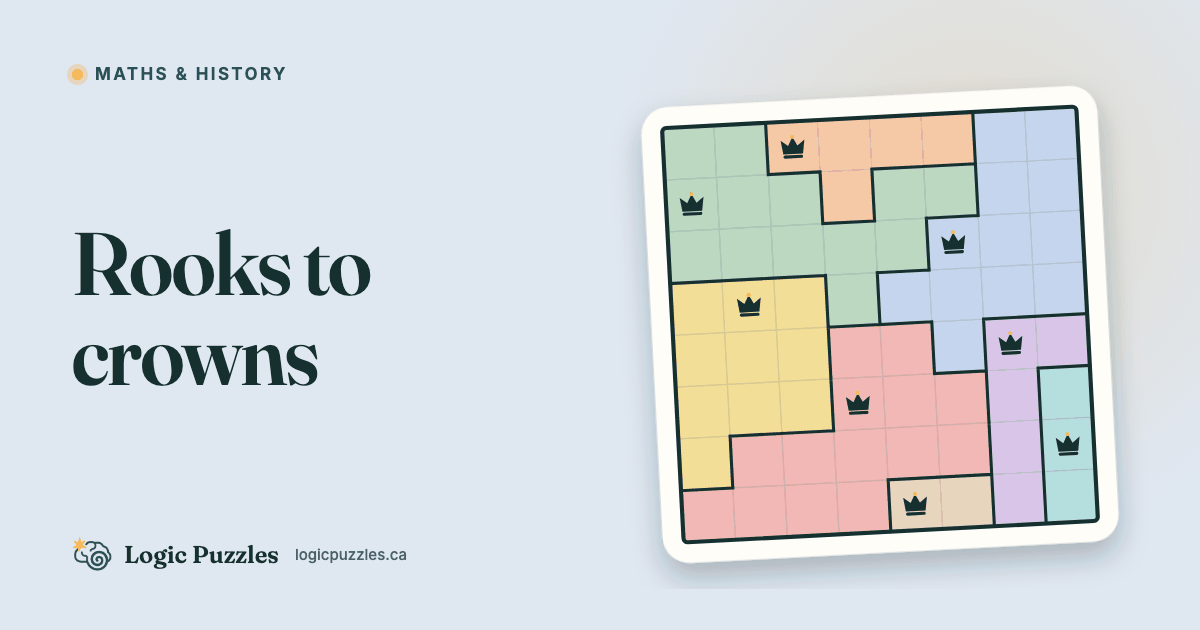
This is where the colored regions earn their keep. Each region must hold exactly one crown, and every region boundary quietly vetoes some of those 5,242 boards. A board that puts two crowns in the green patch is out. A board that leaves the orange patch empty is out.
When we build a grid, the job is to draw boundaries so that exactly one board survives. Too few vetoes and the puzzle has several answers, so you'd have to guess. One survivor means every crown can be reached by pure reasoning. From a designer's chair, a Crowns grid is not really a picture of where the crowns go. It's a carefully drawn filter that lets one shuffle through out of thousands.
That's why small boards settle quickly: on a 5×5 the regions only have to choose among 14 candidates.
Solving with the shuffle in mind
Knowing the skeleton gives you a few practical habits.
Count what's left, not what's placed. Because the answer is a shuffle, every column is used exactly once. When you've placed most of the crowns, list the columns still empty and the rows still empty. The final few crowns often have only one way to pair them up, and you can see it before you look at a single region.
Check neighbouring rows as a pair. Since diagonal touching only happens between adjacent rows, the crowns in any two neighbouring rows must sit at least two columns apart. If one row's crown is pinned to columns 4 or 5, the rows on either side can't use column 4 or column 5, whichever of the two wins. Two crosses in each neighbouring row, from one glance.
Respect the edges. On a small board the elbow-room rule is brutal. The 4×4 only has two legal shuffles before regions are even drawn, so if you know one crown's position, the rest of the board is often already decided. Even on bigger boards, a crown squeezed against the edge leaves its neighbours fewer columns to choose from.
None of this replaces the region tricks you already use. It sits underneath them. Regions tell you which shuffle; the shuffle tells you what any answer must look like.
The deck was always there
There is something satisfying about learning that a puzzle full of colors and crowns is, at bottom, a shuffled deck of numbers with two house rules: no neighbours too close, and one card for each color. The same pattern shows up far from the grid. Seating guests so no two rivals sit side by side, booking meetings so no room is double-used, giving each person on a team one task and each task one person: all of them are shuffles with extra conditions.
The rook problem is easy. The king problem is harder. Adding regions makes it a puzzle. And the habit it teaches is a good one for everyday thinking too: before hunting for the answer, ask what every answer has to look like. Often the shape of the possibilities does half the work for you.