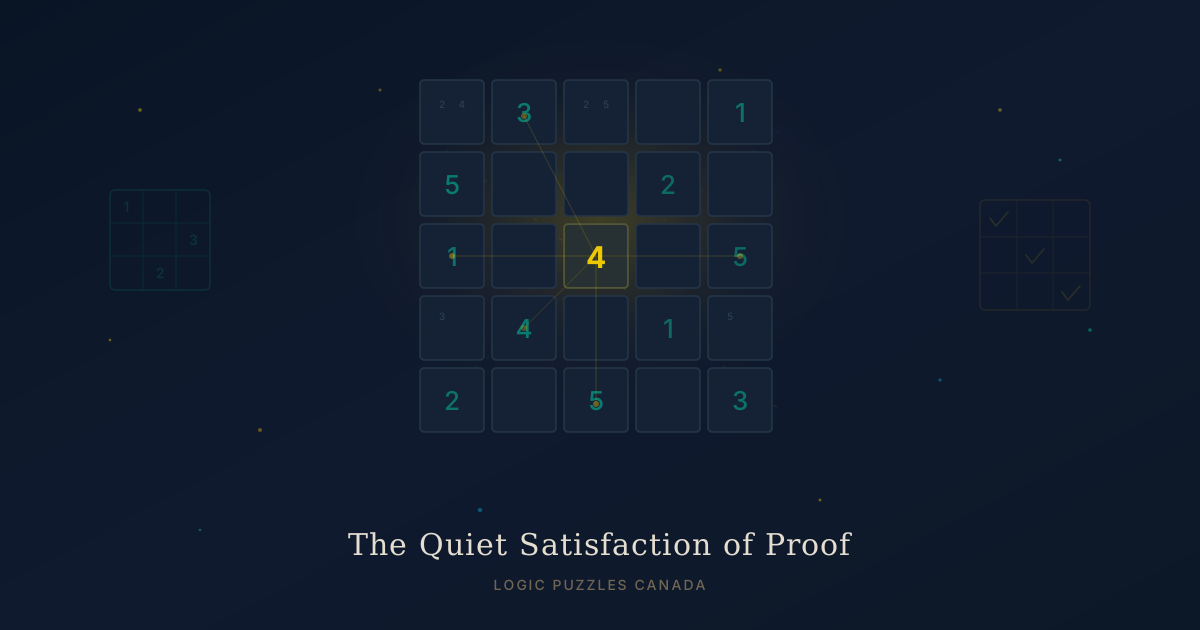
Look at an empty cell in a Sudoku grid. What do you see?
Most people see nothing. A blank space. An absence. Something that has not been figured out yet.
But experienced solvers see something different. They see a container of possibility. That empty cell does not hold zero values. It holds all of them — 1 through 9, simultaneously — until the constraints of the puzzle narrow the field. The cell is not empty. It is full of potential, waiting for logic to decide what stays.
There is something quietly profound in that shift of perspective.
The fullness of nothing
We tend to treat emptiness as a deficit. An empty inbox is cleared. An empty calendar is free. An empty room is unused. In each case, empty means "nothing here yet" or "nothing here anymore." The frame is one of absence.
But in a logic puzzle, emptiness is the opposite of absence. An empty cell is the richest cell on the grid. It contains the most information — not in the sense of what is known, but in the sense of what is possible. A cell with a confirmed value holds one piece of information. An empty cell holds nine potential truths, each waiting to be tested.
This is how quantum physicists describe particles before they are measured — existing in a superposition of states until observation collapses them into one. The analogy is not perfect, but the intuition maps well. The empty cell is not nothing. It is everything, not yet determined.
How an empty cell becomes a filled one
The journey from empty to filled is the entire story of a logic puzzle, and it is worth watching in slow motion.
You start with a cell that could be anything. Then you check the row — two values are already present, so those are eliminated. You check the column — three more gone. You check the box — another two removed. Suddenly, the cell that held nine possibilities holds only two.
Later, a deduction elsewhere in the grid eliminates one more. And just like that, the cell that was everything is now exactly one thing. Not because you decided what it should be, but because logic removed everything it could not be.
The cell did not gain anything during this process. It lost possibilities. And through that loss — that systematic narrowing — it found its identity. What it is was defined entirely by what it is not.
Identity through elimination
This is a strange way to define something, if you think about it. We usually think of identity as additive. You are the sum of your experiences, your choices, your traits. You build yourself up, piece by piece.
But the empty cell suggests another model. Identity is what remains when everything that does not fit has been removed. The cell did not choose to be a 7. It became a 7 because every other option was impossible in that position. Its identity was not constructed but revealed.
There is something liberating about that idea. If you have ever felt paralyzed by the question of what to do with your life, what to prioritize, who to be — the empty cell offers a different approach. You do not have to figure out the answer directly. You can start by eliminating what clearly does not fit. What you are not. What does not work. What contradicts the constraints of your situation.
What remains, however surprising, is the answer.
The power of pencil marks
Experienced puzzle solvers use pencil marks — small notations in the corner of a cell listing its remaining possibilities. To a beginner, pencil marks look like clutter. To a skilled solver, they are the most important information on the grid.
Pencil marks make the invisible visible. They transform an empty cell from a mystery into a known set of options. And more importantly, they allow the solver to see relationships between cells. If two cells in the same row both contain only the options 3 and 7, then those values are locked to those cells, and they can be eliminated everywhere else in that row.
This technique — called naked pairs — is impossible without pencil marks. You cannot see the relationship unless you first acknowledge what each cell could be. The emptiness must be made explicit before it can be resolved.
There is a life lesson here too, though I will let you draw it yourself: you cannot make a good decision about your possibilities until you have actually looked at what they are. Vague uncertainty is paralyzing. Named options are manageable.
The moment of collapse
The most satisfying moment in a puzzle is when a cell with multiple possibilities suddenly collapses to one. Not through a dramatic breakthrough, but through the quiet accumulation of logic elsewhere on the grid.
You were not even looking at that cell. You were working on the other side of the grid, placing values, eliminating options, following constraint chains. And then you glance over, and a cell that had three possibilities now has one. The work you did over there resolved something over here.
This is how well-designed systems work. Local actions have non-local effects. A decision in one part of the grid ripples outward, resolving ambiguity in places you were not thinking about. The puzzle is a connected system, and every filled cell tightens the constraints on every empty one.
This is true in organizations, in ecosystems, in relationships. Solving one thing here often resolves something there. The connections are not always visible in advance, but they are always present.
What the empty cell teaches about patience
Beginning solvers often feel anxious about empty cells. They want to fill them in. The blank spaces feel like failures — evidence that they have not figured things out yet. So they rush, sometimes guessing, sometimes forcing values where logic has not yet determined them.
Experienced solvers have a different relationship with emptiness. They are comfortable with cells that remain unresolved. They understand that an empty cell is not a problem to be fixed but a question to be answered when the time is right. Pushing too hard — trying to resolve a cell before enough information is available — leads to errors. Patience, paradoxically, is faster.
This is the hardest lesson the empty cell teaches, and the one with the broadest application. Not everything needs to be resolved immediately. Some questions need to stay open until the surrounding context provides enough information for a good answer. Premature closure — filling in a cell before the logic supports it — feels productive but leads to contradictions.
The willingness to sit with uncertainty, to let empty cells be empty until they are ready to be filled, is a skill that serves you far beyond the puzzle grid.
Emptiness as invitation
There is one more way to think about the empty cell. It is not just potential, and it is not just patience. It is an invitation.
Every empty cell is an invitation to think. To engage. To bring your attention to a specific question and work it through. A fully solved grid is finished — beautiful, maybe, but inert. There is nothing left to do. The empty cells are where the action is. They are where your mind meets the puzzle and does its work.
In this sense, emptiness is not something to be overcome. It is the reason the puzzle exists. Without empty cells, there is no puzzle. Without unanswered questions, there is no thinking. Without open spaces, there is no room for you.
The next time you look at a grid full of blank cells, try not to see a problem. See an invitation. Every one of those spaces is waiting — not for an answer, but for the process of finding one. And that process, that slow narrowing from everything to one thing, is the whole point.
An empty cell is not nothing. It is where possibility lives.