Picture a maths classroom where a student is staring at a problem and getting nowhere. The teacher walks over. She doesn't give a hint about the answer. She asks a question instead: "What is the unknown?" Then another: "Have you seen a problem like this before?" Slowly, without being told anything new, the student finds the way in.
That scene is more or less the whole design of a small book published in 1945 called How to Solve It. Its author was George Pólya, a Hungarian mathematician born in Budapest in 1887, who taught for years in Zurich before moving to the United States and settling at Stanford. Pólya was a serious researcher. He proved deep results about probability and number theory. But he also cared deeply about a simpler question: how does anyone actually find a solution?
His answer was not a formula. It was a list of questions you can ask yourself when you are stuck. We think it is one of the best toolkits ever written for puzzle solvers, and it fits Crowns almost perfectly.
Four phases, one habit
Pólya split problem solving into four phases:
- Understand the problem.
- Devise a plan.
- Carry out the plan.
- Look back.
That sounds obvious, and Pólya knew it did. The value is in the questions he attached to each phase, because each one points your attention somewhere specific. A stuck solver usually isn't short of brainpower. They're short of direction. A good question supplies it.
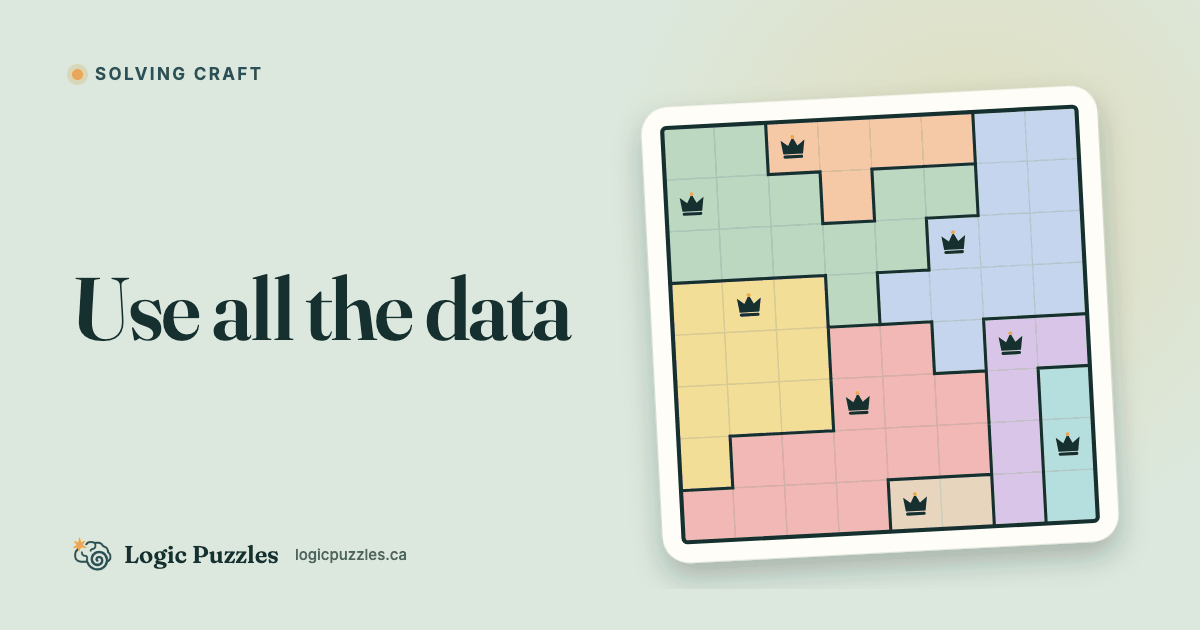
Let's walk through the phases with a Crowns grid in front of us. The rules, as a reminder: place exactly one crown in every row, every column and every colour region, and no two crowns may touch, not even diagonally.
Understand: what is the unknown?
Pólya's first questions are almost insultingly simple. What is the unknown? What are the data? What is the condition?
In Crowns, the unknown is a set of positions: one crown per row. The data is the shape of the coloured regions. The condition is the four-part rule above. Here is the useful bit: on a grid with eight rows there are eight regions and eight crowns, so every region gets exactly one. Nothing is spare.
Saying that out loud changes how you look at the board. You stop seeing 64 cells and start seeing eight little jobs, one per region, each of which must be done. The smallest region is usually the most urgent job, because it has the fewest ways to be done.
Plan: have you seen a related problem?
One of Pólya's central pieces of advice for the planning phase was to look for a related problem, ideally a simpler one you already know how to solve. If you can't solve the whole thing, he suggested, solve a part of it.
Crowns is full of simpler problems hiding inside the big one. A region squeezed into a single row is a tiny puzzle with an instant answer: that region's crown lives in that row, so every other cell of that row is crossed out. A region that sits entirely in one column does the same job vertically. A region of just two or three cells is another small puzzle: wherever its crown goes, some cells nearby will be ruled out by the no-touching rule, and any cell ruled out by every choice can be crossed off now.
None of these is the whole solution. Each is a part you can finish. Pólya would say that is exactly the point: the part gives you a foothold, and the foothold changes the problem.
Carry out: did you use all the data?
This is the phase where most solvers get stuck, and it is where Pólya's sharpest questions live. When the plan stalls, he asked: "Did you use all the data? Did you use the whole condition?"
These are wonderfully rude questions, because the honest answer is usually no. In Crowns, the bits people forget are predictable:
The no-touching rule reaches further than it looks. Everyone remembers that a crown rules out its eight neighbours. Fewer people use it before placing a crown. If a region's remaining cells are two side by side, then whichever one gets the crown, the cells directly above and below the pair are touched. Cross them out.
Rows count as a group, not just one at a time. If two regions both fit entirely inside the same two rows, those two rows are used up by those regions. Every other cell in those rows is out. The same goes for three regions in three columns. This is the condition used as a whole, not piece by piece.
Every region must survive. Before placing a crown, ask whether it would wipe out every remaining cell of some other region. If it would, that cell is impossible, even though it breaks no rule on its own.
In a well-made Crowns grid, the hard moment often turns on one of these forgotten conditions. The puzzle looks stuck. It isn't. Some piece of the data is sitting there unused, waiting for you to ask Pólya's question.
Look back: can you see it at a glance?
Pólya's fourth phase is the one almost everyone skips. When the problem is solved, he urged students to look back: Can you check the result? Can you derive it differently? Can you use the method for some other problem?
For a Crowns solver, looking back takes about thirty seconds and pays off for weeks. When the last crown drops in, glance at the grid and ask: which step actually broke this open? Was it the two regions trapped in two rows? The pair that shadowed the cells above it? Name it. Next time a similar shape appears, you will spot it in a moment instead of a minute.
This is how one puzzle turns into a technique. Without looking back, you solve a grid. With it, you get better at solving grids.
A question in your pocket
What we love about Pólya is that he never pretended problem solving was magic. He thought it could be taught, and that the teaching was mostly a matter of asking the right question at the right time, until students learned to ask it themselves.
That habit travels well beyond the grid. Stuck on a plan at work, a tricky email, a bug that won't die? Try the four plain questions: What exactly is the unknown? Is there a smaller version I can solve? Have I really used everything I know? And afterwards, what did I learn? They won't hand you the answer. They'll point you at where it has been hiding all along.