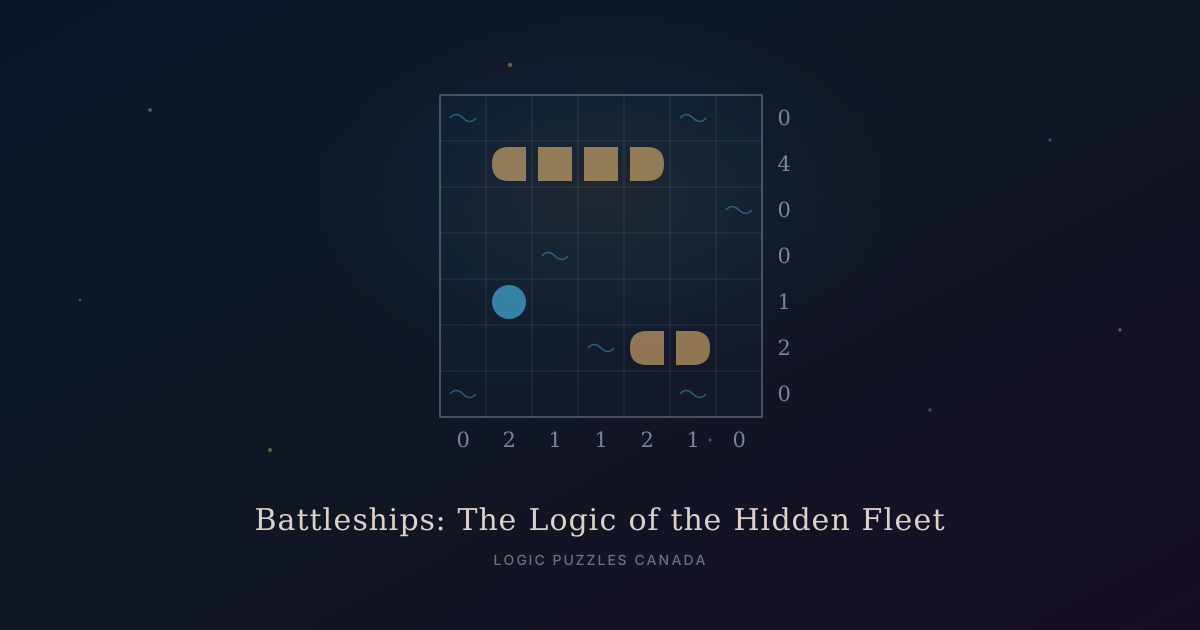
Your mind is usually somewhere else. While you eat, you are thinking about work. While you work, you are thinking about what you will do after work. While you are in a conversation, you are composing your next sentence before the other person has finished theirs. The present moment — the actual, literal now — is the one place your mind rarely visits.
Then you open a logic puzzle, and something shifts. The grid demands attention. Not the scattered, half-present attention you give to most things, but the focused, here-and-now attention that the rest of life so rarely requires.
Why puzzles anchor attention
A logic puzzle is immediate. It does not ask you to remember what happened yesterday or plan for tomorrow. It asks you to look at this grid, right now, and determine what must be true. The information you need is in front of you. The work you need to do is happening in this moment. There is nothing to anticipate and nothing to recall — only the current state of the grid and the constraints that govern it.
This is why puzzles have a centering effect that people often describe but rarely analyze. You sit down scattered, distracted, carrying the residue of a busy day, and within a few minutes of engaging with a grid, the noise quiets. Not because you decided to be calm, but because the puzzle occupied the mental bandwidth that was producing the noise.
Attention is not emptied into calm. It is filled with something specific. The grid does not clear your mind. It replaces what was in your mind with something that requires presence. And presence, it turns out, is what calm feels like.
The attention economy of a grid
Think about what your mind is doing during a puzzle. It is holding the state of several cells in working memory. It is tracking which numbers are placed and which are missing. It is evaluating constraints across rows, columns, and regions simultaneously. It is comparing possibilities and eliminating impossibilities. All of this requires the kind of full-bandwidth attention that leaves no room for anything else.
This is not meditation, but it shares a key feature with meditation: it gives the mind a single object of focus. In meditation, that object might be the breath, or a mantra, or the sensation of sitting. In a puzzle, it is the grid. The mechanism is different but the effect is similar — the mind, given something to focus on completely, stops generating the background chatter that usually fills every quiet moment.
Researchers have found that mind-wandering correlates with unhappiness — not because the thoughts are necessarily negative, but because the act of being mentally absent from your current activity is itself a source of dissatisfaction. The opposite state — being fully present in what you are doing — correlates with well-being regardless of what the activity is. A person fully absorbed in washing dishes is happier than a person half-thinking about a vacation while sitting at their desk.
Puzzles reliably produce this absorption. They are, in effect, a tool for being where you are.
The grid does not wait
One of the underappreciated features of a puzzle is its patience — and its demand for yours. The grid does not change while you are not looking at it. It does not scroll, update, ping, or notify. It sits. It waits. The only thing that moves in a puzzle is your attention.
This stillness is unusual in our environment. Most of the things competing for your attention are designed to pull it away — to interrupt, to redirect, to create urgency where there is none. A puzzle does the opposite. It rewards sustained attention and penalizes distraction. If you look away, you lose your thread. If you check your phone mid-solve, you have to rebuild the mental model of the grid from scratch.
Over time, this trains a capacity for sustained focus. Not through discipline or willpower, but through the natural consequence of engagement: you stay focused on the puzzle because the puzzle is interesting, and the more focused you stay, the more interesting it becomes. The attention feeds itself.
Presence without trying
The beauty of puzzle-induced presence is that it is not effortful. You do not have to try to be present with a puzzle the way you might try during meditation. The puzzle does the work for you — it is engaging enough to capture your attention and structured enough to hold it. Presence happens as a side effect of engagement, not as a goal you are straining toward.
This is important because most people find deliberate presence difficult. Sitting quietly and trying to be aware of the present moment is, for many people, a confrontation with exactly the mental noise they are trying to escape. The instruction to "be present" becomes one more thing to fail at.
A puzzle offers an alternative path. Instead of trying to be present, you do something interesting that requires presence. Instead of fighting the mind's tendency to wander, you give it somewhere specific and absorbing to go. The result is the same — you end up here, now, fully engaged — but the path is enjoyment rather than effort.
After the grid
The benefit does not stop when the puzzle ends. People who regularly engage in focused activities report that the capacity for presence begins to generalize. The mind that has practiced being fully absorbed in a grid finds it slightly easier to be fully absorbed in a conversation, a meal, a walk. Not because puzzles are magic, but because attention is a habit, and habits strengthen with use.
There is also a residual calm that follows a period of deep focus. After twenty or thirty minutes of complete absorption in a grid, the return to ordinary activity feels different — quieter, less rushed, more spacious. The mental bandwidth that was filled by the puzzle is now empty, and instead of being immediately filled with noise, there is a window where the mind is clear and calm.
This window does not last forever. The noise comes back. But it comes back more slowly after a period of focused attention, and if you solve puzzles daily, you get that window daily. It accumulates. The baseline shifts. You become, gradually, a person who is slightly more present, slightly less scattered, slightly more here.
A practice of presence
You do not need to think of puzzles as a mindfulness practice. You do not need to set an intention before you solve or reflect on your state of mind afterward. You do not need to do anything differently than you already do.
Just solve the puzzle. Pay attention to the grid. Follow the logic. Let the rest of the world wait.
The present moment is always right here. The puzzle just makes it easier to notice.