There is a moment in every logic puzzle, just before you place a number, where something clicks. Not a guess. Not a hunch. A certainty. You have followed the constraints, tested the possibilities, and arrived at a conclusion that cannot be wrong. Then you place it, and the grid accepts it like a key sliding into a lock.
That feeling has a name. It is proof. And in a world full of maybes, it is quietly one of the most satisfying things a mind can experience.
What proof feels like
We do not use the word "proof" casually in everyday life. We say "I think," "I'm pretty sure," "probably." Most of our daily decisions are made on incomplete information with reasonable confidence. That is fine - life requires it.
But a logic puzzle operates in a different register. When you determine that a cell must contain a 4, you are not estimating. You are not weighing probabilities. You are constructing an argument - often without realizing it - that makes every other value impossible. The 4 is not your best guess. It is the only option that survives.
This is deductive proof, the same kind of reasoning that underlies mathematics, formal logic, and scientific law. The difference is that in a puzzle, you get to experience it directly, viscerally, dozens of times in a single sitting.
Why certainty is rare
Think about how much of your day involves uncertainty. Will this project go well? Is this the right decision? Did I say the right thing? We navigate constant ambiguity, making peace with the fact that most of our choices are educated bets.
There is nothing wrong with that. But it means that genuine certainty - the kind where you know something is true and can trace exactly why - is uncommon outside of very specific domains. Mathematicians experience it. Logicians experience it. And puzzle solvers experience it, every single day, without needing a degree.
When you place a value in a Sudoku grid because every other number in that row, column, and box has been accounted for, you are standing on the same logical ground as a mathematician completing a proof. The scale is different. The feeling is the same.
The anatomy of a deduction
What happens inside a puzzle deduction is worth slowing down to appreciate. Take a simple example:
You are looking at a row in a Sudoku grid. Seven of the nine cells are filled. The remaining two cells need a 3 and a 7. One of the two cells shares a column with an existing 3. Therefore, that cell must be the 7, and the other must be the 3.
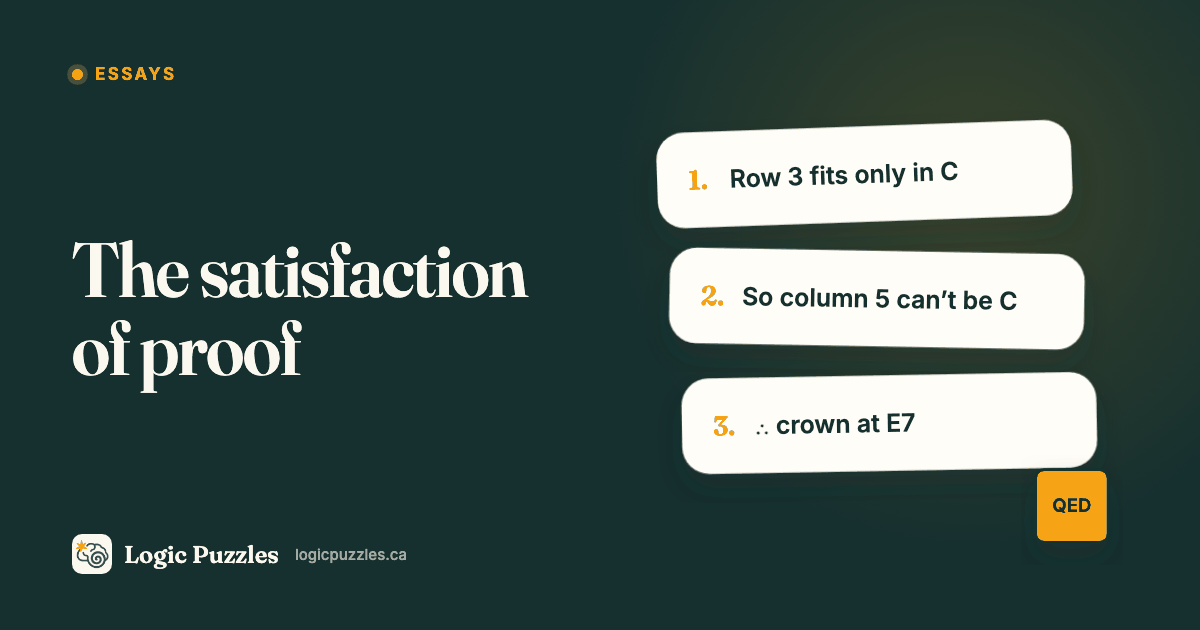
That is a tiny proof. It has premises (the filled cells, the column constraint), a logical step (the 3 cannot go where a 3 already exists), and a conclusion (the forced placement). Nothing about it was uncertain. Every piece was necessary. The answer was inevitable.
Now multiply that across an entire grid. Dozens of small proofs, each building on the last, each airtight. By the time you place the final number, you have constructed a web of reasoning where every cell is justified by the cells around it. The completed grid is not just a solution - it is a body of evidence.
The difference between knowing and guessing
Guessing has its own energy. It is exciting, hopeful, sometimes reckless. But it carries doubt. You guess and then you wait to see if you were right. The feedback is external - the world tells you whether your bet paid off.
Proof works differently. The feedback is internal. You do not need the puzzle to confirm your answer. You already know it is correct, because you derived it. The placement is a conclusion, not a wager.
This distinction matters more than it might seem. When you practice proof-based reasoning in puzzles, you are training yourself to distinguish between "I feel like this is right" and "I can show that this is right." That is a skill with real-world weight.
A developer debugging code uses proof when they isolate a bug through systematic elimination rather than changing things randomly and hoping. A doctor uses proof when they reach a diagnosis by ruling out alternatives rather than guessing from symptoms. In both cases, the confidence comes not from intuition but from structure.
Why we design for deduction
Every puzzle on LogicPuzzles.ca is built so that the solution can be reached entirely through deduction. No puzzle requires a guess. No puzzle has a step where you must try something and see if it works.
This is not the default in puzzle design. Many puzzle generators produce grids that technically have unique solutions but include difficulty spikes where the only practical path forward is trial and error - bifurcation, as puzzle designers call it. The solver picks a value, follows the chain, and either reaches a contradiction or does not.
We reject that approach. A puzzle should be provable from start to finish. Every step should be deducible. The solver should never need to say "let me try this and see." They should be able to say "this must be true, and here is why."
The reason is simple: the satisfaction of a puzzle comes from the proof. Remove the proof, and you are left with a guessing game dressed up as logic.
Small proofs, big rewards
There is something almost meditative about the rhythm of solving a well-designed puzzle. You scan. You notice a constraint. You follow it to a conclusion. You place a value. You scan again. Each cycle is a small proof, and each proof makes the next one possible.
The grid gets easier as you go - not because the logic simplifies, but because every proven cell adds information to the system. Your earlier proofs are doing work for you. They are tightening the constraints, narrowing the possibilities, building the scaffolding for the proofs that come next.
This compounding quality is what makes puzzle solving feel so different from other forms of entertainment. You are not consuming content. You are constructing knowledge, cell by cell, and the structure you build is entirely your own.
The proof is the point
When someone finishes a puzzle, they sometimes say "I solved it." But what they really did is closer to "I proved it." The completed grid is not a lucky outcome. It is the endpoint of a chain of reasoning, every link forged by the solver's own logic.
That is worth more than a solved grid. It is a small, private demonstration that your mind works. That you can take a tangle of constraints and find the single thread of truth running through them. That certainty is not just something handed to you - it is something you can build.
The next time you finish a puzzle, take a moment before moving on. Look at the completed grid. Every cell in it is something you proved. That quiet satisfaction? It is earned.