In 2001, the Japanese puzzle publisher that raised Sudoku introduced a grid puzzle about placing light bulbs. Its international name is Light Up. But its Japanese name is the tell: 美術館, Bijutsukan - "Art Gallery."
That name is either a lovely coincidence or a quiet tip of the hat, because for decades mathematicians had already been obsessing over a problem with the same name, the same furniture, and the same soul: how do you illuminate a complicated space with as few watchers as possible? The two galleries - the puzzle's and mathematics' - are worth touring together.
The mathematicians' gallery
In 1973, the geometer Victor Klee posed a deceptively simple question. An art gallery is a polygon-shaped room with n walls, possibly jagged and alcoved. Guards stand at fixed points and see in every direction, but walls block sight. How many guards are always enough, no matter how devious the floor plan?
Two years later Václav Chvátal answered exactly: ⌊n/3⌋ guards always suffice, and some galleries need every one of them. A 300-wall gallery, however maliciously designed, falls to 100 well-placed guards - and there exist comb-shaped galleries with 300 walls where 99 cannot cover the prongs.
The result became famous less for its statement than for a proof discovered in 1978 by Steve Fisk - three sentences long, and included in Proofs from THE BOOK, the collection named for Paul Erdős's fantasy of God's perfect proofs. Triangulate the polygon (carve it into triangles using its own corners). Color the corners with three colors so every triangle wears all three - always possible for a triangulated polygon. Now pick the least-used color: it appears at most n/3 times, and since every triangle contains it, guards at those corners see everything. The argument converts a security problem into a coloring problem, wins, and goes home. Solvers should savor that move - recast, then count - because it is the same trick that cracks grids: the answer was never about guards, just as your deduction was never about that one cell.
The puzzle's gallery
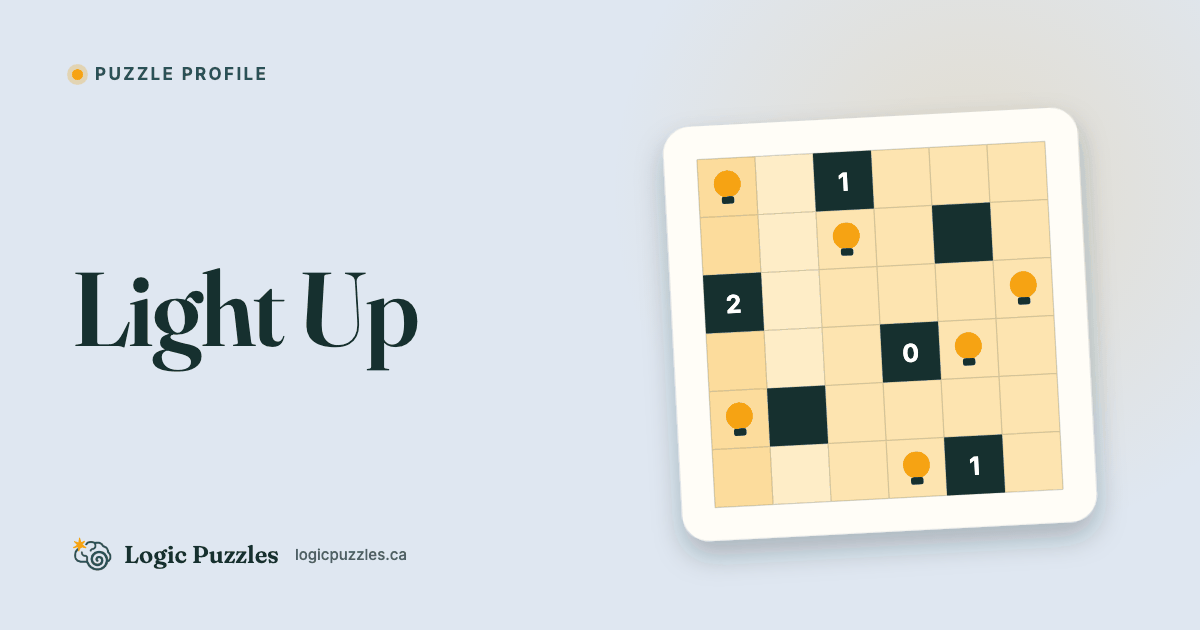
Light Up plays the same game on graph paper. A grid holds white cells and black walls; you place bulbs on white cells. A bulb shines along its row and column until a wall blocks it. Two laws:
- Every white cell must be lit.
- No bulb may shine on another bulb.
Some walls carry numbers counting the bulbs orthogonally adjacent to them - a 4 demands bulbs on all four sides; a 0 forbids them entirely.
The duality with Klee's problem is exact: cover everything (the guard condition) using watchers that must not see each other (a mutual-exclusion condition mathematicians study as the "hidden guards" variant). And as with most Japanese grid classics, the general problem is provably hard - Light Up has been shown NP-complete - while every published instance is hand-guaranteed to fall to reasoning alone. You are, as ever, touring the solvable wing of an intractable museum.
How to actually solve it
Light Up rewards a specific discipline: track negative space. Experienced solvers mark not just bulbs but dots - cells proven bulb-free - because the second law is where the logic lives.
Open with the loud numbers. A 4-wall lights all four neighbors immediately. A 0-wall dots all four. A 3-wall on an edge, or a 2 in a corner, is saturated the same way. These are the puzzle's gimmes, and they cascade: every placed bulb dots its entire line of sight.
Watch diagonal 1s and 3s. Two numbered walls touching diagonally constrain their shared corner cells in classic patterns - a 1 diagonal to a 3 forces bulbs onto the 3's far side, since the two cells the walls share can feed only one of them. You will meet these shapes so often they become vocabulary rather than deduction.
Hunt the lonely cells. The winning midgame question is not "where can I put a bulb?" but "how does this cell get lit?" A cell whose row and column of sight are all dotted except one candidate - that candidate is a bulb, by necessity. Corridor dead-ends and alcoves behind walls are chronically lonely; check them early. This is the puzzle's version of the hidden single, and it is easy to miss precisely because it concerns cells you cannot mark yet.
Respect the exclusion. Two lonely cells that see each other can host at most one bulb between them; if each is also the only lighter of some third cell, contradictions bloom fast. When stuck, pick the emptiest corridor and enumerate its legal lightings - there are usually two, and some cell agrees in both. (Overlap logic again. It follows solvers everywhere.)
Why illumination problems feel good
There is a particular satisfaction to coverage puzzles - Light Up, its cousin problems of guards and cameras, even placing lamps in a real room - that constraint-counting puzzles don't quite match. My conjecture: it is because the goal is generous. You are not sorting digits to satisfy a census; you are making sure every corner of a little world is seen and no watcher glares at another. Total coverage, zero conflict - it is the office seating chart, the wifi router placement, the streetlight plan, rendered exactly.
And the real world agrees about the difficulty. Klee's theorem gives the worst-case guarantee, but finding the true minimum number of guards for a given gallery is NP-hard, which is why actual camera-placement software leans on heuristics and why your hardest Light Up endgames feel the way they do. When a museum's security consultant and your Tuesday puzzle share a complexity class, the puzzle is not pretending to be relevant. It simply is the problem, shrunk to fit an evening - with the puzzle's one great mercy added: in their gallery, unlike Klee's, a perfect arrangement is always waiting, exactly one, provably findable by the person holding the pencil.