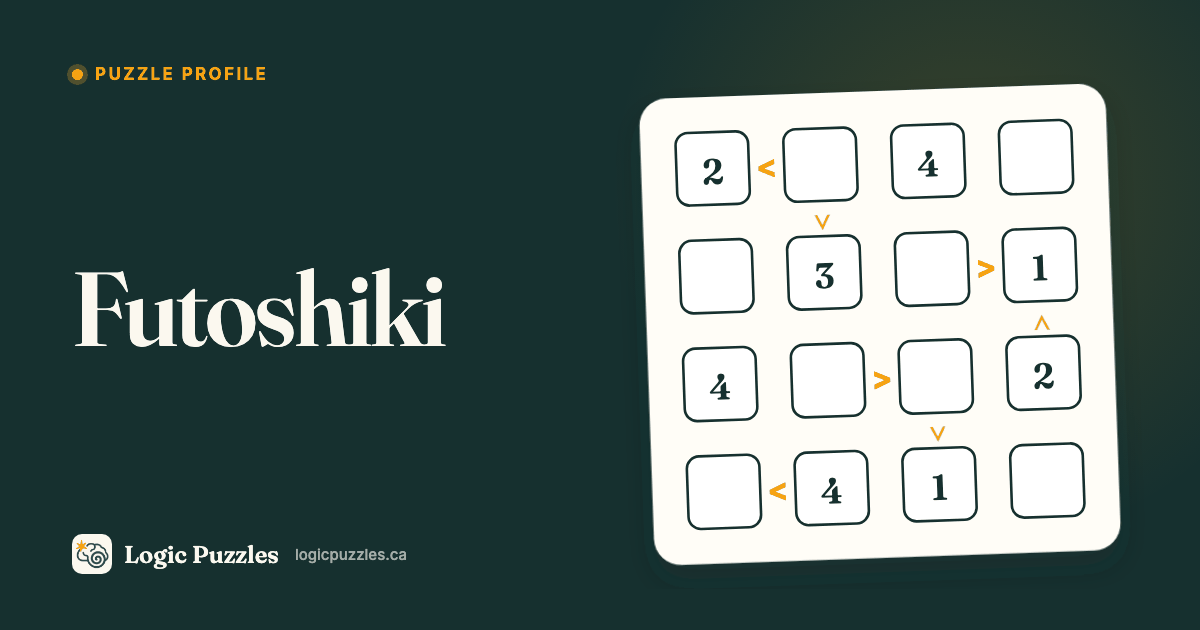
Most number puzzles clue you with values: this cell is 7, this cage sums to 12, this row holds three tents. Futoshiki - the name is Japanese for inequality - refuses the entire category. Its grid starts nearly empty; its clues are small arrowheads wedged between cells, each making the humblest possible claim: this one is bigger than that one.
No amounts. No sums. Just direction. And from a scatter of these almost-nothings, plus the Latin square rule - digits 1 through n once per row and column - a full grid follows with certainty. Futoshiki, which spread from Japan to become a fixture of British newspapers in the mid-2000s, is the purest lesson in a truth that runs deep in mathematics and deeper in daily life: relative information is information. Knowing nothing about two things except which is greater is knowing quite a lot, if you have the discipline to spend it.
Floors and ceilings
The foundational move in Futoshiki is converting relations into ranges.
Consider a 5×5 grid, and a cell A with an arrow declaring A < B. Immediately: A cannot be 5 (nothing is bigger), and B cannot be 1 (nothing is smaller). One arrow, two eliminations. Now chain it: A < B < C. The chain has length three, so A ≤ 3, B is 2–4, and C ≥ 3. Each link squeezes both ends: a cell's floor is the number of cells provably below it, plus one; its ceiling is n minus the number provably above. A cell sitting at the bottom of a long chain is nearly determined by geography alone - in a 5×5, a chain of five cells is forced completely: 1, 2, 3, 4, 5 in chain order, wherever it snakes.
This is the puzzle's opening ritual: trace every chain, pencil every floor and ceiling. It feels mechanical, and it is - the insight arrives in the second act.
Transitivity, the free clue
The arrows you are given are never all the arrows that exist. If A < B and B < C, then A < C - no one printed that third arrow, but it binds like the others. Transitivity manufactures clues out of clues, and strong Futoshiki play is largely the habit of consulting relations the setter implied but never drew.
The subtle version crosses with the Latin square rule. Suppose cell X must be less than its row-mate Y, and your pencil marks show X at {3, 4} and Y at {4, 5}. The arrow alone resolves nothing: X = 4 would force Y = 5, but X = 3 leaves Y loose. Now consult scarcity - the row still owes a 5, and every other cell in it has lost 5 to column constraints. Y is the 5's last home, so Y = 5, a placement the arrow could gesture at but only the Latin square could close. The solving texture is exactly this: arrows and scarcity taking turns tightening the same cells, neither sufficient alone. Sudoku players arrive with half the toolkit and are often startled by how alive the other half feels - inequalities propagate in a direction, like current, and a single placement at a chain's summit can cascade to its root.
Two smaller weapons complete the kit. Extremes love arrows: the digit 1 can never sit at the greater end of any arrow, and n never at the lesser end - so scan each row asking "where can the 1 legally live?" and watch arrows disqualify squares the way walls do in other puzzles. And watch for duels: two cells in a row locked in mutual candidacy {4,5} with an arrow between them are fully resolved - the arrow breaks the tie that position alone couldn't.
The mathematics between the cells
Here is the part that elevates the puzzle. The structure Futoshiki trades in - a set of items, some pairs comparable, others not - is what mathematicians call a partial order, and it is one of the quiet organizing ideas of the modern world.
A total order ranks everything against everything: the integers, finishing times, alphabetical lists. But most real orders are partial. Project tasks: "foundation before walls" and "wiring before drywall," yet foundation and wiring float free of each other. Software dependencies. Prerequisites in a degree. Family trees. In each, some pairs have an arrow, most don't, and the grand question is always the same as Futoshiki's: what completions are consistent with the arrows I have? Computer science calls finding one such completion topological sorting, and runs it billions of times a day - every software build, every spreadsheet recalculation, every task scheduler is solving a Futoshiki with the values hidden.
Even the puzzle's frustrations are theorems in disguise. The moment you notice two cells that no chain connects - and realize the arrows alone will never rank them, so you must lean on the Latin square - you have discovered incomparability, the defining feature of partial orders. And should you ever chase arrows in a circle, A < B < C < A, you've met the contradiction that build systems report as a "dependency cycle" and Futoshiki setters are sworn never to print.
Thinking in relations
The transferable skill here is unusually easy to name. Life rarely hands you absolute values; it hands you comparisons. This candidate interviewed better than that one; this risk worries the team more than the other; the second draft is stronger than the first. People often treat such knowledge as inferior to "real" numbers - mere opinion pending measurement. Futoshiki's daily sermon is the opposite: a web of honest comparisons, worked transitively and pinned by scarcity, determines far more than any single measurement could. Rankings, tournament seedings, preference votes, and search-result orderings are all built this way - arrows first, values never.
So the little arrowheads deserve more respect than their size suggests. Each one is the smallest possible fact - barely a bit, less than any digit. Futoshiki is the demonstration, repeatable every morning, of how completely the smallest facts, taken seriously together, close around the truth.