In 1848 a Bavarian chess composer named Max Bezzel posed a question in a Berlin chess magazine. Take the most powerful piece in the game, the one that sweeps along rows, columns and diagonals as far as it likes. How many ways can you place eight of them on an ordinary board so that none attacks another?
It sounds like a parlor trick. It turned into one of the most studied problems in recreational mathematics. Gauss traded letters about it. Franz Nauck published the full answer in 1850, 92 arrangements, and asked what happens on bigger boards. A century later it became the standard way to teach computers how to search. And today it lives on, reshaped, in the daily grid we call Crowns. This essay is about that journey, and about why the reshaping matters: it turns a riddle with 92 answers into a puzzle with exactly one.
Ninety-two, or really twelve
The first surprise is how few answers there are. A chessboard offers more than four billion ways to drop eight pieces onto 64 squares, and only 92 of them are peaceful. Spin the board or hold it up to a mirror and many of those 92 turn out to be the same arrangement seen from a different chair. Remove those duplicates and just 12 truly different solutions remain. Twelve needles in four billion pieces of hay.
The second surprise is how stubborn the counting gets. On larger boards nobody has found a formula for the number of solutions. Each new size has to be counted by brute force, and the work explodes. The 27×27 board was finally counted in 2016, after a year of computing, at roughly 235 quadrillion arrangements. In 2021 the mathematician Michael Simkin showed that the count grows about like (0.143n)ⁿ: we know the shape of the curve, but still not the exact numbers on it.
And the third surprise is the one that matters most to solvers. Finding one answer on any board from 4×4 upward is easy; explicit recipes have existed since the 1870s. But if someone places a few pieces first and asks you to finish the board, the problem becomes as hard as anything in computer science. In 2017 a team of researchers proved this "completion" version NP-complete, the same family as scheduling, routing and number-placement puzzles on giant grids. Open board: trivial. Board with a few commitments already made: potentially brutal. Every solver who has watched a puzzle get harder the moment they pencilled in one wrong mark already knows this in their bones.
The program that learned to back up
In 1972 the computer scientist Edsger Dijkstra used the eight-piece problem to show programmers a cleaner way to think. Place a piece in the first row. Move to the next row and place one wherever it's safe. If a row has no safe square, back up: undo the last placement and try the next option there. This is backtracking, the same depth-first search that powers the simplest number-grid solvers, and it finds all 92 answers in a blink.
Watch it work and you see something humbling. The program is not clever. It never "sees" a pattern. It simply refuses to keep going down a path once that path is dead, and it remembers where it was. That habit, prune early, back up cleanly, is most of what separates a calm solver from a frantic one.
What Crowns changes
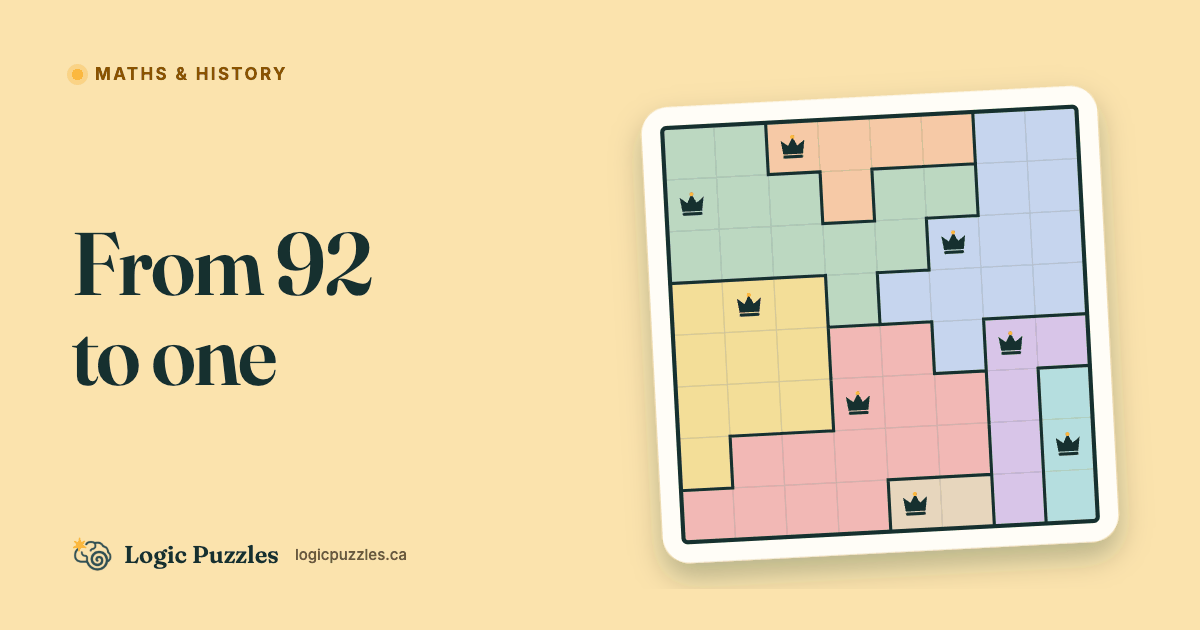
Crowns keeps the bones of the 1848 riddle and changes three things:
- One crown in every row and every column, as before.
- Crowns can't touch, not even corner to corner. The long diagonal rule is gone, and in its place each crown rules out the eight cells around it.
- Colored regions. The grid is divided into irregular patches of color, and each region must hold exactly one crown.
That third rule is the designer's chisel. Rows, columns and the no-touching rule alone still leave many valid boards. Every region boundary slices some of them away, and a well-built Crowns grid carves until exactly one arrangement survives. A riddle with 92 answers becomes a puzzle with one, and a puzzle with one answer can be solved entirely by reasoning, never guessing. That is the contract every grid we publish is checked against before it reaches you.
The regions also change how you think. In the classic problem you reason about lines. In Crowns you reason about shapes, and the shapes leak information everywhere.
Three moves that crack the grid
1. The lonely region. If a region sits entirely inside one row, its crown must land in that row, so that row's crown is already spoken for. Cross out every other cell in the row that belongs to a different region. The same goes for columns, and a region of a single cell is simply a free crown. Most grids open with one of these; it's the free move every grid hands you first.
2. The squeeze. Now scale that up. If two regions both fit entirely inside the same two rows, those two rows must spend their crowns on those two regions, with nothing left for anyone else. Every cell in those rows that belongs to a third region is dead. Three regions inside three rows, same story. It's the pigeonhole principle in its working clothes: count the regions that need a home, count the homes, and when the numbers match, the homes are taken. The squeeze runs backward too. If two rows contain cells from only two regions, those regions have to put their crowns in those rows, so cross out their cells everywhere else.
3. The shadow. Sometimes you can't tell where a region's crown will go, but you can still tell where everything else can't go. Suppose a region has only two candidate cells left, side by side. Whichever one wins, it will touch the cells directly above and below the pair. Those cells sit in the shadow of both options, so cross them out now. The general rule: if every remaining candidate in a region would rule out the same cell, that cell is dead no matter what. Finding a shadow feels like cheating, and it's often the move that breaks a stuck grid open.
When all three run dry, do what Dijkstra's program does, but carefully. Pick the region with the fewest candidates, suppose a crown in one of them, and follow the consequences until they either settle or collide. A collision is not failure. It's a proof that the supposition was wrong, and the cell you tried is now crossed out for good.
The peace treaty
There's something fitting in where this puzzle ended up. Bezzel's riddle was about the most aggressive piece in chess, eight warlords that had to be arranged so none could strike. Crowns trades the warlords for monarchs who simply need some personal space: one per row, one per column, one per province, and nobody standing on anyone's toes. It's a gentler image, and a better puzzle, because the regions give every grid a single right answer and give you a reason for every step on the way there.
A hundred and seventy-eight years later, the question is still the same one Bezzel asked: how do you give everyone room? The answer, it turns out, is the same one every good solver learns. Look at who has the fewest options, give them their place first, and watch the rest of the board make way.