On December 17, 1962, readers of a weekly magazine's international edition turned a page and found a short list of statements about five houses. The Englishman lives in the red house. The Spaniard owns the dog. Coffee is drunk in the green house. The Ukrainian drinks tea. There were fifteen of these little facts, and then two questions at the bottom: Who drinks water? Who owns the zebra?
Here is the wry part. Read the fifteen clues as carefully as you like, and you will not find the word "water" or the word "zebra" anywhere in them. The puzzle asks you about two things it never describes. And yet it has exactly one answer.
That riddle became known as the Zebra Puzzle, and it is often called the ancestor of the logic grid riddle, including the ones in our game Logic Grid Puzzles. Over the years it has been credited to various famous names without evidence, which tells you something about how clever people felt after solving it.
Five houses, a lot of possibilities
The setup is simple. Five houses stand in a row. Each is painted a different colour, and each is home to a person of a different nationality who drinks a different drink, smokes a different brand of cigarette and keeps a different pet. Every category has exactly five items, and each item belongs to exactly one house.
How many ways could the street be arranged? For each category, there are 5 × 4 × 3 × 2 × 1 = 120 ways to hand its five items out to the five houses. There are five categories, so the total is 120 to the fifth power (five 120s multiplied together): 24,883,200,000. That's nearly 25 billion possible streets.
Fifteen short sentences cut that down to one. No reader in 1962 was going to check 25 billion streets, and nobody needs to. The trick is that each clue doesn't just remove a few options. It removes whole families of options at once, and clues lean on each other until the street has no room left to move.
Watching the street lock into place
You can feel this happen in the first few minutes. A handful of the original clues are enough to paint every house:
- The Norwegian lives in the first house.
- The Norwegian lives next to the blue house.
- Milk is drunk in the middle house.
- The green house is immediately to the right of the ivory house, and coffee is drunk in the green house.
The first house has only one neighbour, house 2, so house 2 is blue. Now the ivory-and-green pair needs two side-by-side houses, and any pair that uses house 2 is out because house 2 is already blue. That leaves houses 3 and 4, or houses 4 and 5. But green means coffee, and house 3 drinks milk, so green can't be house 3. Ivory is house 4 and green is house 5.
Red and yellow are left for houses 1 and 3. The Englishman lives in the red house, and house 1 belongs to the Norwegian, so red is house 3 and yellow is house 1. Five colours placed, and we haven't touched a pencil-heavy technique yet. Each step was just one clue meeting another.
The rest of the puzzle continues the same way, and at the end two gaps remain: one house with no drink assigned and one with no pet. Water and the zebra fill them. The Norwegian drinks water, and the Japanese man owns the zebra.
The clue that isn't written down
So how can a puzzle ask about something it never mentions? Because the most important clue is not in the list. It's in the setup: every house has exactly one of each thing. That rule means that once four drinks are placed, the fifth drink has to go in the last empty house, whatever it's called. You don't need to be told about water. You only need to know there's one drink left.
This is a habit worth stealing. Beginners read a logic grid riddle as a list of fifteen facts. Strong solvers read it as fifteen facts plus a structure: a set of rules about how the categories fit together. The structure does as much work as the clues. Often it does more.
How the elimination grid does your thinking for you
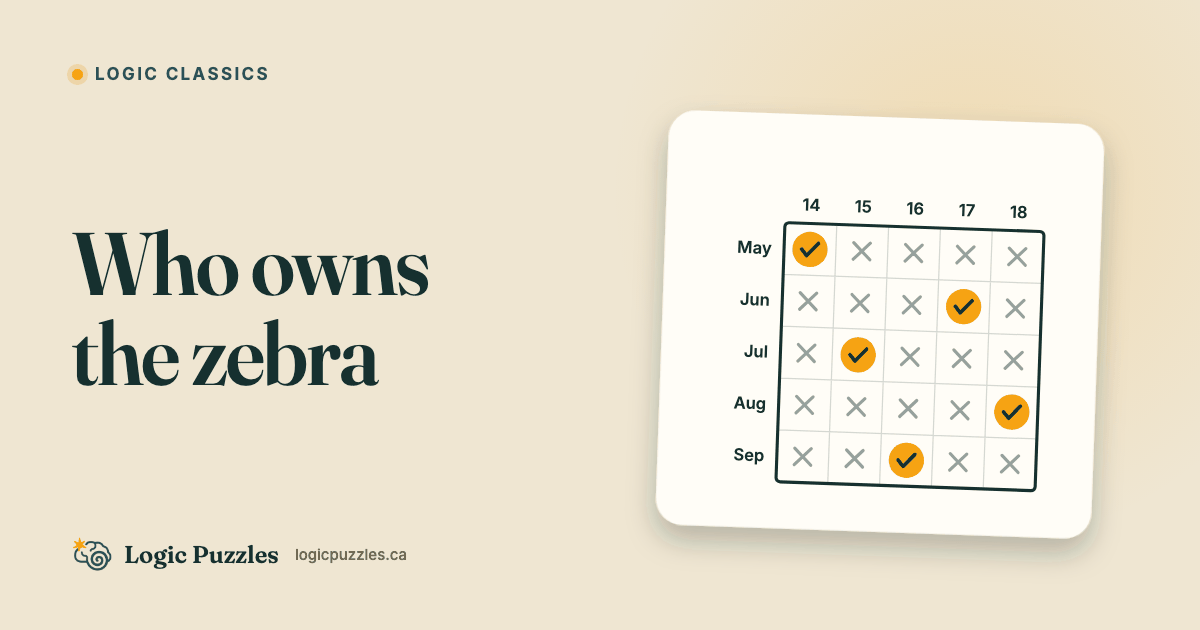
The Zebra Puzzle can be solved in your head, but most people reach for paper, and the tool they invent is the one our game gives you. In Logic Grid Puzzles, you match items from different categories using an elimination grid, marking positive and negative matches until every item is paired.
A few techniques carry most of the load:
1. One tick, many crosses. When you confirm a match, cross out every other cell in that row and that column of the block. A single positive mark can produce eight negative ones in a five-item puzzle.
2. The last one standing. If four cells in a row are crossed, the fifth must be a tick. This is the zebra trick in miniature: you never needed a clue that names the answer.
3. Carry facts between blocks. If the Englishman lives in the red house, then anything true of the red house is true of the Englishman, and anything ruled out for one is ruled out for the other. Copy crosses across the grid whenever you learn a match. Many puzzles stall only because a fact sits in one block and hasn't been carried to another.
4. Treat "next to" clues as pairs. Position clues ("immediately to the right of", "next to") rarely place anything alone. List the few places the pair could sit, then test each against the other clues, just as we did with ivory and green.
What the missing zebra teaches
The Zebra Puzzle still feels slightly magical because it seems to produce knowledge from nowhere. But nothing is hidden. The answer was always in the structure: five houses, five of each thing, one each. The clues just cleared away everything else until the gap had a shape.
That idea travels well beyond the grid. When a problem asks you something you can't find in the facts, don't only reread the facts. Look at the rules around them: what has to add up, what must be unique, what can't be left out. Sometimes the answer isn't written anywhere, because it doesn't need to be. It's simply the only thing that fits in the space that's left.