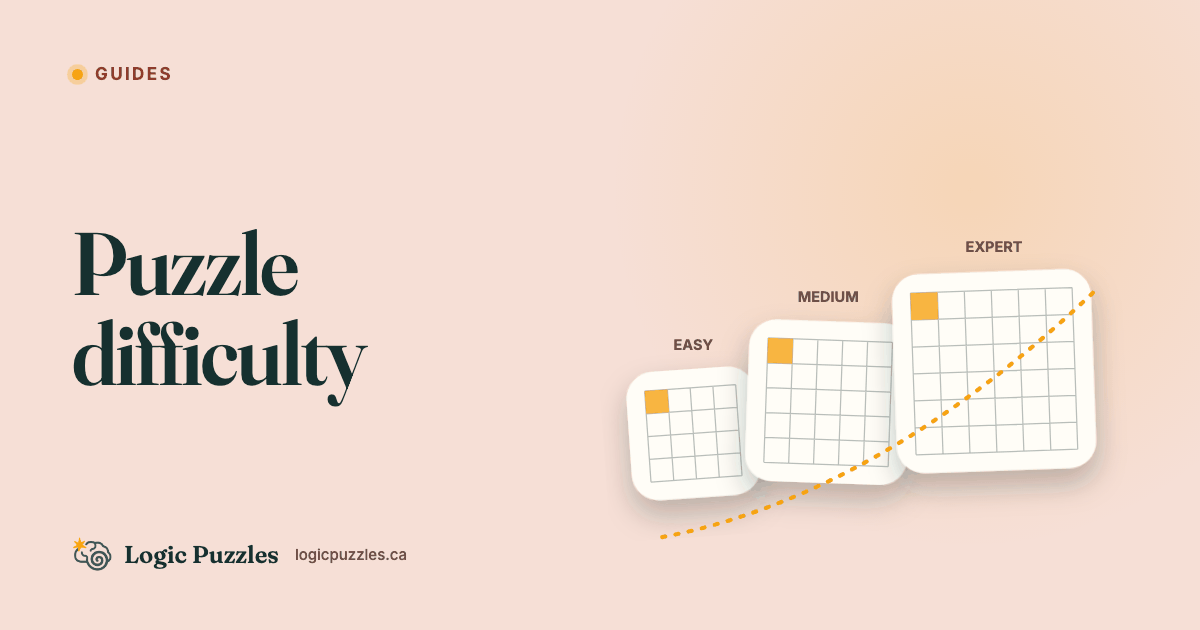
One solver’s "easy" is another solver’s "expert." That is because difficulty is not just about grid size - it is about how many steps of deduction you need and how clear the next step is.
Here is a simple way to think about puzzle difficulty so you can choose the right level for your day.
1. The Number of Forced Moves
Easy puzzles usually present a clear forced move within the first few steps. Harder puzzles require a longer chain of deductions before anything becomes certain.
If you find yourself staring for a while before placing a single piece, the puzzle is probably in a higher tier.
2. The Depth of Logic Required
Some puzzles rely mostly on basic elimination (this cannot go here). Others require multi-step reasoning:
- If A is here, then B must be there
- If B is there, then C is impossible
- Therefore A cannot be here
These chains create the satisfying "aha" moments, but they also push the puzzle into advanced territory.
3. The Density of Constraints
More constraints can make a puzzle easier or harder depending on how they interact. A clean, well-structured puzzle will use constraints to guide you. A dense puzzle with overlapping rules can increase difficulty quickly.
4. The Size of the Search Space
Larger grids have more possible placements, which usually means more difficulty. But a large grid with strong clues can still be approachable. That is why we offer size options across most games.
5. The Amount of Backtracking
In a well-designed logic puzzle, you should not need to guess. But some puzzles feel like you are stuck because the next deduction is subtle. When that happens, step back and re-check constraints - you likely missed a hidden forced move.
Choosing a Level That Fits Your Day
Here is a quick guide we recommend:
- Easy: Quick, low-friction puzzles. Ideal for busy days.
- Medium: Balanced challenge with steady progress.
- Hard: Deeper deduction chains. Great when you have focus time.
- Expert: Long logic chains and fewer obvious moves. Best when you want a real mental workout.
A Practical Tip: Use Time as Feedback
If a puzzle takes you longer than expected, it may be too high for your current energy level. Lower the difficulty and keep the habit alive - you can always move up later.
The Goal Is Flow
When the difficulty is right, you feel a steady rhythm of small deductions, occasional breakthroughs, and a satisfying finish. That is the sweet spot we aim for in every puzzle we publish.
Want to try different difficulty tiers?