Meet Otto. Otto has Alzheimer's disease and carries a notebook everywhere, writing down anything he will need later. One day he hears about an exhibition and decides to go. He opens the notebook, reads that the museum is on 53rd Street, and sets off. His friend Inga hears the same news, thinks for a moment, remembers the address, and sets off too.
Otto and Inga are invented. They appear in a short paper from 1998 by the philosophers Andy Clark and David Chalmers, called "The Extended Mind", and the paper asks a cheeky question: where does your mind stop? Inga's belief about the museum lives in her head. Otto's lives on paper. But it does the same job, at the same moment, and leads to the same walk. Clark and Chalmers argued that the notebook deserves to count as part of Otto's thinking.
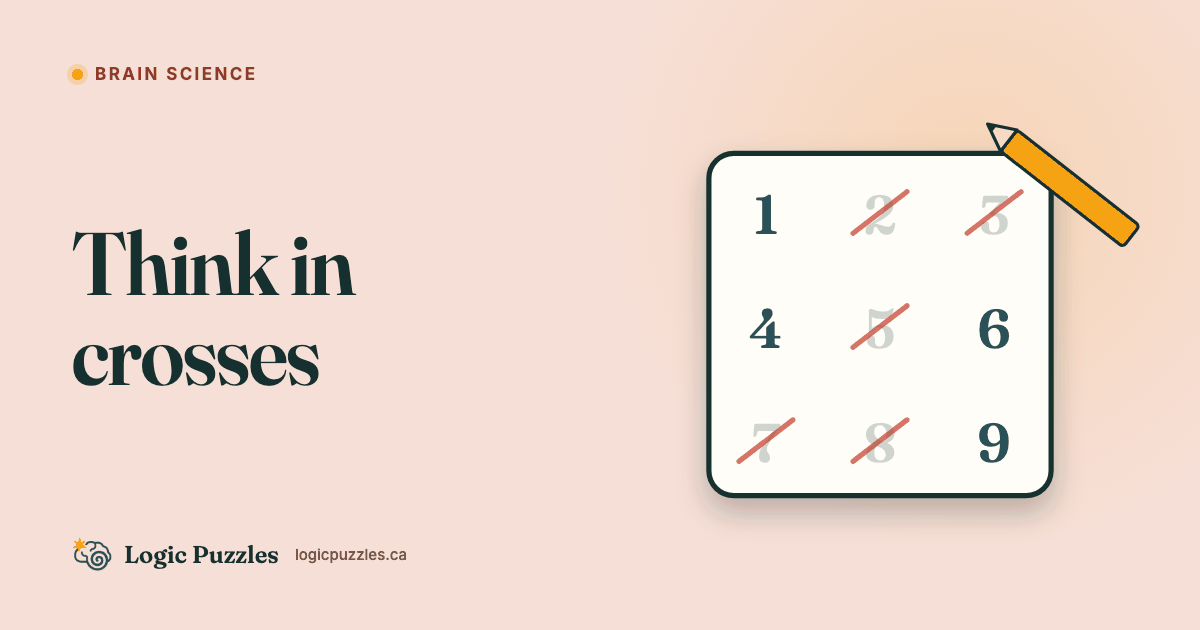
Philosophers are still arguing about that. Solvers, though, have an example to add, because every Crowns grid you have ever filled with little crosses was a small version of Otto's notebook.
Moves that aren't moves
A few years before Otto, two cognitive scientists at the University of California, San Diego, went looking for wasted effort. David Kirsh and Paul Maglio studied people playing a video game in which shapes fall down a screen and must be turned and slotted into place. If you imagine a player as a planner, the plan is simple: look at the shape, work out the right position in your head, then press the buttons once.
That isn't what they saw. Players kept turning pieces more than they needed to, sometimes rotating a shape past the position it would finish in. On paper those were mistakes. But Kirsh and Maglio worked out what the turns were for. Spinning a shape on the screen was several times quicker than spinning it in your head. The players weren't being careless. They were letting the screen do the part of the job that the screen does faster.
In their 1994 paper the pair gave these actions a name. A pragmatic action moves you closer to the goal. An epistemic action changes what you can know, or how easily you can know it, and might not move you closer at all. It's the difference between walking to the door and switching on the light to see where the door is.
Every X is an epistemic action
Now look at the rules of Crowns. Place exactly one crown in every row, every column and every color region, and crowns can never touch, not even diagonally. Tap a cell once to mark it with an X, and tap again to place a crown.
Only the crowns count towards the finish. By Kirsh and Maglio's definition, each X is a purely epistemic action, a move made only so that you can see better. And yet, as our rules page says, marking impossible cells is the key to every solve.
Some simple arithmetic shows why. Put one crown somewhere in the middle of an 8×8 grid. It rules out the other 7 cells in its row, the other 7 in its column, and the 4 diagonal neighbours that aren't already in that row or column. That's 18 cells gone, before you count the rest of its region.
Psychologists disagree about the exact limit of working memory, but a widely cited estimate from Nelson Cowan puts it at about four items at once. Eighteen cells do not fit in four slots. Without marks, you are not solving the puzzle so much as repeatedly recalculating it.
Turning memory into eyesight
The real gift of a cross isn't storage, though. It's that it changes what kind of work comes next.
Holding a board in your head and asking "which cells of the green region are still alive?" is slow, effortful work. Looking at a board where the dead cells are crossed out and seeing two green cells left is nearly instant. Your visual system is very good at noticing what stands out, and it asks far less of those four precious slots. A good mark converts a memory problem into a seeing problem.
Pay the full price right away. When a crown lands, cross out its row, its column, its neighbours and the rest of its region before you do anything else. A consequence you've postponed is a consequence you have to remember, which is exactly the thing you were trying to avoid.
Mark what you've proved, not just what you've placed. If you work out that a cell is dead even though you can't place a crown yet, put the X down at once. A deduction held in your head will leak away the moment the next idea arrives. On the grid, it stays and goes to work.
After marking, look before you think. Each new round of crosses may have left some region, row or column with one or two living cells. Give the board a slow sweep and let it show you. Often the next move is already sitting there, and hunting for a clever deduction would only have been a detour.
When stuck, audit. Before reaching for anything fancy, go back through your crowns and check that every consequence has been marked. A single missing X can hide the one cell that would have stood out.
The notebook has a catch
Offloading isn't free. Researchers who study it, including Evan Risko and Sam Gilbert in a 2016 review, point out the obvious risk: if the outside world is holding the information, you may not be learning it. Otto's notebook only helps while Otto has it.
A fair compromise is to let the marks carry the facts while you keep the reasons. Cross out freely, but when a grid finishes, ask yourself which X made the difference and why it was true. The marks are for this puzzle. The reason comes with you to the next one.
Where your thinking lives
We tend to think of intelligence as something that happens behind the eyes, with hands and pencils merely reporting the results. Otto, the game players and the crosses all suggest a looser picture. Shopping lists, sticky notes, a mechanic's tools laid out in order and a table covered in sorted receipts are all pieces of thinking that happen to sit outside the skull.
So don't feel that marking a grid is a crutch. Setting up your surroundings so the next step is easy to see is one of the cleverest things a mind can do.