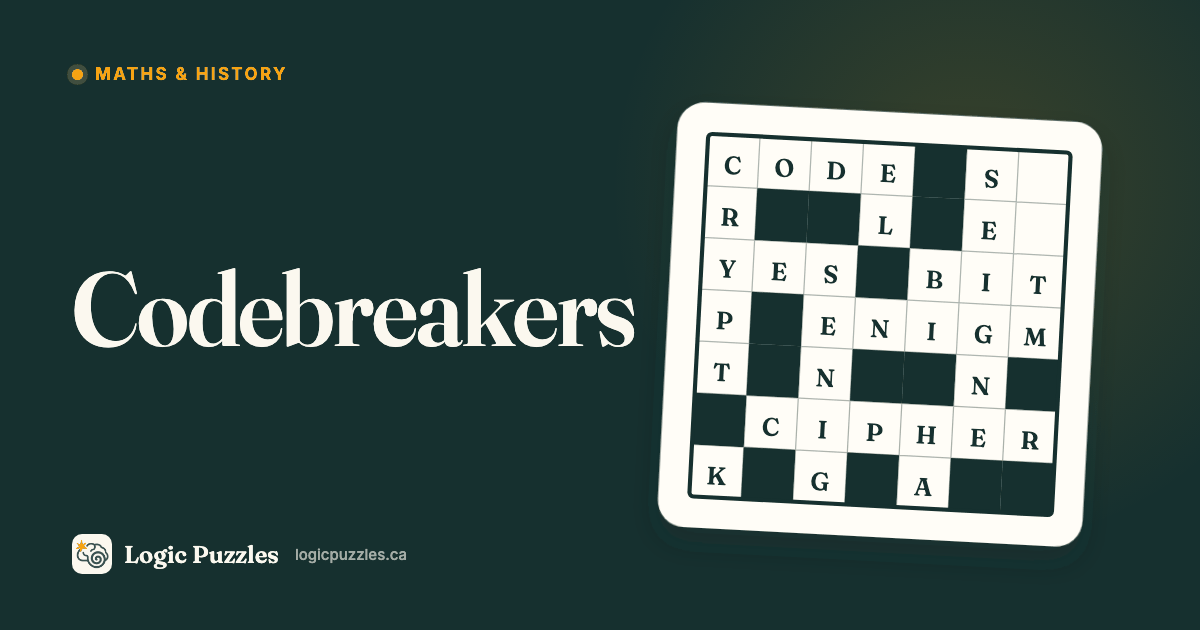
In January 1942, with the Battle of the Atlantic going badly and Britain's survival arithmetic grim, a London daily newspaper staged a peculiar event: a crossword speed championship. Readers had written in claiming the paper's puzzle had gotten too easy; the editor called the bluff and invited them to solve one under exam conditions. A dozen or so competitors sat in the newsroom; the fastest finished in under eight minutes; several beat the twelve-minute mark.
The contest looked like a circulation stunt. Weeks later, the participants who'd made time received discreet letters from the War Office, inviting them to discuss "a particular type of work" of national importance. The work was at a country estate called Bletchley Park. The paper's puzzle page had been, that Saturday, a filter for finding a specific kind of mind - and the government was standing behind the curtain, taking names.
The estate of puzzle people
Bletchley Park, home of the Government Code and Cypher School, is remembered for Alan Turing, and deservedly. But its deeper story is a staffing insight decades ahead of its time: the qualities that break ciphers do not live in any one profession. So Bletchley recruited by aptitude wherever it flashed - mathematicians, yes, but also chess champions like Hugh Alexander and Stuart Milner-Barry, classicists, linguists, musicians, and demon crossword solvers. At its peak the operation ran to some ten thousand people, roughly three-quarters of them women, many recruited young and told nothing except that the work mattered.
What did a crossword prove, exactly? Consider what a cryptic solver does: holds a surface reading while hunting the hidden one; refuses the obvious interpretation on principle; tries transformations - anagram, container, reversal - systematically rather than randomly; and abandons a beloved hypothesis the instant it stops fitting crossers. Now consider an Enigma cryptanalyst's day: exploiting the machine's one flaw (no letter ever encrypts to itself), hunting cribs - guessable plaintext like weather reports and the German fondness for formulaic sign-offs - and testing alignments where the guess never collides with the cipher. It is the same posture: pattern-hunger, disciplined trial, allergy to assumption. The crossword didn't teach anyone to break Enigma. It revealed the temperament that could learn to.
The pipeline paid for itself many times over. Turing's bombes - electromechanical devices that raced through Enigma rotor settings by chasing contradictions from a crib - turned decryption into an industrial process. Elsewhere on the estate, the mathematician Bill Tutte reconstructed the logical structure of the far tougher Lorenz cipher without ever seeing the machine - from ciphertext alone, an act sometimes called the greatest intellectual feat of the war - and the engineer Tommy Flowers built Colossus, the world's first large-scale electronic programmable computer, to attack it. Modern computing's delivery room was, functionally, a puzzle club with a security fence.
The oldest trick in the book
None of Bletchley's methods emerged from nowhere; they sit on a thousand-year lineage that recreational solvers still walk. In ninth-century Baghdad, the polymath al-Kindi wrote the earliest surviving description of frequency analysis: every language leans on its letters unevenly, so a substitution cipher - which masks letters but preserves their pattern of use - can be peeled by counting. English, for instance, spends nearly an eighth of itself on E; one-letter words are A or I; an apostrophe before a lone letter whispers T or S.
That is precisely the game our cryptograms offer, unchanged in five hundred years except for the stakes. When you crack one - counting the most common symbol, planting THE like a crowbar, watching the vowels confess - you are performing, at kitchen-table scale, the exact craft that filled Hut 6. The continuity is not metaphorical. It is the same attack, on the same weakness: language cannot stop repeating itself, and repetition is a fingerprint no mask conceals.
The panic of May 1944
The war gave the crossword one more starring role, this time as suspect. In the weeks before D-Day, the paper's puzzles began surfacing the invasion's most guarded vocabulary as answers: UTAH and OMAHA - the landing beaches - then MULBERRY, the codename for the floating harbors, then NEPTUNE and OVERLORD, the operation names themselves. MI5 descended on the setter, a mild schoolmaster named Leonard Dawe, and interrogated him as a possible channel to the enemy.
The likeliest explanation, pieced together decades later, is more human: Dawe habitually let schoolboys suggest words for his grids, and his students mingled with the soldiers encamped around their evacuated school - soaking up loose codewords and recycling them innocently into puzzles. No espionage; just the porousness of language around teenagers. But the episode is a perfect parable of the puzzle mind's wartime status: the authorities found it entirely plausible that a crossword could be a weapon, because for two years, quietly, it had been.
The temperament, at peace
Bletchley's veterans returned to ordinary lives, sworn to silence for decades - many died before their families learned what the "clerical work" had been. What outlived the secrecy is the recruiting insight, which modern research on problem-solving keeps re-confirming from other directions: the skills that matter compound across domains that look unrelated. Systematic elimination, crib-hunting, holding hypotheses loosely, hearing signal inside noise - these are not crossword skills or cipher skills. They are one temperament, and it is trainable, and every puzzle you solve is a small unsupervised session at the estate.
The paper's twelve-minute crossword is the cheerful proof that nobody knows where that temperament is parked. In 1942 it was found in accountants and schoolteachers who happened to be fast with anagrams - and it helped shorten a world war. Whatever your grid of choice trains in you, history's advice is not to call it a pastime too quickly. Someone, someday, may need exactly that shape of mind - and the people who have it always turn out to have been practicing somewhere unglamorous.