Most grid puzzles hand you clues about contents: this row sums to eleven, this region holds one star. Skyscrapers does something more cinematic. Its clues are views. Every number around the border is a person standing at the end of a street, reporting how many buildings they can see - where each building in the row is a different height, and taller ones completely hide shorter ones behind them.
That single conceit produces one of the most satisfying logic puzzles in the modern canon, a staple of the World Puzzle Championship and a favorite of setters because it teaches, faster than almost any other grid, the skill of reading a constraint from someone else's point of view.
The rules in one breath
An N×N grid must be filled with heights 1 through N so that every row and every column contains each height exactly once - Skyscrapers is a Latin square at heart, Sudoku's older, box-free ancestor. Around the edge, clue numbers count visible buildings looking down that row or column: a 3 means exactly three buildings poke into view from where the clue stands, each taller than everything in front of it.
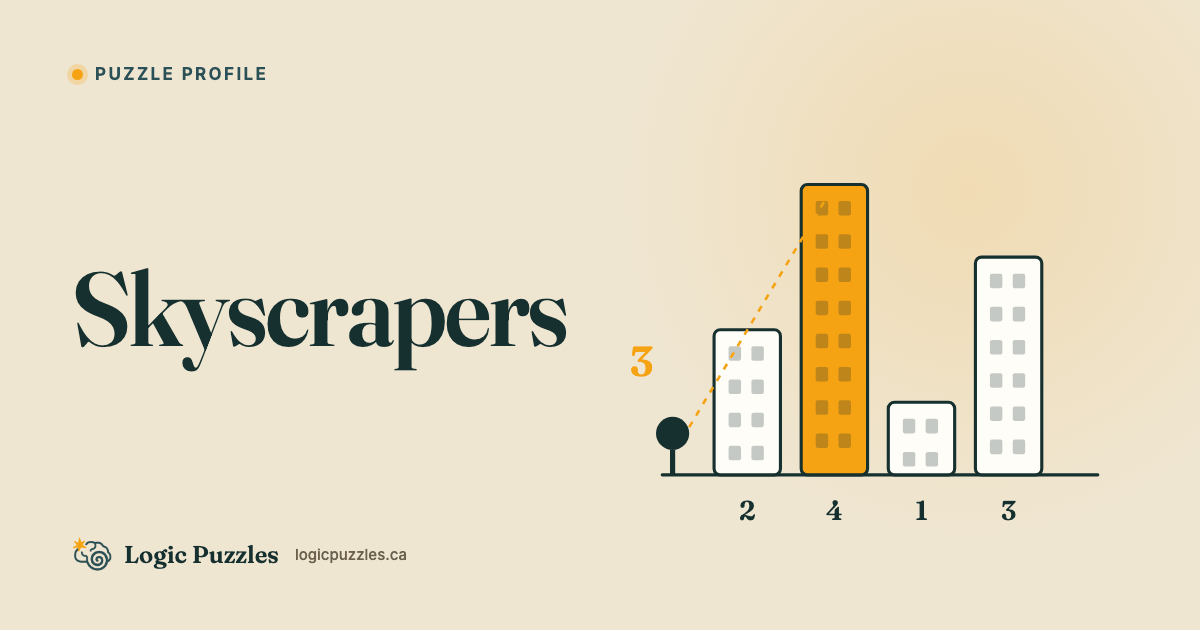
A row reading 2, 4, 1, 3 shows the observer on the left exactly two buildings: the 2, then the 4 towering behind it, with the 1 and 3 lost in its shadow. Now stand at the right end of the same street and count for yourself before reading on. You meet the 3 first - visible. The 1 hides behind it. The 4 clears everything - visible. The 2 is buried. Two again, by a completely different route. If you just walked that street twice in your head, you have already performed the puzzle's core move: the clue is not a formula, it is a view, and simulating it is the technique.
The opening book
Like chess, Skyscrapers has standard openings - clue values whose consequences are immediate.
Clue = N: the full staircase. If the observer sees all N buildings, nothing hides, so heights must strictly increase away from them: 1, 2, 3, … N, in order. The entire line fills in from a single number.
Clue = 1: the wall. Seeing exactly one building means the very first one blocks everything - the tallest building, height N, stands adjacent to the clue.
The exclusion rule. Subtler and more powerful: for a clue of c, the tallest building cannot stand within the first c−1 cells of that line. If it did, too few buildings could precede it for the count to reach c. A clue of 3 on a 5×5 immediately bans the 5 from the line's first two cells. Cross-reference these bans from both ends of every row and column, and the tallest skyscraper's possible homes often collapse to one or two cells before you've placed anything. Most hard skyscraper puzzles are cracked exactly here - by hunting where each column's N can legally live.
Opposite clues negotiate. The two ends of one street constrain each other; a street showing 1 from the left must show its buildings piled against the far view. In general the two clues on a line can sum to at most N+1 - a sanity check that also powers deductions on nearly-extreme pairs. A 5×5 line clued 4 and 2 has very few skylines; sketch the possibilities and intersect them, nonogram-style, keeping any cell all candidates agree on.
Records: the clue's secret identity
Here is the part where a border number turns out to be respectable mathematics. What a Skyscrapers clue counts, a statistician calls records - the running maxima of a sequence. Scanning down the street, a building is visible precisely when it is taller than everything seen so far: a new record.
Records have famously pretty behavior. In a random ordering of N distinct heights, the expected number of records is the harmonic sum 1 + 1/2 + 1/3 + … + 1/N - about ln N. A random 5×5 street shows on average only around 2.3 buildings; a random street of a million buildings shows, on average, barely fourteen. Records are rare, and each new one is rarer than the last, which is why big clue values are so violently informative: a 4 on a 5-line is demanding a genuinely improbable arrangement, and improbable arrangements are nearly forced ones. The same mathematics governs record floods, record heatwaves, and record sprint times - when a forecaster says a once-a-century event, they are reading a skyscraper clue off the world.
The transferable skill
Skyscrapers trains a move that generalizes beautifully: stand where the constraint stands. The grid looks entirely different from the left end of row three than from the top of column two, and the puzzle only yields when you keep re-planting your feet - walking each street, asking what this observer must see and what they cannot.
That habit - evaluating a system from inside each of its constraints rather than from a god's-eye nowhere - is negotiation practice, code review practice, chess practice. It is also, not incidentally, the empathy of good explanation: the writer asking what this sentence looks like to someone who hasn't read the previous one. Puzzles rarely advertise which mental muscle they are secretly training. This one tells you outright: the clue is a person, standing somewhere, telling you honestly what they see. Believe them, join them on the corner, and the skyline has no choice but to appear.