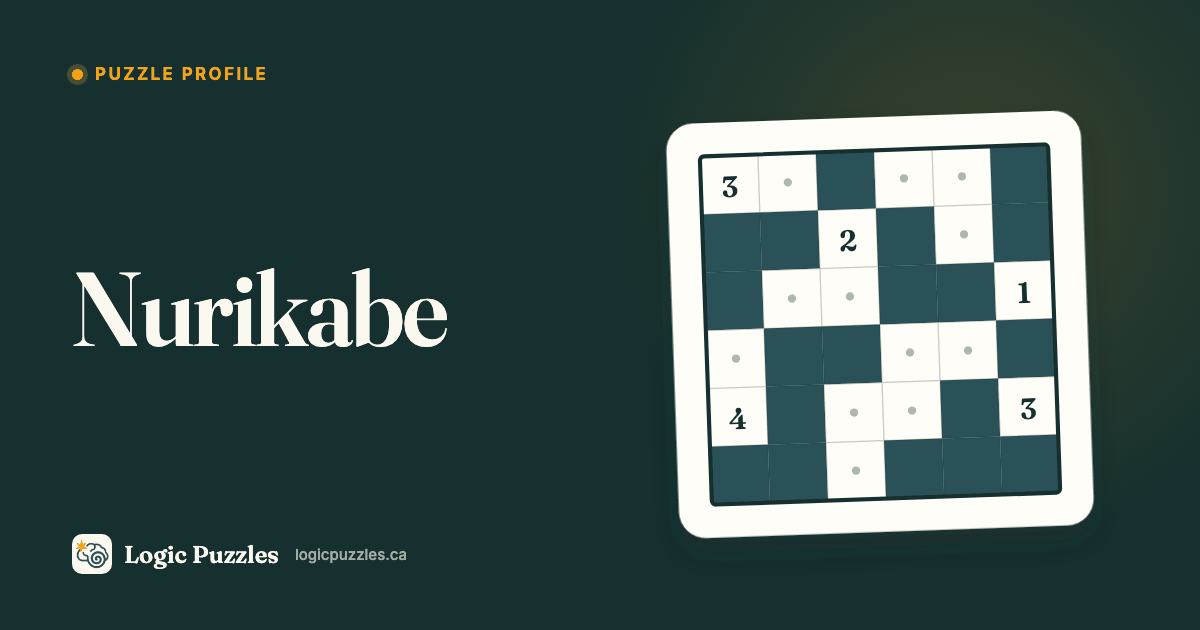
Japanese folklore describes a spirit called the nurikabe: an invisible wall that materializes across country roads at night, halting travelers in the dark. Push it, walk around it - useless; the wall extends as far as you wander. The stories say it yields only to an odd, specific courtesy: knock low, near the ground, and it vanishes.
In the early 1990s, a Japanese puzzle publisher borrowed the ghost's name for a new grid puzzle, and rarely has a name fit better. Solving Nurikabe is negotiating with an invisible wall - the black cells are nowhere at the start, everywhere by the end, and they appear not because you find them but because logic leaves them no other way to be. It is also, quietly, the best introduction in all of puzzledom to a kind of reasoning most grids never touch: thinking about connection itself.
The rules of the haunting
A grid contains scattered numbers. When solved:
- Each number belongs to a white island of exactly that many cells, containing exactly one number.
- All black cells - the sea, or the wall - form one single connected region (orthogonally).
- The sea never pools: no 2×2 block is ever entirely black.
Islands cannot touch each other orthogonally (they'd merge into one island with two numbers - illegal). That's everything. From four sentences: one of the deepest solving experiences on square paper.
Where the first stones come from
Nurikabe openings are pure logic made visible, and they are teachable in a paragraph.
Diplomatic buffer zones. Any cell orthogonally adjacent to two different numbered islands must be black - white there would fuse two islands into one, which no number permits. Scan any fresh grid for numbers two cells apart, or diagonal neighbors: the cells between them are wall, immediately.
Finished islands wall themselves in. A "1" is an island already complete at birth; all four neighbors are instantly black. Any island that reaches its full size does the same - completion draws its own border. (The folklore got this right: the wall appears exactly where travel ends.)
The unreachable are the sea's. Here is the move that makes Nurikabe feel like no other puzzle. A white cell must ultimately belong to some numbered island - so any cell that no number could possibly reach, given sizes and distances, is black now. A "2" can claim cells at most one step away; anything beyond every island's reach is wall before you've deduced a single island's shape. Experienced solvers open hard grids by shading entire distant corners on reachability alone: the wall builds itself out of pure geography.
The sea must breathe. Rules 2 and 3 make the black region a living constraint. A black cell being cut off from the rest of the sea is illegal - so the lone black square in a corner must tunnel out, and there is often only one way. Conversely, three black cells forming an L must never close their 2×2 square: the fourth cell is white, free of charge. Endgames are frequently decided entirely by the sea's plumbing - walls forced to snake down the one corridor that keeps them whole without pooling.
Count the world. The island numbers sum to the total white count; everything else is black. On a 9×9 with numbers summing to 30, you know the sea holds 51 cells before you start - a running census that catches errors and settles endgames, exactly like the 45-rule in a Sudoku row.
Local versus global, felt in the fingers
Why single out Nurikabe for an essay? Because it teaches the difference between two species of constraint, and the lesson transfers far beyond puzzles.
Most grid rules are local: a clue governs its row, its cage, its neighbors. You verify them by looking at a small window. But "all black cells are connected" is global - no window can confirm it; the property belongs to the whole grid at once, and a single wrong cell three corners away can strangle it. Computer scientists meet the same division constantly: checking a row sum is trivial; checking connectivity requires walking the graph. Whole solver architectures pivot on the difference, and it is why Nurikabe resists lazy algorithms - and lazy habits - that treat cells independently.
For the human solver, the global rule demands a new posture. You cannot grind Nurikabe cell by cell; you must keep asking system questions: can the sea still hold together if this goes white? Can that island still reach its size if this goes black? It is the reasoning of the city planner, not the bricklayer - every local decision priced against the survival of a network. Players who internalize it report the same experience: other connectivity puzzles (Yin Yang's two unbroken colors, pipe-linking grids, wall-building games) suddenly feel like dialects of a language they already speak.
Knock low
The folklore's advice - the wall falls when you knock at its base - makes surprisingly good solving counsel. Nurikabe rarely yields to grand frontal reasoning about the middle of the board. It yields at the bottom: the humblest facts first. The 1-islands. The cell pinched between two numbers. The corner no island can reach. The lone black square that must tunnel out. Each is trivial alone; together they cascade, and the invisible wall assembles itself while you attend to small courtesies.
That is the general shape of hard problems more often than we admit. The traveler who shoves the middle of the wall gets a longer wall. The one who works patiently at ground level, where the structure meets its constraints, watches the whole thing come down - or in Nurikabe's case, watches it rise, cell by inevitable cell, into the only sea the numbers ever allowed.