Raymond Smullyan may be the only person in history to have worked as a stage magician, a concert pianist, and a professor of mathematical logic - and he treated all three as the same job. Born in 1919, he paid his way through school doing close-up magic, studied logic under Alonzo Church at Princeton, and spent his long life (he died in 2017, at 97) writing books that read like joke collections and teach like graduate seminars.
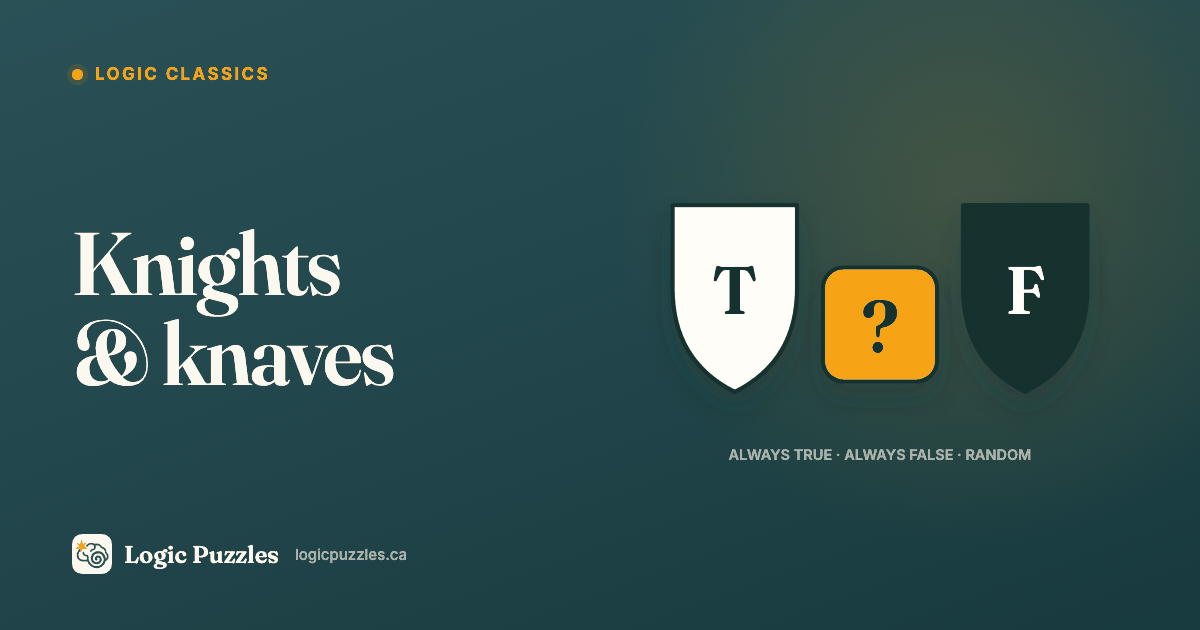
His signature invention is an island. On it live two kinds of inhabitants, indistinguishable by sight: knights, who always tell the truth, and knaves, who always lie. Every puzzle is a meeting: some islanders, some statements, and you - trying to work out who is what from words alone.
Learning the island's grammar
Start with the classic. You meet two islanders, A and B. A says: "We are both knaves."
Pause on it, because the reasoning is a perfect miniature of all logical deduction. Could A be a knight? Then his statement is true - both are knaves - which makes A a knave. Contradiction. So A is a knave, and his statement is therefore false. But notice the precision required: the negation of "both of us are knaves" is not "both of us are knights" - it is "at least one of us is not a knave." Since A is a knave, the falsehood must live in B's half. B is a knight, A is a knave, and the puzzle is solved by nothing but care.
That care is the entire curriculum. Knights-and-knaves puzzles are drills in the exact skills that formal logic runs on: track what follows from what, negate statements correctly, hunt contradictions, and treat "assume, then check" as a respectable way of knowing. Smullyan escalated the drills gorgeously - islanders who answer only yes or no, sane and mad vampires whose beliefs are inverted rather than their speech, days of the week on which lions lie. Each variation swaps one rule and asks you to rebuild your method.
The one-question fork
The most famous island problem is practical. You reach a fork in the road. One path leads to safety, the other to ruin. A single islander stands there - knight or knave, you cannot tell - and you may ask one yes-or-no question. Which?
Asking "Does the left road lead to safety?" wastes the question: a knight's yes and a knave's yes mean opposite things, and you cannot tell which you received. The masterstroke is to fold the islander's own nature into the question: "If I asked you whether the left road leads to safety, would you say yes?"
Follow the cases. A knight answers honestly about his honest answer: yes means yes. A knave lies about the lie he would tell - and the two inversions cancel. If the left road is safe, his truthful inner answer would be "no" (he'd lie), so, lying about that, he says "yes." Either way, the answer you hear is the truth about the road. Double negation, weaponized. Computer scientists will recognize the move: it is error correction, building a reliable channel out of an unreliable component by routing the signal through the distortion twice.
From party trick to Gödel
Here is what elevates Smullyan above a riddle-writer. He noticed that his island could hold the deepest result in modern logic.
Consider an islander who says: "You will never know that I am a knight." Work it through. If he were a knave, the statement would be a lie - meaning you could someday know he's a knight - but knaves can never be known to be knights, since they aren't. Contradiction: so he must be a knight. But wait - you have just proven it, and his true statement says you never would. The only escape is unsettling: he can be a knight, and his statement can be true, only if that truth stays forever outside what you can establish.
This is a pocket version of Gödel's incompleteness theorem - the 1931 discovery that any consistent formal system rich enough to do arithmetic contains true statements it cannot prove. Gödel built a sentence that says, in effect, "this statement is unprovable"; Smullyan built an islander who says it at a cocktail party. His books walk ordinary readers from two-liner riddles to the actual architecture of Gödel's proof in small, playable steps - probably the gentlest on-ramp to profound mathematics ever written.
The hardest logic puzzle ever
The tradition has an official summit. In 1996, the Harvard philosopher George Boolos published a problem he titled - formally, in a journal - The Hardest Logic Puzzle Ever, crediting its invention to Smullyan (with a final twist from the computer scientist John McCarthy).
Three gods stand before you: True, who always speaks truly; False, who always lies; and Random, whose answers are chance. You must identify all three using three yes-or-no questions, each addressed to one god. The twist: the gods understand you, but answer in their own language - da and ja - and you do not know which word means yes.
It sounds impossible: unknown identities, an unreliable oracle, and answers in a language you can't read. Yet it falls to an industrial-strength version of the fork trick. Questions of the form "If I asked you Q, would you say da?" cancel both the lying and the language - whatever da means, whoever answers, the reply carries the truth of Q. The remaining art is question one: use it to locate a god who is definitely not Random, so questions two and three land on speakers whose distortions cancel. Chance can't be error-corrected, so the strategy quarantines it instead.
The solution repays study, but its moral fits a sentence: there is no source so unreliable that logic cannot sometimes build a truth-channel through it - except pure randomness. That is a theorem about conversations, and everybody who has navigated office politics already suspected it.
The island in every grid
Knights and knaves distill what every logic puzzle asks of you: hold hypotheses lightly, follow each to its collision, and let contradictions - not hunches - do the eliminating. When you crack a logic grid by noting "if the doctor were in the red house, two clues would clash," you are doing island reasoning with furniture. Smullyan's magic trick was making the practice indistinguishable from play, which he would have said was no trick at all. The full title of his most famous collection is a knight-knave puzzle of its own: What Is the Name of This Book?