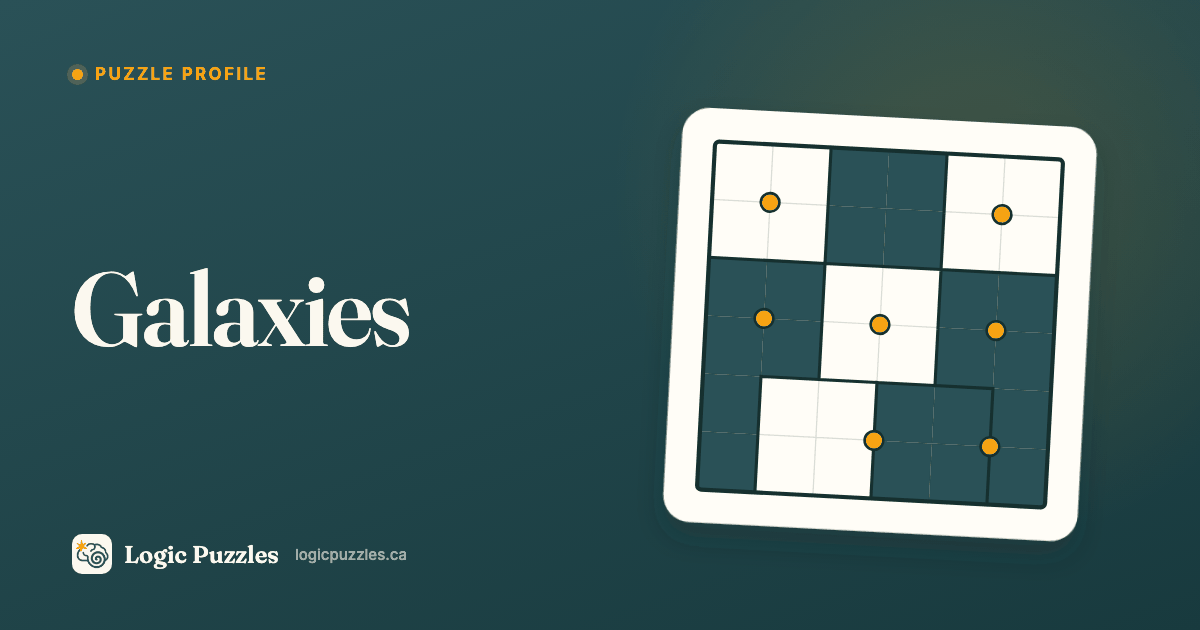
Some puzzles hide their best idea in the rules. Galaxies hides it in the name. The puzzle was first published in Japan as Tentai Show - a pun so perfect it borders on showing off: read one way it means "astronomical show," a sky full of spiral galaxies; read another it is ten-taishō - point symmetry, the puzzle's entire law. One name, both halves of the design: what it looks like, and what it obeys.
The look: a grid scattered with dots, like stars on graph paper. The law: carve the entire grid into regions - galaxies - such that each region contains exactly one dot, and each region is perfectly symmetric under a 180-degree rotation about its dot. Spin any galaxy half a turn around its star and it lands exactly on itself.
From that single constraint comes one of the most distinctive solving experiences in the Japanese grid-puzzle canon - and a working introduction to the tool that modern physics considers its deepest: symmetry as a generator of certainty.
The buy-one-get-one principle
Here is the whole engine of Galaxies, expressible in one sentence: every cell you assign instantly assigns a second cell. If cell X belongs to the galaxy with dot D, then the cell diametrically opposite X through D - its mirror twin - must belong to that galaxy too. No exceptions; symmetry is not a preference but the rule itself.
This changes the solving economics completely. In Sudoku, a placement earns its own consequences. In Galaxies, every deduction is matched, move for move, by an invisible bookkeeper on the far side of each dot. Strong play is largely the discipline of collecting the twin immediately - mark X, mark its mirror before your pencil lifts - because forgotten twins are how contradictions hide.
The same principle runs in reverse with lethal efficiency. If X's mirror-through-D is off the grid, or already claimed, or walled away, then X can never belong to D - struck from D's possibilities without further thought. The puzzle's hardest-looking deductions are usually this negative form: a cell far from any dot, whose candidate galaxies die one by one because their required twins are impossible, until a single owner remains. (Solvers of Nurikabe will recognize the "who could ever reach this cell?" instinct; Galaxies sharpens it with geometry.)
Add the dot positions themselves - dots sit on cell centers, edges, or corners, so a galaxy's core is one, two, or four forced cells - and the opening ritual writes itself: claim every core, claim every twin, kill every orphan. Grids often half-solve on this alone, and what remains is a border negotiation between neighboring galaxies, each expansion echoed point-for-point across its star.
Symmetry as a fact-multiplier
Step back from the grid and notice what the puzzle has done: it has taken symmetry - something we usually treat as decoration, the property of butterflies and cathedrals - and revealed it as a constraint that halves the world's freedom. A symmetric galaxy has only half the choices of a free-form one; the other half is dictated. Symmetry is information.
This is not a puzzle-sized truth; it may be the largest truth working science owns. Crystallographers classified all seventeen fundamentally different wallpaper symmetries in the nineteenth century, and the classification dictates what crystal structures can exist - geometry legislating chemistry. And in 1918, the mathematician Emmy Noether proved what physicists regard as one of the most beautiful theorems ever found: every continuous symmetry of nature's laws forces a conservation law. Because physics runs the same today as tomorrow, energy is conserved; because here works like there, momentum is conserved. Conservation of momentum is, in a precise sense, the universe collecting its mirror twin.
You need none of that to enjoy Tentai Show. But it is worth knowing that the move you perform there - this half is known, so that half is known - is the professional method of theoretical physics, played on a lattice instead of a Lagrangian.
The aesthetic of the half-turn
Why did the designers choose rotational symmetry rather than the mirror kind? Partly mechanics: mirror symmetry needs an axis, which privileges certain grid lines, while point symmetry travels anywhere a dot can sit. But mostly, one suspects, feel. Mirror symmetry is static - the calm of a face, a Rorschach blot. Rotational symmetry is dynamic: pinwheels, propellers, spiral arms. A solved Galaxies board genuinely resembles its namesake - irregular luminous shapes, each coiled around its star, tiling the sky with no gap. Among logic puzzles only Nonograms rival it for the reward of a finished picture, and the Galaxies picture is abstract art you were forced, cell by cell, to get exactly right.
There is a design lesson here that we return to often: the best puzzle rules are load-bearing beauty. The symmetry law isn't a theme painted over a grid - it is simultaneously the puzzle's entire logic, its visual identity, and its name's pun. Nothing is wasted. Sudoku achieves this with the number 9; Galaxies achieves it with half a turn.
Solving with the universe's habit
A practical close, because Galaxies rewards a specific discipline worth stating as drill:
- Core first. Mark the forced cells around every dot - center, edge-pair, or corner-quad.
- Twin always. Every claim and every exclusion, reflect through the dot before moving on.
- Orphan hunt. For lonely cells, list candidate dots and execute their twins mentally; most die on arrival.
- Borders last. Where two galaxies meet, one cell's fate settles both - and its two mirrors settle two more.
Four rules, and the fourth is just the first three at a boundary. If the rhythm feels familiar, it should: it is the rhythm of every symmetric argument you've ever met - prove it for one side, claim it for the other, spend the savings on the hard part. The universe has been solving this way, Noether assures us, since the beginning. The least we can do is keep up on graph paper.