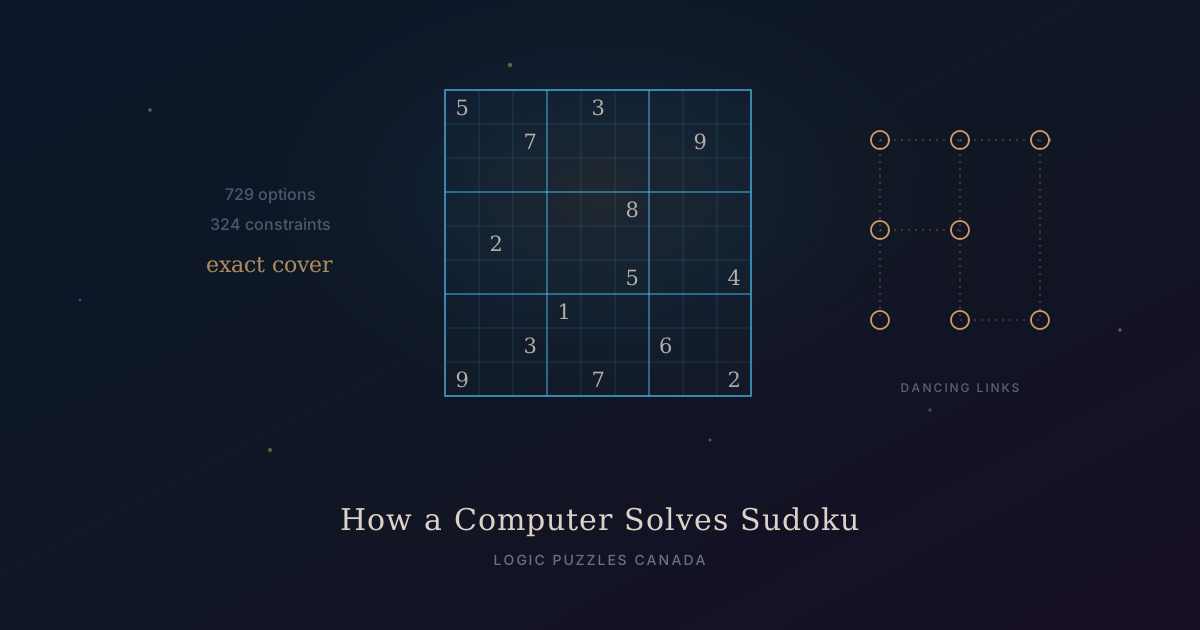
Every puzzle you solve has ancestors. The Sudoku on your phone this morning did not appear from nowhere — it is the current generation of a conversation that has been running for centuries, carried across borders by mathematicians, magazine editors, a retired judge, and a publisher who named his company after a racehorse. The history is better than you would guess, and knowing it changes how the grid feels under your fingers.
A turtle and a square
Begin with legend. Chinese tradition tells of a turtle emerging from the Lo River bearing a 3×3 arrangement of numbers on its shell — the Lo Shu square, in which every row, column, and diagonal sums to fifteen. The story is myth, but the object is real and ancient: the magic square, humanity's first grid puzzle. Numbers, a grid, and a constraint that must hold everywhere. Every logic puzzle since is a variation on those three ingredients.
Magic squares fascinated scholars across China, India, the Islamic world, and eventually Europe — Albrecht Dürer engraved a famous 4×4 into his 1514 print Melencolia I, slyly working the date into the bottom row. For most of history, though, these were objects of mysticism and mathematics, not pastimes. The puzzle as entertainment needed two more inventions: a theory, and a printing press with empty column space.
The colonel's problem
The theory arrived in 1782, when Leonhard Euler — the most prolific mathematician who ever lived — posed a deceptively simple question. Take thirty-six officers, from six regiments and six ranks. Can you arrange them in a 6×6 square so that no row or column repeats a regiment or a rank?
Euler suspected the answer was no, but could not prove it; confirmation took until 1900, when Gaston Tarry checked the possibilities by exhaustive hand analysis. Then in 1959 came one of the great twists in mathematics: three researchers proved Euler's broader conjecture wrong for every other size he had doubted — earning themselves the nickname "Euler's spoilers" and, remarkably, coverage on the front page of The New York Times. A puzzle about parade formations had become front-page news.
Out of the officer problem, Euler formalized what he called Latin squares: grids where each symbol appears exactly once per row and column. He considered them a curiosity. They became foundations of experimental design in statistics and of error-correcting codes — and, two centuries later, of a certain 9×9 pastime. A completed Sudoku is simply a Latin square with one extra constraint, which means every solver is unknowingly working in Euler's notebook.
Puzzles go to press
The next carriers were newspapermen. Around the turn of the twentieth century, Sam Loyd in America and Henry Dudeney in England turned mathematical recreation into mass entertainment, publishing thousands of puzzles for ordinary readers. In 1931 Dell launched the modern puzzle magazine in the United States, and the pencil-puzzle industry was born — cheap paper, spare time, and a public that had just learned, via the crossword craze of the 1920s, that grids were fun.
The pivotal moment passed almost unnoticed. In the May 1979 issue of Dell Pencil Puzzles & Word Games, a puzzle appeared under the name "Number Place": a 9×9 grid, nine 3×3 boxes, digits one through nine, no repeats. It ran without a byline. Puzzle historians — Will Shortz prominent among them — later traced it through Dell's contributor lists to Howard Garns, a retired architect from Indianapolis, then in his seventies. Garns died in 1989, never knowing what his little grid was about to become.
The quiet revolution in Tokyo
What it became required Japan. In 1980, Maki Kaji founded a puzzle company in Tokyo and named it Nikoli, after a racehorse he had backed. Nikoli did something unprecedented: it treated puzzles as a craft culture, publishing grids hand-made by its own readers and refining formats through feedback, iteration, and taste.
In 1984, Nikoli imported Garns's Number Place under the name sūji wa dokushin ni kagiru — roughly, "the digits must remain single" — soon compressed to Sudoku. Nikoli did not just rename the puzzle; it refined it, insisting on aesthetics like symmetrical clue placement that American publication had never bothered with. And Sudoku was only one entry in the catalogue. Nikoli's workshop originated or perfected an astonishing share of the modern canon — Slitherlink in 1989, Nurikabe, Masyu, Hashiwokakero — and gave Kakuro its name after adopting Dell's older "Cross Sums." Kaji, who died in 2021 remembered worldwide as the godfather of Sudoku, described his life's work as "puzzle communication." It is hard to think of a better two-word description of what a good puzzle is.
The judge with a laptop
The final carrier was an amateur. In 1997, Wayne Gould, a recently retired Hong Kong judge, wandered into a Tokyo bookshop and picked up a Nikoli Sudoku collection. He spent the next six years — as a hobby — writing software that could generate the puzzles. In late 2004 he walked into the offices of The Times of London and offered them grids for free; the first ran on November 12, 2004.
What followed was the fastest spread of any puzzle format in history. Within months, virtually every British newspaper carried a daily grid; within a year, the craze was global, drawing comparisons to the Rubik's Cube. Trace the full arc and it is almost absurd: invented by an American architect, refined and named by a Japanese publisher, automated by a New Zealand-born judge, detonated by British newspapers, and solved, now, everywhere on Earth.
Pictures in the windows
One more thread, because it is too good to leave out. In the late 1980s a Tokyo graphic designer named Non Ishida won a competition for window art — pictures made by switching skyscraper lights on and off in a grid. Around the same time, puzzle maker Tetsuya Nishio independently hit on the same idea as a paper puzzle: reveal a hidden picture from numeric clues about filled cells. Japanese magazines began publishing these picture-logic puzzles in 1988, and in 1990 The Sunday Telegraph introduced them to Britain under a new name honoring Ishida: the Nonogram. You may know them as Picross or Hanjie. Same lineage, same delight — logic that ends in an image.
A three-century conversation
Here is what the history actually teaches. Puzzle formats are invented rarely, but they become classics through everything that happens afterward: refinement, naming, curation, and carriage across borders by people who loved them enough to move them. Euler supplied the mathematics. Garns supplied the grid. Kaji supplied the craft. Gould supplied the scale.
You supply the next part. Every morning you sit down with a grid, you are answering a correspondence that has been going for three hundred years — and it is your move.