Open a blank document and write something brilliant. Paint anything you want on an empty canvas. Build whatever you can imagine from scratch.
These invitations are supposed to feel exciting. They usually feel paralyzing.
The blank page problem
There is a well-documented phenomenon in psychology called the paradox of choice. When people are given too many options, they do not feel liberated - they feel stuck. Too many possibilities become indistinguishable. The mind searches for a foothold and finds none.
This is why a blank page is harder than a half-written one. Why "write about anything" is a harder prompt than "write about a time you changed your mind." Why an infinite canvas feels less creative than a 5x5 grid with three rules.
Freedom, it turns out, is not the absence of constraints. It is the presence of the right ones.
How constraints create possibility
A logic puzzle is nothing but constraints. A Sudoku gives you a 9x9 grid and three rules: no repeats in any row, column, or box. That is it. From those three constraints, an entire universe of deduction opens up.
This is the paradox that puzzle solvers understand intuitively: the more restricted the system, the more meaningful each decision becomes. When anything is possible, nothing matters. When only certain things are possible, every choice carries weight.
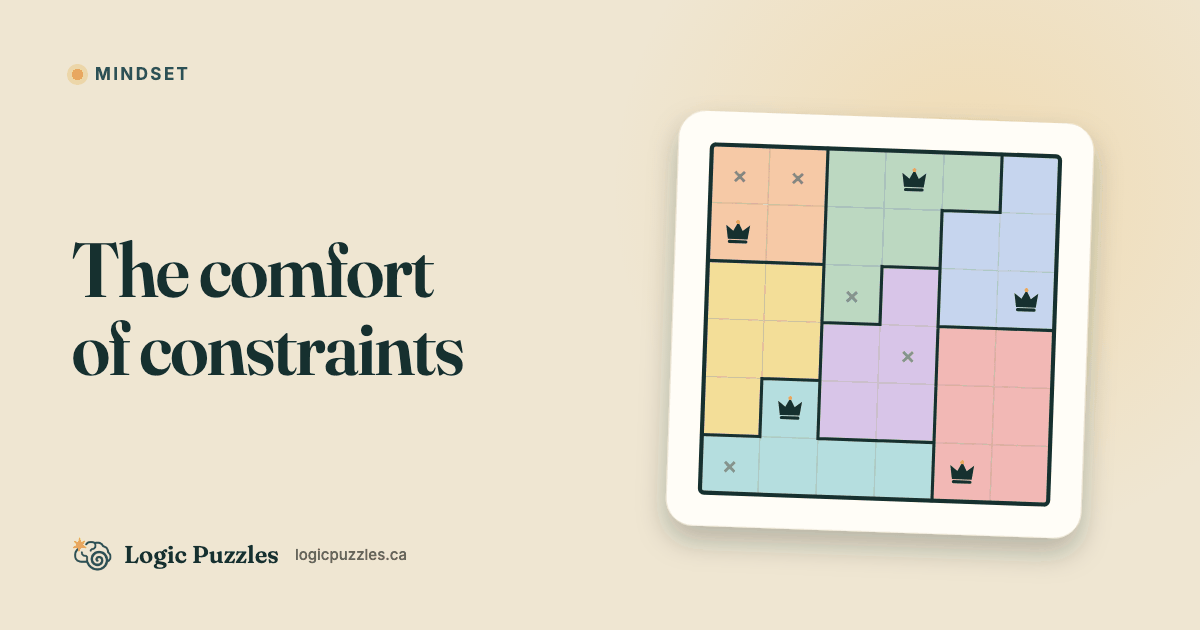
Consider a Crowns puzzle. The rules are minimal - place one crown per color region, and no two crowns can touch, even diagonally. From that tiny set of restrictions, a web of implications unfolds. Each constraint interacts with the others, creating a logic chain that is far richer than any individual rule suggests.
The constraints do not limit your thinking. They give your thinking somewhere to go.
Why we crave structure
Modern life sells us on the value of optionality. Keep your options open. Maximize flexibility. Never commit too early. The assumption is that more choices lead to better outcomes.
But our brains did not evolve for infinite choice. They evolved for environments with clear boundaries and knowable rules. When the rules are clear, we can think deeply. When they are ambiguous, we spend our mental energy just trying to figure out what the game even is.
This is part of why puzzles feel so satisfying. When you sit down with a Nonogram or a Calcudoku, the rules are defined. The boundaries are fixed. The goal is unambiguous. There is no strategy meeting about what success looks like. There is no scope creep. There is just a set of constraints, a solution that satisfies all of them, and your mind in between.
That clarity is a gift. In a world where most problems are fuzzy, open-ended, and subject to change, a problem with firm edges is a relief.
Constraints as creative fuel
Artists have known this forever. Give a poet fourteen lines and a rhyme scheme, and you get a sonnet. Give them infinite freedom, and you get a blank page and a deadline.
The same principle applies to puzzle design. Our best puzzles come not from having more mechanics, but from having fewer. Binary Sudoku+ has two core rules. Aquarium has one central mechanic. These games are deep not despite their simplicity but because of it. When the rule set is small, every interaction between rules becomes significant. Depth emerges from constraint.
Solvers experience this too. The most satisfying deductions are not the ones with many options. They are the ones where the constraints narrow the field to a single inevitable conclusion. The tighter the squeeze, the more rewarding the click.
What puzzles teach about real problems
The constraint principle extends far beyond grids and numbers.
The best engineers do not build systems with unlimited flexibility. They build systems with well-chosen limitations that prevent entire categories of errors. The best writers do not use every word available to them. They restrict their vocabulary to find precision. The best decision-makers do not keep every option on the table forever. They set criteria, eliminate what does not fit, and commit.
In each case, the constraints are not obstacles to good work. They are what make good work possible.
Puzzles train this instinct. When you practice working within constraints daily - finding not just any answer, but the only answer that satisfies every rule - you build a mental model for how restrictions create clarity rather than limiting it.
The anxiety of open-endedness
There is a reason people reach for their phones in every idle moment. Open-ended time feels uncomfortable. What should I do? What is the best use of this moment? The question itself is exhausting.
A puzzle eliminates that question entirely. For the next ten or twenty minutes, you know exactly what you are doing. Not because someone told you to, but because the constraints of the puzzle define the task completely. There is no ambiguity about what progress looks like. There is no second-guessing whether you are spending your time wisely.
This is not mindlessness. It is the opposite - focused, deliberate thought within a defined space. And that combination of engagement and clarity is precisely what makes puzzles feel restful even though they require effort.
Choosing your constraints
The puzzles you enjoy most probably say something about the kind of constraints your mind finds most comfortable.
Some people love the spatial logic of Nonograms, where constraints play out visually across a grid. Others prefer the numerical precision of Sudoku or Calcudoku. Some are drawn to the regional thinking of Crowns or Aquarium, where constraints operate on groups rather than individual cells.
There is no wrong preference. But it is worth noticing what draws you. The constraints you choose voluntarily often reflect the kind of thinking you find most satisfying - and most restorative.
The freedom inside the rules
Here is the thing about constraints that the "keep your options open" crowd misses: constraints do not eliminate freedom. They focus it.
Inside a well-designed puzzle, you are free in the ways that matter. Free to approach the grid from any angle. Free to choose which constraint to apply first. Free to develop your own solving style, your own notation, your own rhythm. The rules define the space, but within that space, the thinking is entirely yours.
That is a better kind of freedom than the blank page offers. Not the freedom to do anything, but the freedom to think clearly about something specific. Not limitless possibility, but meaningful choice within defined bounds.
The next time you feel overwhelmed by options - at work, in a decision, in how to spend an evening - try the opposite of keeping things open. Pick up a puzzle. Accept its constraints. And notice how quickly your mind stops spinning and starts working.
The edges of the grid are not a cage. They are a frame.