Take an ordinary chessboard - 64 squares - and 32 dominoes, each sized to cover exactly two adjacent squares. Covering the board is trivial; a child does it in a minute. Now mutilate the board: slice off two diagonally opposite corners, leaving 62 squares, and hand over 31 dominoes.
Same game, slightly smaller. And it cannot be done. Not "is hard" - cannot, ever, by anyone, and no amount of rearranging will help. People given the physical pieces will shuffle them for an hour, increasingly suspicious of the universe. The proof, when it lands, takes two sentences and produces one of the cleanest thunks of insight available anywhere in mathematics. This essay is about that thunk, the puzzle genre built on domino logic, and why "prove it's impossible" is a solving skill you already need.
Two sentences
Every domino, wherever placed, covers exactly one dark square and one light square - adjacent squares always differ in color. But diagonally opposite corners share a color, so the mutilated board has 32 squares of one shade and only 30 of the other; 31 dominoes would need 31 of each. There is nothing left to say. No tiling exists.
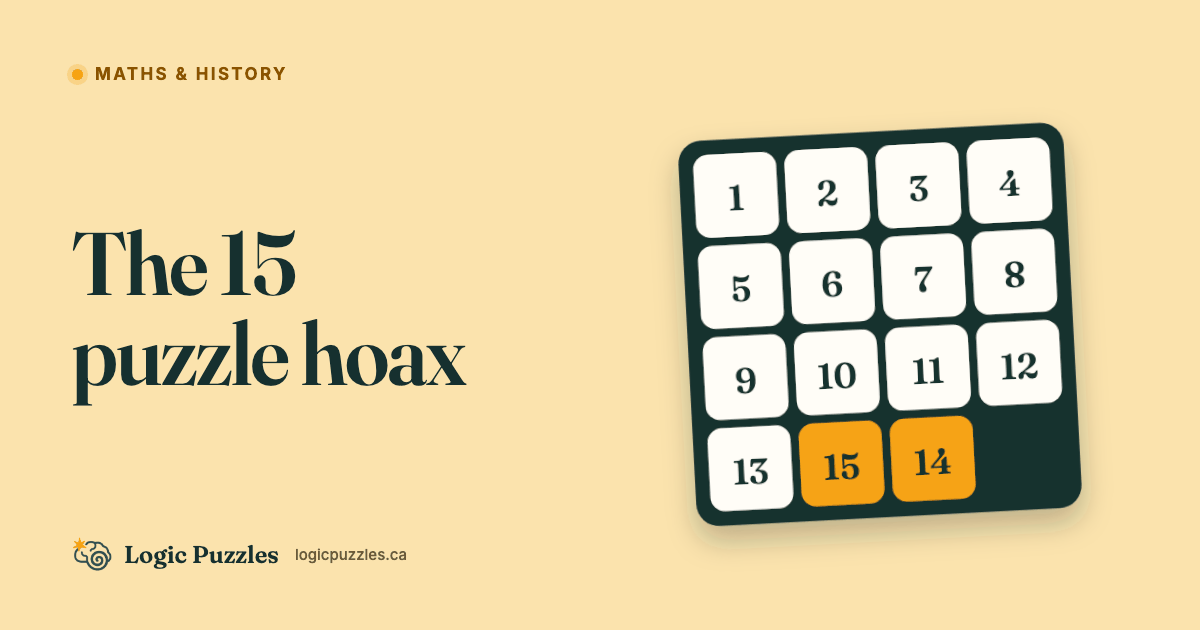
The problem became a classroom classic after the philosopher Max Black posed it in 1946, and Martin Gardner - patron saint of recreational mathematics - spread it to millions. What everyone remembers is not the answer but the method: the coloring was invisible until summoned, and once summoned it settles infinitely many futile arrangements in one stroke. It is the 15 Puzzle's parity argument wearing checkerboard dress - the invariant that no rearrangement can escape.
And the story has a gorgeous second act, too little known. Remove one square of each color - any two, anywhere on the board - and a complete tiling always exists. The proof, due to the mathematician Ralph Gomory, is a picture: thread a single closed rook's tour through all 64 squares, a loop visiting each once. Deleting one dark and one light square cuts the loop into two chains, each alternating in color and therefore of even length - and even alternating chains fall to dominoes like zippers closing. One drawing, all cases, forever. Impossibility by counting; possibility by construction; the whole temperament of combinatorics in one board.
Dominosa: the census with teeth
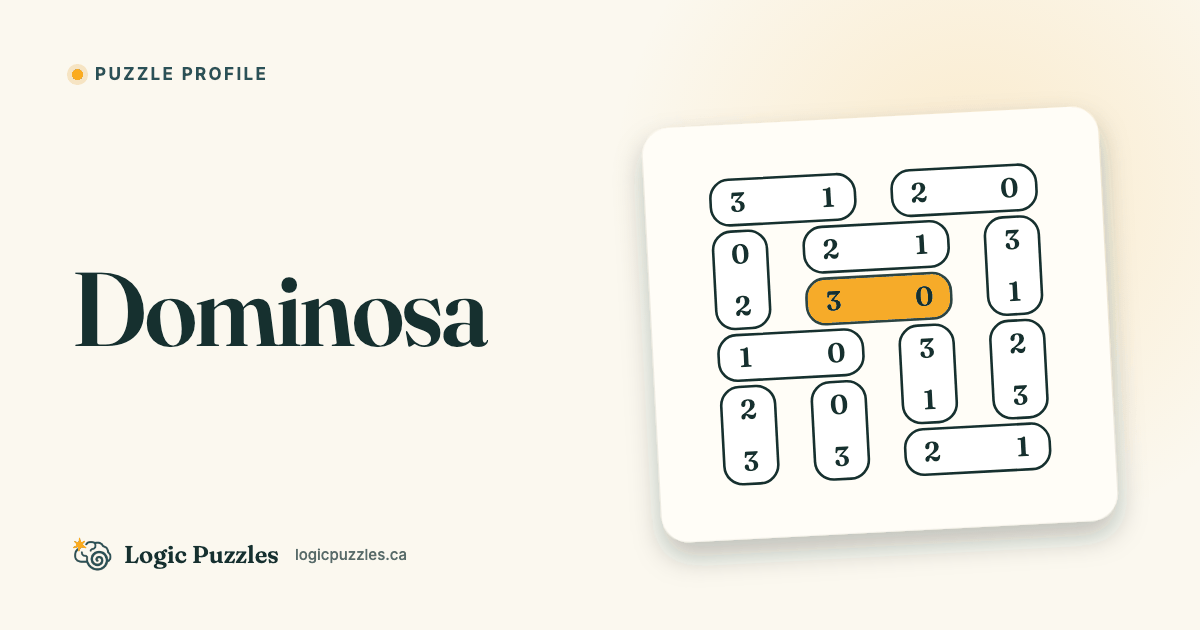
The puzzle shelf's purest expression of domino logic is Dominosa, a genre going back to the nineteenth century. You're shown a grid filled with numbers - say every value from 0 to 6 - and told the grid is secretly a complete set of dominoes laid flat: each pair {a,b}, including doubles, appears exactly once (the classic double-six set has 28 tiles; the grid has 56 cells). The tiles' borders have been erased. Restore them.
The rules are a census, and the census bites in both directions:
Uniqueness places tiles. Scan for a pairing that exists in only one spot: if 6 touches 3 at just one place on the whole grid, that domino lives there - done. Every placement then erases options: the {6,3} tile is spent, so any other 6-beside-3 adjacency is now a proven border between two different tiles. Mark borders as eagerly as tiles; like the water in Fleet or the dots in Light Up, the negative marks carry half the logic.
Geometry places tiles. A cell whose neighbors are all consumed except one must marry that survivor, whatever the numbers say - the forced-neighbor move, first cousin to the lonely cells of Light Up. Corners and edges, born with fewer neighbors, resolve earliest; every border you draw manufactures new near-orphans down the line.
Between the two engines - "this pair has one home" and "this cell has one partner" - runs the bookkeeping: a tally of spent tiles, exactly the fleet-accounting discipline of a Fleet puzzle. Hard Dominosa endgames add the chessboard's own weapon: when a region stalls, count it. A pocket of five cells can't be tiled by two-cell pieces; a pocket whose parity or color-count fails is dead, so the assumption that sealed it off is wrong. You are wielding the mutilated-board argument, live, as a solving tool: not "I can't find a tiling" but "no tiling of this pocket can exist, therefore my border is a lie."
Matchings, dimers, and the count you didn't ask for
Mathematics sees all of this as one object. Make each cell a node, join adjacent cells, and a domino tiling becomes a perfect matching - a pairing-off of the whole graph, the same abstraction that runs kidney-exchange programs and assignment algorithms. Physicists know it as the dimer model, their toy for molecules settling onto lattices - and in 1961 they solved it exactly: the number of domino tilings of an ordinary 8×8 board is 12,988,816. Twelve million ways when whole; zero when two same-colored corners leave. Structure, not quantity, decides everything - you can feel why physicists find phase transitions here.
The right to say never
Here is the transferable cargo. Most solving effort goes into finding what works, and when nothing does, we usually stop at exhaustion: I couldn't make it fit. The chessboard offers the upgrade: a way to know that no one could - searching for the conserved quantity, the coloring, the parity that every legal move respects and the desired outcome violates. That is a different and better kind of certainty, and it converts frustration into information. In Dominosa it prunes false borders; in the 15 Puzzle it saved 1880s America from an unwinnable bet; in engineering and proofs and project plans it is the difference between "we haven't succeeded yet" and "this approach cannot succeed - redesign."
Keep the two-sentence proof somewhere you can reach it. Not for chessboards - for the moment, inevitable in every solver's life, when the pieces have stopped cooperating and the real question is no longer how but whether. Sometimes the deepest move on the board is to stop moving and count the colors.