Before a single clue is written, every grid puzzle makes a decision so fundamental that nobody notices it: the shape of its cells. Sudoku, Nonograms, mine-counting grids, crosswords, Calcudoku, chess - squares, squares, squares. The uniformity is so total it feels like a law of nature rather than a design choice.
It is a little of both, and the story of why squares - and of the strange, wonderful grids that exist where squares were refused - is a tour through some of the prettiest geometry there is.
The shortlist written into the plane
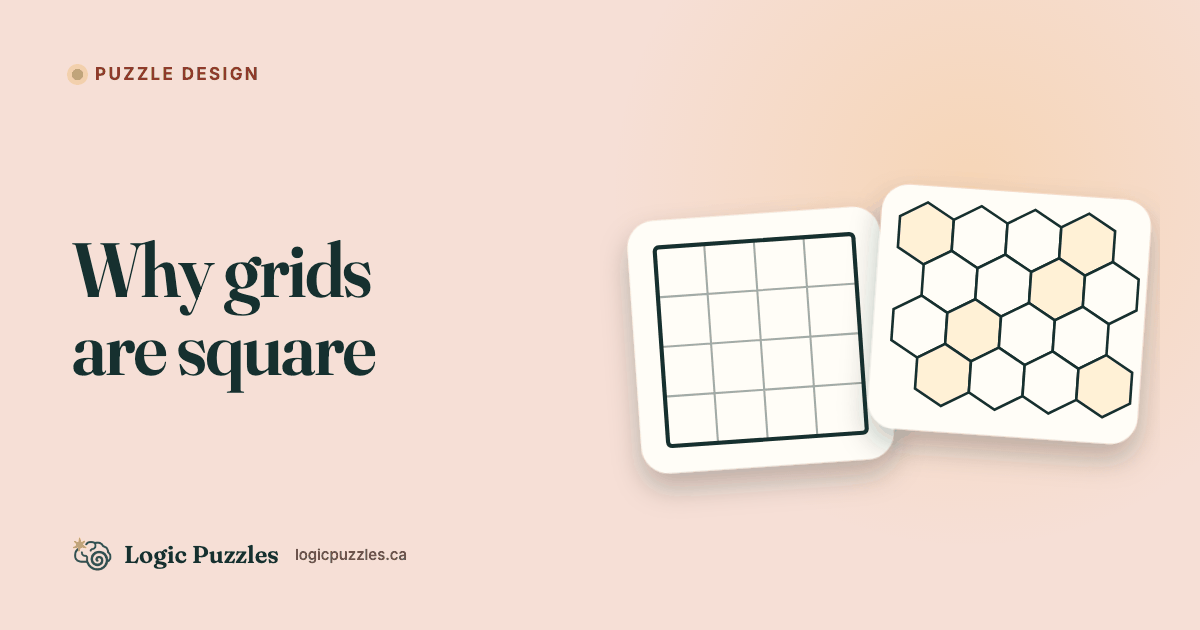
Start with the constraint no designer can negotiate. If you want to tile an infinite flat surface with copies of a single regular polygon, leaving no gaps, geometry gives you exactly three options: equilateral triangles, squares, and regular hexagons. The proof fits in a sentence - around any corner point, the meeting angles must sum to exactly 360 degrees, and among regular polygons only the triangle's 60, the square's 90, and the hexagon's 120 divide 360 evenly. Pentagons jam; heptagons overlap. The Pythagoreans reportedly knew this; Johannes Kepler catalogued it systematically in his Harmonices Mundi in 1619, four centuries before pixel art.
Every grid puzzle in history begins by choosing from this menu of three. So why did one option run the table?
The case for the square
Squares have rows and columns. This is the decisive fact. A square grid supports two perpendicular, independent families of lines, each a natural home for a constraint: one number per row and per column; this row sums to eleven; that column sees three skyscrapers. Nearly every classic puzzle mechanism is built on the crosstalk between horizontal and vertical claims - the entire engine of Nonograms and Fleet is row-versus-column negotiation. Hexagons offer three directions, which sounds richer but overwhelms both clue notation and working memory; triangles alternate orientation cell by cell, so even "adjacent" needs a footnote.
Squares agree with our tools. Paper is rectangular, type is set in lines, screens are literal grids of square-ish pixels, and coordinates - B7, row 3 column 5 - fall out for free. A publisher in 1890 or an app developer in 2026 pays nothing to print a square grid and a real tax for anything else.
Squares are honest about neighbors - mostly. Four orthogonal neighbors, four diagonal, and each puzzle simply declares which count (mine-counting puzzles say all eight; Nurikabe says four; Slant builds its whole identity on the diagonals). The declaration is cheap because the geometry is familiar to every player from childhood graph paper.
The square, in short, is not the most interesting tile. It is the best infrastructure - the shape that gets out of the way.
The hexagon's revenge
The hexagon lost the puzzle wars but won nearly everything else, because it holds two superpowers the square lacks. Every pair of touching hexagons shares a full edge - no ambiguous corner-contact, no diagonal debate - and all six neighbors sit at identical distance, which is why strategy games from Hex to wargames to Catan swear by hex boards: movement and adjacency behave isotropically, with no cheaper diagonal shortcuts.
Nature concurs. In 1999, Thomas Hales proved the Honeycomb Conjecture: of all ways to partition the plane into equal-area cells, the hexagonal grid has the least total boundary. Bees, optimizing wax for two hundred million years... arrived where the theorem did. When you meet a hexagonal puzzle variant - hex mine-counting, hex loops - notice how different it feels: no corners to hide in, information flowing in three grains instead of two. The mechanics are the same; the texture of deduction changes completely. Designers keep returning to hexagons for exactly this reason, and keep retreating because clues, notation, and thumbs still prefer the square.
Off the menu entirely
The three-tile menu assumed one shape, repeating forever, in lockstep periodicity. Drop those assumptions and the plane gets strange and beautiful.
In 1961 the logician Hao Wang studied square tiles with colored edges and conjectured that any set which tiles the plane must be able to do so periodically - in a repeating wallpaper pattern. His student Robert Berger proved him wrong in 1966, exhibiting a set of tiles that tile the plane but only aperiodically, never repeating. (Berger's original set needed 20,426 different tiles; decades of sport whittled the count down.) In 1974 Roger Penrose got it to two - kites and darts, the famous Penrose tiling, which paves forever without ever repeating itself, and now paves floors and physics (quasicrystals, a Nobel Prize in 2011).
One question remained open for fifty years: could a single tile do it? Mathematicians gave the hypothetical shape a German nickname meaning "one stone." In March 2023 it was found, and by the best possible person: David Smith, a retired print technician and shape hobbyist in Yorkshire, playing with cutouts. With Joseph Samuel Myers, Craig Kaplan, and Chaim Goodman-Strauss, he published "the hat," a bland-looking 13-sided shape that tiles the plane and cannot do so periodically - no matter how you lay it, the pattern never repeats. An amateur, pushing shapes around a table, settled a half-century-old open problem. Every recreational solver is entitled to feel personally represented.
What the cell teaches the solver
Why should a puzzle player care about tiling theorems? Because the grid is the first clue you are given, and most solvers never read it.
The square lattice is why "row logic" and "column logic" exist as separate tools; why corners are the most constrained cells on most boards (fewer neighbors, fewer escapes - check corners first); why diagonal adjacency is a choice each puzzle announces, worth re-reading the rules for. Change the tiling and whole techniques evaporate while new ones appear - which proves the techniques were never universal truths, just shadows cast by geometry.
There is a comfortable-sounding lesson there, and a sharper one. Comfortable: constraints breed creativity - three tiles, infinite games. Sharper: the most invisible decision in any system is usually the one made before you arrived. The grid was chosen. The clue directions follow from it. The hobbyist with scissors is a standing reminder that even the floor under the game can still surprise the people willing to look down.