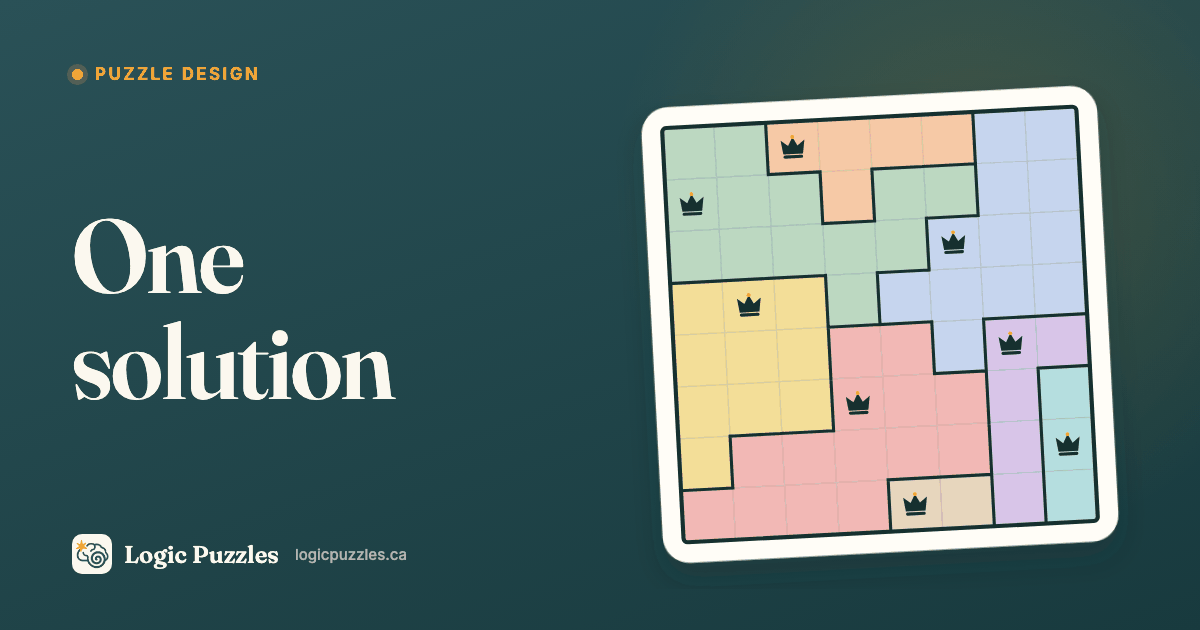
Uniqueness is the quiet contract between a puzzle and a player. It says, "If you think clearly and follow the rules, the answer will be there." That promise matters more than we often admit, and it is why one-solution puzzles tend to feel better designed.
"It is a truth universally acknowledged, that a single man in possession of a good fortune, must be in want of a wife."
- Jane Austen, Pride and Prejudice
That opening line is famous because it lands with certainty. In puzzle design, certainty is earned, not assumed. A unique solution tells the player that the designer took the time to remove ambiguity and replace it with logic.
What "one solution" really means
In most logic puzzles, a unique solution means:
- Every valid move can be justified by logic, not guessing.
- Following the rules leads to exactly one final state.
- The puzzle has been tested for alternate completions and contradictions.
This does not necessarily mean every step is obvious. It means that a logical path exists, and the final answer does not depend on luck.
Why uniqueness makes puzzles feel fair
Players accept difficulty when it is explainable. A unique solution creates that feeling of fairness in several ways:
- No coin flips: If two answers can fit, the player cannot know which one is "right." Uniqueness removes that dead end.
- Clear feedback: Hints, errors, and validations can be precise because there is only one target.
- Trust in the rules: The player learns that the rules are sufficient, which builds confidence over time.
"Call me Ishmael."
- Herman Melville, Moby-Dick
That simple invitation earns trust: you are being told the name, the point of view, the anchor. A single-solution puzzle does the same. It says: start here, reason forward, and you will arrive.
Why uniqueness supports learning
Unique-solution puzzles are better teachers. They allow a designer to:
- Introduce a new mechanic without hidden traps.
- Build a progression where each puzzle focuses on a specific idea.
- Help players form reliable mental models, not habits of guessing.
When a puzzle has multiple answers, it becomes harder to tell which rule the player misunderstood. With one solution, a wrong step is a useful signal.
How designers ensure uniqueness
Uniqueness is not an accident. Designers typically rely on:
- Constraint checking: Automated solvers or SAT checks that verify only one completion exists.
- Minimum clues or givens: Removing hints until the solution is just barely forced.
- Playtesting: Watching real players to catch ambiguity the tools missed.
- Consistency passes: Ensuring that each rule contributes something essential.
These checks protect the player's time and attention, which is the most valuable resource in any game.
"All that glitters is not gold."
- William Shakespeare, The Merchant of Venice
In puzzles, an apparently valid path can be a false shine. A unique solution ensures the shimmer is real, not a trick of the light.
The exceptions (and why they are rare)
Some puzzle genres intentionally allow multiple solutions: creative problems, open-ended riddles, or sandbox-style challenges. Those are great, but they carry a different promise. For logic puzzles that ask for deduction, uniqueness is the standard because it protects clarity.
The takeaway
One solution is not about rigidness. It is about respect. It says the designer cares about the player's reasoning, and the player can trust that reasoning to work. That is great puzzle design.
Experience puzzles built on this principle: