In October 1998, an anonymous bidder at Christie's in New York paid just over two million dollars for a small, scorched, mold-eaten medieval prayer book. As devotional objects go it was in miserable condition. As an auction lot it was arguably the bargain of the century - because faintly visible beneath the prayers, running perpendicular to them, lay the scraped-off handwriting of the greatest mathematician of antiquity.
The book is the Archimedes Palimpsest. Around the tenth century, a Byzantine scribe had copied several treatises of Archimedes onto parchment. Three centuries later, parchment being precious, a monk unbound the mathematics, scrubbed the pages, rotated them, and overwrote a prayer book - a routine act of recycling called palimpsesting that accidentally created a time capsule. The Danish scholar Johan Ludvig Heiberg recognized the undertext in Constantinople in 1906 and transcribed what his magnifying glass could reach; the book then vanished into private hands for most of a century, losing pages and gaining forged illustrations, before resurfacing at that auction.
The buyer did the unexpected thing: deposited it at the Walters Art Museum in Baltimore and funded a decade of open conservation. Multispectral imaging - and, for the worst pages, X-ray fluorescence at a particle accelerator, which made the iron in the ancient ink glow through the paint above it - recovered text Heiberg never saw. Among the treasures: the fullest text of The Method, where Archimedes explains how he actually discovered results before proving them. And several pages about something almost embarrassing to find in such company: a puzzle.
Fourteen pieces of trouble
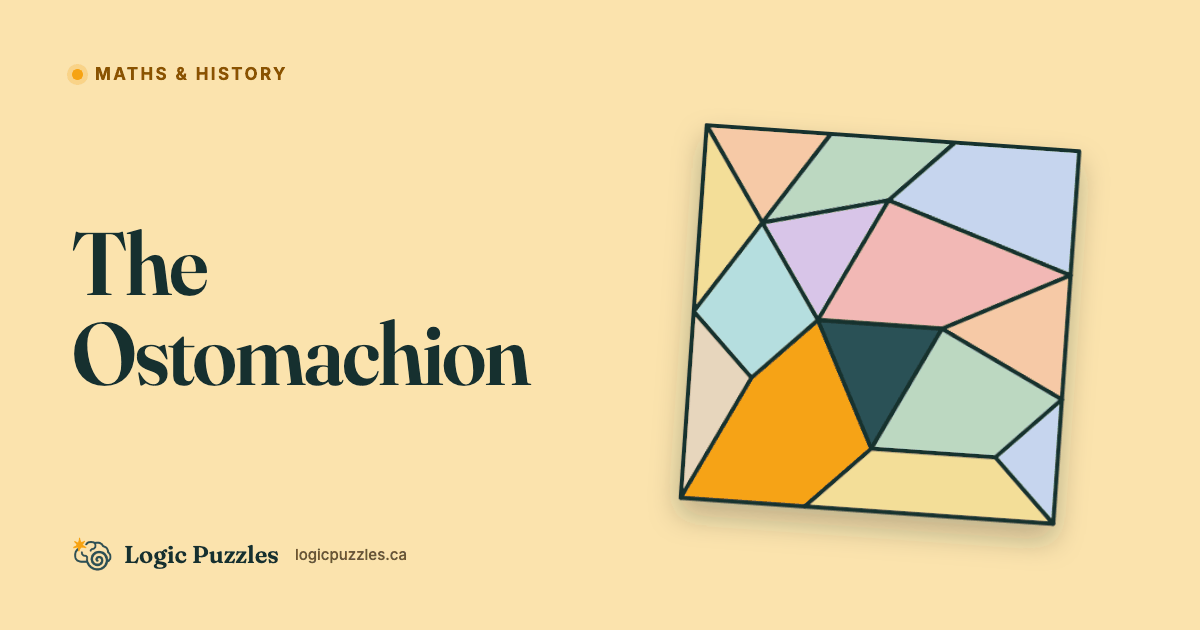
The Ostomachion - also called the Stomachion, roughly "the thing that makes you angry"; Romans knew it as the loculus Archimedius, "Archimedes' little box" - is a dissection of a square into fourteen flat pieces: eleven triangles, two quadrilaterals, a pentagon, all with clean rational proportions. Ancient writers describe it as a game: scramble the pieces, reassemble the square, or arrange them into elephants, ships, warriors. A tangram, seven centuries before the tangram's ancestors, and it is the oldest puzzle for which we possess both the object's design and a mathematical treatise by its (possible) inventor.
The question that electrified scholars was: what did Archimedes want with it? The surviving fragment computes areas of the pieces - fine, but trivial for the man who weighed parabolas. The historian Reviel Netz, who led the palimpsest's decipherment, advanced a bolder reading of the fragment's language: Archimedes was asking how many ways the fourteen pieces assemble into the square. Not whether it can be done. Not which way is best. How many ways - a question with no practical use whatsoever, asked purely because counting possibilities is its own species of truth.
If Netz is right, this scorched page is the earliest serious document of combinatorics - the mathematics of counting arrangements - a field with no other classical footprint, one that would wait nearly two millennia for Pascal and Fermat to take it up while counting gambling outcomes.
17,152
Archimedes' answer, if he found one, is lost to the mold. The modern answer arrived in 2003, when the puzzle-maker and computer scientist Bill Cutler ran an exhaustive search: the fourteen pieces tile the square in 17,152 distinct ways - 536 fundamentally different solutions, multiplied by the square's rotations, reflections, and some interchangeable-piece swaps.
Feel the number for a moment. Seventeen thousand is shockingly many - hand anyone the physical pieces and they'll sweat to find even one assembly. It is also shockingly few - fourteen pieces can be heaped in astronomically many ways, and virtually all of them are garbage. That double surprise is the signature of every good combinatorial object: the constraint (make a perfect square) annihilates almost everything, yet what survives is a rich, countable world. It is the same shape of fact as Sudoku's 6.67 sextillion grids or the 15 Puzzle's exactly-half-reachable positions - and the Ostomachion asked it first, in Syracuse, twenty-three centuries ago.
There is a fine irony in the verification, too: the count required a computer search of exactly the kind we described in our essay on how machines solve grids. Archimedes posed a question that could not be conclusively answered until humanity built the machines his own tradition of mathematics eventually made possible.
Older still
The Ostomachion is the oldest puzzle with a named mathematician attached, but puzzling itself is older than almost everything. Problem 79 of the Rhind papyrus - an Egyptian mathematical scroll from around 1550 BC - is a whimsical inventory: seven houses, each with seven cats, each cat watching seven mice, each mouse with seven ears of grain, each ear yielding seven measures. Sum the estate. It is a geometric-series exercise dressed as a riddle, and its DNA survives in the English nursery rhyme about the man going to St. Ives. The Greeks traded number riddles; the Sphinx guarded Thebes with a lateral-thinking question; riddle contests appear in the oldest literatures we have.
The pattern across all of it: whenever a culture develops mathematics, it immediately develops mathematical play - and the play is never far from the research frontier. Archimedes counting puzzle assemblies between treatises on floating bodies is not a great mind slumming. It is how great minds have always metabolized their subject: by finding the part that feels like a game and pulling the thread.
The little box's long argument
The Palimpsest now sits digitized, free, online - prayers and proofs visible together, each layer legible at last. Of everything recovered, the Ostomachion pages make the humblest and maybe the deepest claim on us. The eternal treatises argue that Archimedes was a genius. The puzzle argues that he was one of us: a person who took fourteen scraps of bone or bronze, asked a question with no purpose except the pleasure of certainty, and found the question worth writing down.
Twenty-three centuries later, a person opens an app at a kitchen table and asks how many ways a fleet can fit an ocean. The technology is unrecognizable. The species hasn't changed at all.