There is a moment, early in learning a new puzzle type, when the rules stop being instructions and start being obvious. You no longer think "no repeats in a row." You just see it. The grid speaks, and you understand.
That moment is worth paying attention to, because something interesting is happening underneath it. You are not just learning a game. You are learning a language.
A language without words
Most languages require words. They require shared vocabulary, agreed-upon grammar, years of study before you can think in them fluently. They are powerful and beautiful, but they are also barriers. If you do not speak the language, you are locked out.
Puzzle grids work differently. A Sudoku printed in Tokyo is identical to one printed in Toronto. The rules are not expressed in Japanese or English — they are expressed in structure. Rows, columns, boxes. The constraint is the grammar, and the grid is the sentence.
This is not a small thing. There are very few human activities where a person in one country can sit down with something created in another country and understand it completely, without translation, without context, without any shared spoken language at all. Music comes close. Mathematics comes closer. Puzzles might be the most accessible example of all.
The syntax of constraint
Every language has syntax — rules about how pieces fit together to create meaning. In English, word order determines who did what to whom. In puzzle grids, the syntax is spatial.
A row means something. It means that whatever rule governs the puzzle applies horizontally across those cells. A column means the same rule applies vertically. A region — a box in Sudoku, a color group in Crowns, a water zone in Aquarium — adds another dimension of meaning.
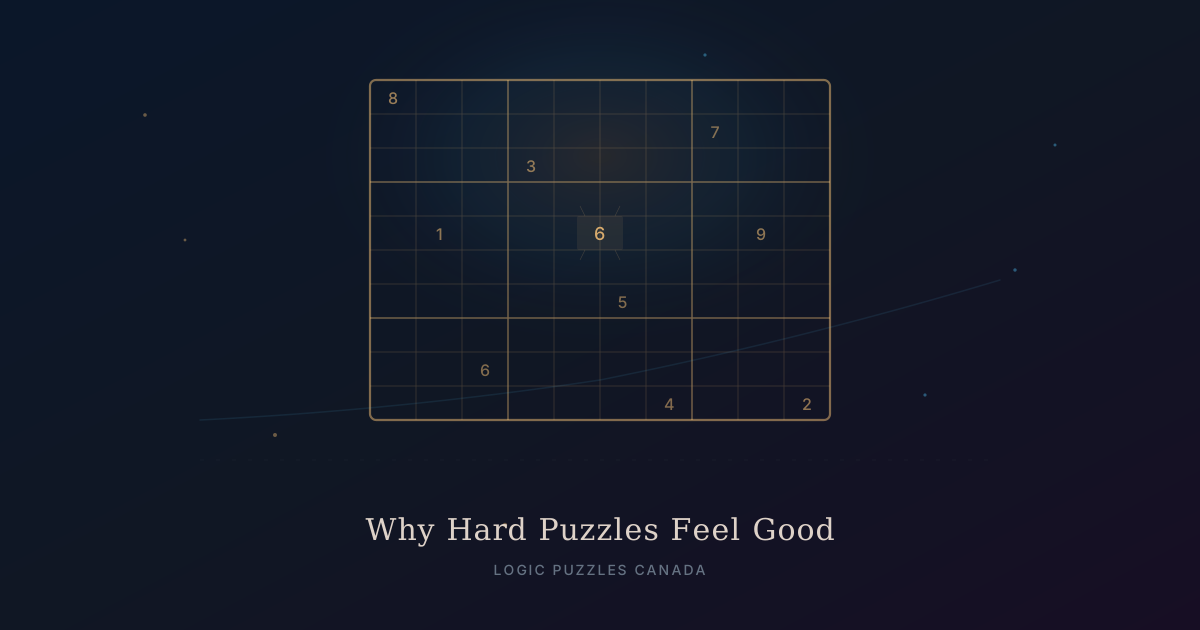
These structural elements are the grammar of the grid. They tell you how to read the puzzle before you know a single value. When you look at a 9x9 grid divided into 3x3 boxes, you already understand the relationships between cells, even if every cell is empty. The structure itself communicates.
This is why experienced solvers can glance at a puzzle type they have never seen before and immediately grasp most of what is happening. The specific rules might be new, but the grammar is familiar. Rows constrain. Columns constrain. Regions constrain. The details vary, but the underlying syntax is universal.
Reading before solving
Good readers do not decode words one at a time. They see phrases, sentences, whole paragraphs in chunks. Their brains have internalized the patterns of the language so deeply that comprehension feels automatic.
Good puzzle solvers do the same thing. They do not check each constraint individually. They read the grid. They see patterns — a nearly complete row, a region with only two possibilities, a column that forces a chain of deductions. The grid communicates these patterns visually, and fluent solvers receive them instantly.
This is what makes watching an experienced solver so fascinating. They seem to skip steps. But they are not skipping anything — they are reading at a higher level. Where a beginner sees individual cells, the expert sees sentences. Where the beginner checks rules one by one, the expert comprehends the grid as a whole.
The progression from beginner to expert in puzzles mirrors the progression from sounding out letters to reading fluently. It is the same cognitive journey, expressed in a different medium.
Why grids transcend culture
Language is culture. The words we have shape the thoughts we can easily express. Different languages carve up reality differently — some have dozens of words for snow, others have none. This richness is beautiful, but it also means that translation is always imperfect. Something is always lost.
Grids lose nothing in translation because there is nothing to translate. A constraint is a constraint. A row is a row. The logic that solves a Nonogram is the same logic everywhere on Earth, because it depends on structure rather than meaning.
This universality explains something I have noticed over the years: puzzle communities are among the most naturally international communities online. When the shared activity does not require a common language, barriers dissolve. A solving technique discovered by someone in India works identically for someone in Iceland. The grid is the common ground.
The vocabulary of solving
Every puzzle type introduces its own vocabulary — not in words, but in patterns.
Sudoku solvers learn to see naked pairs, hidden singles, X-wings. These are not arbitrary names for arbitrary tricks. They are named patterns in the visual language of the grid. Once you can see a naked pair, you can never unsee it. It becomes part of your vocabulary, a concept that your brain recognizes automatically.
Nonogram solvers develop a different vocabulary. They learn to see overlaps — the cells that must be filled regardless of where a run is placed. They learn edge logic and gap analysis. Each of these is a visual word, a unit of meaning in the language of that particular grid.
KenKen, Futoshiki, Aquarium, Crowns — each has its own dialect. The grammar is shared (rows, columns, regions), but the vocabulary is distinct. And like learning a new dialect of a familiar language, picking up a new puzzle type is easier than learning your first one. The structural intuitions transfer.
What grids teach about communication
There is a broader lesson here about how we communicate and what makes communication successful.
The most effective communication is often the most constrained. Legal contracts work because they use rigid structure. Mathematical proofs work because they follow strict rules of inference. Code works because compilers enforce an unambiguous syntax.
In each case, the constraints are not enemies of expression — they are what make expression precise. When the grammar is rigid, the meaning is clear. When the grammar is loose, ambiguity creeps in.
Puzzles embody this principle in its purest form. A well-designed puzzle communicates a single, unambiguous logical path through a visual language that requires no explanation beyond the rules themselves. There is no room for misinterpretation. The grid says exactly what it means.
Learning to see
The most valuable thing about becoming fluent in the grammar of grids is not the puzzles it lets you solve. It is the way it trains you to see structure.
Once you spend enough time reading grids, you start noticing structural patterns everywhere. The way a spreadsheet organizes information into rows and columns. The way a calendar constrains events into time slots. The way a well-designed form guides you through a process by limiting your choices at each step.
These are all grids, in their way. They all use the same grammar — spatial relationships that encode constraints and create meaning. The person who is fluent in reading puzzle grids has practiced, thousands of times, the skill of looking at a structured space and understanding what it is trying to say.
A universal conversation
Every evening, millions of people around the world open a puzzle. They do not share a language. They do not share a culture. They may not share a single belief or experience. But they share a grid.
And in that grid, they have a conversation — not with each other, but with the same underlying logic. They encounter the same constraints, follow the same deductions, arrive at the same inevitable solution. They are all reading the same sentence, written in a language that belongs to no one and is understood by everyone.
There is something quietly beautiful about that. In a world that often struggles to communicate across differences, the grammar of grids offers a reminder: some languages need no translation. Some conversations happen in structure, not in words. And some of the deepest understanding requires nothing more than a row, a column, and a rule.