In the winter of 1880, a small wooden box conquered the world. Inside were fifteen numbered tiles in a four-by-four frame, one space left empty, and a single instruction: slide the tiles until the numbers run in order. No batteries, no opponent, no clock. Within months it was everywhere - offices, parlors, streetcars, the floor of the German Reichstag. Newspapers reported employers banning it during working hours and ran editorials about a nation losing its mind to a toy.
The Fifteen Puzzle was the first true puzzle craze of the modern age, the Magic Cube of the horse-and-buggy era. And nearly everything the public came to believe about it - who invented it, and whether its most famous challenge could be won - was wrong.
A prize with a secret
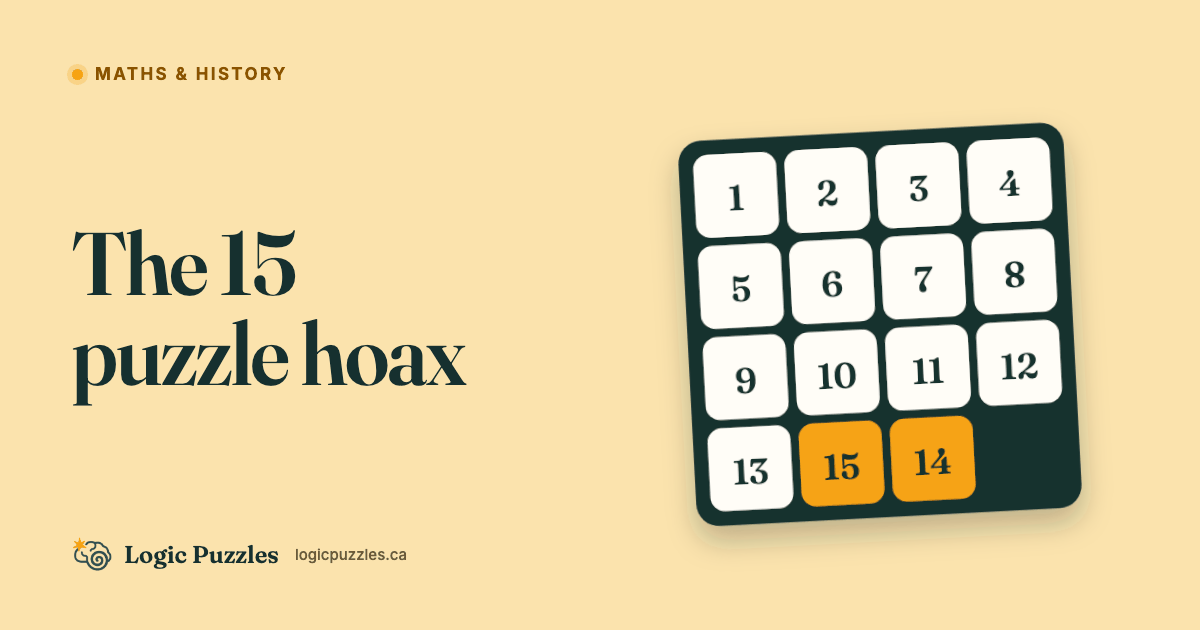
The fever had a specific source: a version of the puzzle that arrived scrambled in a particular way. Every tile sat in its correct place except the last two - the 14 and the 15 were swapped. Restore perfect order, the challenge went, and glory was yours. A Worcester dentist named Charles Pevey made it concrete, publicly offering cash and a set of teeth to anyone who could show him the winning sequence of moves.
People tried for hours, then days. Some swore they had done it once but could not reproduce the feat. Here is the delicious part: they never would. The 14-15 swap is mathematically impossible to fix. Not extremely hard - impossible, in the way that no amount of cleverness makes seven an even number.
The proof at the height of the fever
What makes the Fifteen Puzzle a landmark in the history of logic is how quickly this was proved. Right at the peak of the craze, in an 1879 volume of the American Journal of Mathematics, two mathematicians - Wm. Woolsey Johnson and William E. Story - published a short paper showing exactly which scrambles can be solved and which cannot.
The argument is one of the loveliest ideas in mathematics: the invariant. Every arrangement of tiles is either an "even" or an "odd" rearrangement of the solved position - a property computed by counting how many pairs of tiles are out of order. Johnson and Story showed that every legal slide preserves a certain combination of this parity and the position of the blank. Sliding tiles all afternoon changes the arrangement, but it can never change the arrangement's parity class, any more than shuffling a deck can change the number of cards in it.
The solved position is even. The 14-15 swap is odd. No path of legal moves connects them - so exactly half of all 20-plus trillion arrangements of the tiles can ever be solved. The dentist's teeth were perfectly safe.
There is something wonderful in the timing. While crowds pushed tiles in taverns, the answer was already sitting in a mathematics journal: you are not failing; the task is a fiction. It may be the first time in history that a mass entertainment was debunked by a parity argument.
Enter Sam Loyd, retroactively
Now the hoax on top of the hoax. If you have read anything about the Fifteen Puzzle, you have probably read that it was invented by Sam Loyd, America's great puzzle showman - author of thousands of chess problems and brainteasers, a man with a genuine claim to being the best puzzle composer who ever lived.
He did not invent it. Loyd had nothing to do with the puzzle until years after the craze, when he began claiming it as his own - asserting he had "driven the entire world crazy" with fourteen and fifteen, and offering a $1,000 prize for a solution to the swap. It was a magnificent piece of theater: the prize generated publicity, the publicity cemented the origin story, and the money was never at risk, because Loyd understood the parity argument perfectly well. He was selling an impossible challenge as an advertisement for himself.
The claim went essentially unchallenged for a century. Only in 2006, when puzzle historians Jerry Slocum and Dic Sonneveld published an exhaustive investigation, was the record fully corrected. The trail they reconstructed leads instead to Noyes Palmer Chapman, a postmaster in upstate New York who had devised a precursor puzzle in the 1870s, and to a Boston craftsman who began selling the "Gem Puzzle" in late 1879. The craze grew out of their work. Loyd simply annexed it - and history, preferring a good story to a true one, let him.
What the fraud teaches solvers
Strip away the carnival and the Fifteen Puzzle leaves behind three lessons that apply to every grid you will ever touch.
Some positions cannot be reached, and effort will not change that. The solvers of 1880 interpreted failure as a personal shortfall - try harder, try longer. The real explanation lived a level deeper, in the structure of the puzzle itself. Modern solvers meet the same moment whenever a line of attack keeps failing: sometimes the answer is not "push harder" but "prove to yourself this road goes nowhere, and stop walking down it."
Invariants are the solver's X-ray. The question that cracked the puzzle - what stays the same no matter what move I make? - is among the most powerful in all of problem-solving. When you notice that a region must always contain an even count of something, or that a color must alternate along any path, you are wielding exactly the tool Johnson and Story used. One good invariant can replace ten thousand attempts.
Provenance deserves skepticism. The best-known "fact" about the puzzle was marketing. A century of encyclopedias repeated it because it was repeated, not because it was checked. Puzzle people, of all people, should appreciate the difference between a claim that is widely believed and one that has been verified.
The tiles today
The Fifteen Puzzle never really left. It lives on phones and in schoolyards, and in computer science it became a standard laboratory animal - the classic benchmark for search algorithms, the puzzle on which generations of students first meet the A* algorithm. Finding the shortest solution to a scrambled position turns out to be genuinely hard even for machines, which is a fine irony: the toy that fooled the public with an impossible challenge now humbles computers with a legitimate one.
A century and a half later, the box still teaches the same quiet lesson it taught in 1880, to anyone willing to hear it: before you spend an evening trying, spend a minute asking whether the thing can be done at all.