How many people must be in a room before it becomes more likely than not that two of them share a birthday?
There are 365 days in a year, so intuition reaches for something like half of that - 180 people, give or take. Even cautious guessers say 60 or 70.
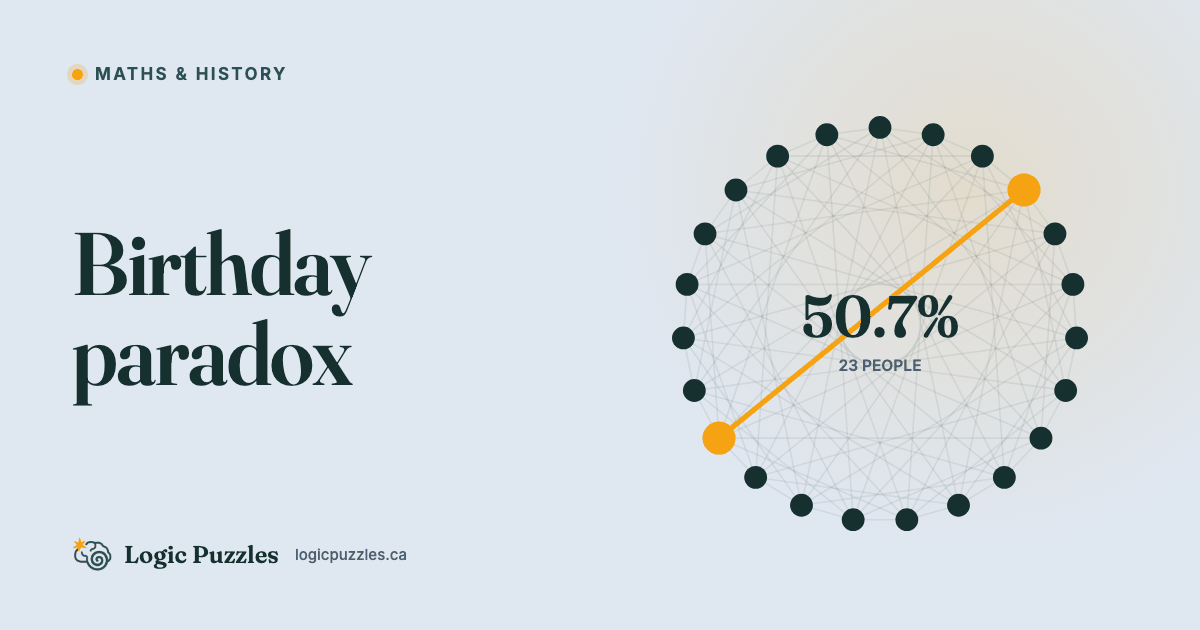
The answer is twenty-three. A classroom. Two soccer teams and a referee. At 23 people, the odds of a shared birthday cross fifty percent; at 50 people they reach 97 percent; at 70, better than 99.9. Nothing is wrong with the arithmetic of the universe - something is wrong with the machine we consult before doing arithmetic. Puzzle people should study these failures the way pilots study stalls, so this essay tours the two most famous, and what they reveal.
The birthday paradox: you forgot you're not the center
The birthday problem fools us because we silently compute the wrong question. Hearing it, you imagine yourself walking into the room: what are the chances someone shares my birthday? That is indeed unlikely - with 23 people it sits around six percent.
But the question asked about any pair, and pairs are what intuition fails to count. Twenty-three people form 23 × 22 ÷ 2 = 253 pairs - 253 lottery tickets in a lottery where each ticket wins about one time in 365. Suddenly a coin flip's worth of probability looks reasonable, even inevitable. The paradox dissolves the moment you count the comparisons instead of the people; the difficulty was never the math but noticing that the math was pairwise. Combinatorial growth is invisible to the gut: double the room and you quadruple the pairs.
This one failure pattern - linear intuition applied to quadratic (or exponential) reality - may be the most economically important bug in human cognition. It is why the collision that "couldn't happen" happens (cryptographers literally call these birthday attacks), why coincidences astonish us daily ("what are the odds?" - with enough pairs of events, excellent), and why every viral process, from gossip to pathogens, outruns the forecast in our heads.
Monty Hall: the door that learned something
In September 1990, a Parade magazine reader asked the columnist Marilyn vos Savant about a game show scenario. Three doors: one hides a car, two hide goats. You pick a door. The host - who knows where the car is - opens one of the other doors, always revealing a goat, and offers you a switch to the remaining closed door. Should you take it?
Vos Savant answered correctly: switch. Sticking wins one time in three; switching wins two times in three.
What followed is legend. Roughly ten thousand letters arrived, around a thousand bearing PhDs, many dripping with condescension, informing her the odds were obviously fifty-fifty. Mathematicians scolded her in print. The great Paul Erdős - one of the most prolific mathematicians in history - reportedly refused to accept the answer until shown a computer simulation.
The correct reasoning is short. Your first pick captures the car one time in three; nothing the host does changes that. The remaining two-thirds of the probability lived behind the other two doors - and the host, by knowingly opening a goat door, sweeps all of it onto the single door he leaves shut. His move is not noise; it is information, because his hand was forced by knowledge.
Still itchy? Stretch the problem, a move every solver should own. A hundred doors; you pick one; the host, knowing all, opens ninety-eight goats, leaving yours and one other. Sticking now means betting you nailed a 1-in-100 pick. The 3-door version is the same logic at a scale small enough to fool you.
The deep lesson isn't about game shows. It is that probabilities are attached to what is known, not to objects, and they move when knowledge moves. Two closed doors are "fifty-fifty" only when nothing distinguishes them; here, one door was chosen blind and the other was curated by an informed adversary. Distinguishing those took the world's smartest readers embarrassingly long - vos Savant had the last word when schoolteachers ran the experiment with paper cups and wrote back converted.
Why grids don't lie to you (and dice do)
Notice where these failures live: probability and combinatorics, the mathematics of aggregates. Logic puzzles occupy the neighboring country - deduction, where conclusions are certain - and the border crossing is instructive.
A Sudoku never gaslights you. Every inference is checkable; wrongness announces itself as contradiction. That is what makes grids such honest training: the feedback is immediate and incorruptible. But step into the endgame of a randomly mined board, or any decision under uncertainty, and the currency changes from proof to probability - and the birthday-paradox machinery in your head starts quietly misquoting exchange rates. The solvers who handle those moments best borrow deduction's habits and apply them to chance: enumerate, don't vibe. Count the pairs. List the equally likely worlds and see in how many of them each choice wins - the Monty Hall answer falls out in three lines of honest bookkeeping. When enumeration is beyond you, simulate, as Erdős finally did; running the experiment a thousand times is the modern solver's abacus.
And when a probability claim offends your common sense, treat that feeling as data about your intuition, not about the claim. The feeling of obviousness is generated by the same organ that says 180 people and fifty-fifty.
A short field guide to self-distrust
Three habits, cheap to carry:
Ask "compared to how many chances?" before marveling at any coincidence or trusting any "unlikely." Most miracles are large numbers of pairs, quietly.
Ask "who knew what when?" before calling alternatives equally likely. Curated options are never symmetric with blind ones - in game shows, in grids ("this cell was constrained by three clues, that one by none"), in life.
Scale the problem up or down until your intuition works again, then carry the verdict back. A hundred doors, two people, a million trials - the truth survives rescaling; illusions usually don't.
None of this makes intuition the enemy. It is a magnificent instrument, trained on faces, physics, and yesterday. It was simply never issued the firmware for 253 pairs - and wisdom, for a solver, is mostly knowing which tool is currently guessing.